Artificial Intelligence in Mobile Apps: Use Cases, Benefits & Trends
AI-powered mobile applications are driving business outcomes across industries. As mobile becomes the dominant digital touchpoint, AI integration now differentiates market leaders from the competition. Companies implementing AI capabilities in their mobile applications are seeing improvements in user retention, engagement, and conversion rates.
Introduction: Why AI in Mobile Apps Matters for Businesses
AI implementation in mobile applications has evolved from experimental novelty to strategic consideration. According to Deloitte's Tech Trends report, many businesses are still in planning phases, while market leaders are deploying AI to solve three core business challenges:
- Customer acquisition optimization
- Support automation
- Defensible user experiences
The advantage comes from targeting specific friction points within existing business models. Analysis shows that companies achieving the best results identified quantifiable pain points before implementation, rather than applying AI indiscriminately.
For founders and product leaders, this suggests AI capabilities should be mapped to legitimate business constraints rather than deployed solely as technology showcases.
What is AI in Mobile App Development?
Definition and Business Relevance
AI in mobile development refers to embedding intelligent systems that can learn from user interactions, adapt to behavioral patterns, and make decisions with minimal human intervention. Unlike static applications with predetermined response paths, AI-powered mobile solutions evolve through usage, creating value as they accumulate data.
The business relevance operates on three levels:
- Operational efficiency – Automating routine processes and reducing manual intervention
- Customer experience enhancement – Delivering contextually relevant, adaptive interactions
- Business intelligence acceleration – Transforming interaction data into actionable market insights
For product leaders, AI represents a shift from one-size-fits-all tools to systems that adapt to individual users, creating personalized experiences at scale.
Core AI Technologies Powering Mobile Apps
The technologies underpinning mobile AI implementations include:
- Natural Language Processing (NLP) – Powers conversational interfaces, semantic search, and content analysis
- Computer Vision – Enables visual recognition, AR feature overlays, and physical-world data processing
- Machine Learning – Drives predictive analytics, segmentation engines, and behavior modeling
- Deep Learning – Handles pattern recognition for personalization and analysis of unstructured data
- Reinforcement Learning – Creates systems that improve through user interaction patterns
- Federated Learning – Enables on-device model improvement while preserving privacy
Note: Implementation maturity varies significantly across these technologies. NLP and recommendation systems are more accessible through APIs, while reinforcement learning typically requires specialized expertise.
Why AI is Transforming Mobile Experiences
The contrast between traditional and AI-enhanced mobile experiences:
Traditional App Experience:
- Static navigation requiring manual content discovery
- Generic interfaces, regardless of user history
- Fixed recommendation systems based on broad categories
- Reactive support requiring human intervention
- Consistent feature exposure regardless of usage patterns
AI-Enhanced Experience:
- Predictive navigation showing likely destination points
- Interface elements that adapt to usage patterns and preferences
- Dynamic recommendations incorporating contextual factors
- Proactive support that anticipates potential issues
- Feature exposure optimized for individual usage patterns
This evolution can positively impact engagement metrics when properly implemented and optimized over time. Users experiencing well-designed AI-enhanced interactions may develop improved feature utilization and retention patterns.

Top Use Cases of Artificial Intelligence in Mobile Apps
Each implementation area represents potential ROI opportunities with varying implementation complexity and timeframes.
Chat Automation & Conversational Interfaces
Modern NLP-powered conversational systems can resolve customer inquiries without human intervention. When properly implemented and trained over time, this can reduce support costs and increase capacity.
Implementation barriers have decreased with APIs from OpenAI, Google, Anthropic, and domain-specialized providers managing the NLP infrastructure while development teams focus on integration. Time-to-implementation varies significantly based on complexity and integration requirements.
Implementation considerations: Effective conversational systems require careful design, training data, ongoing optimization, and human fallback options.
Digital Assistants & Voice Recognition
Voice interfaces have evolved beyond basic functionality into more sophisticated tools. Potential implementation areas include:
- Operational workflows: Factory floor applications with hands-free process guidance
- Data analysis interfaces: Executive dashboard voice interaction
- Clinical documentation: Healthcare applications for documentation
- Field service support: Maintenance applications with voice-guided protocols
- Logistics optimization: Warehouse management systems with voice direction
The technical maturity of voice recognition continues to improve, though performance varies significantly by environment, accent, and application. Accessibility benefits can be substantial, with voice interfaces potentially offering advantages for users with mobility limitations.
Predictive Analytics & Recommendations
Recommendation engines drive significant revenue across digital platforms like Amazon, Netflix, and Spotify. Mobile applications can benefit from similar approaches to increase session duration, purchase likelihood, cart value, and content consumption.
The barriers to implementation have decreased with:
- Pre-trained recommendation models available through cloud APIs
- Collaborative filtering algorithms accessible as services
- Transfer learning techniques that can work with less proprietary data
Implementation timeframes vary based on complexity, data availability, and integration requirements. Basic systems can be implemented more quickly than complex custom solutions.
Note: Effective recommendation systems require ongoing maintenance, monitoring for bias, and regular updates to remain relevant.
Object Detection & Real-Time Processing
Mobile devices can now process visual data in real-time, creating applications that bridge digital and physical worlds. Potential applications include retail (virtual try-on), banking (document scanning), insurance (visual assessment), industrial (component identification), and real estate (measurement).
Implementation has been facilitated through specialized SDKs from Apple (Vision framework), Google (ML Kit), and third-party providers offering pre-trained models for common detection scenarios.
Technical considerations: Performance varies significantly by device capability, lighting conditions, and subject complexity. Implementations should include graceful degradation for older devices.
Enhanced App Security with AI
AI security systems can offer advantages over traditional rule-based approaches by creating more adaptive defense mechanisms:
- Anomaly detection to identify potentially fraudulent activities
- Behavioral biometrics for passive authentication
- Continuous authentication monitoring for unusual patterns
- Network traffic analysis to identify potential security issues
Financial applications implementing AI security can potentially reduce fraud while reducing friction for legitimate users. The security enhancement can extend to malware detection, phishing identification, credential management, and data loss prevention.
Implementation note: Security systems require extensive testing, monitoring for false positives, and regular updates to maintain effectiveness.
User Behavior Personalization
Behavioral adaptation represents a strategically significant AI implementation area. Applications that adapt to user behavior patterns may show improvements in retention, task completion time, feature discovery, cross-feature utilization, and revenue per user when properly implemented and optimized.
Advanced personalization systems incorporate multiple contextual dimensions including:
- Temporal patterns: Time-of-day adaptations
- Location context: Geospatial-aware interfaces
- Behavioral cohorts: Dynamically grouped users
- Usage intensity: Interface density optimization
- Completion patterns: Adaptive funnels
The strategic value lies in creating digital experiences that become increasingly personalized with continued usage. This addresses the challenge of extending user lifespan to amortize acquisition costs and maximize lifetime value.
Implementation reality: Effective personalization requires significant data, ongoing testing, and careful balancing of adaptation with predictability.
Other Emerging AI Use Cases
Several innovative application areas showing potential:
- Gesture control interfaces for touch-free interaction
- Emotion analysis systems to detect user satisfaction
- Edge AI implementations for low-connectivity environments
- Ambient computing integration for environmental control
- Sound recognition for contextual awareness
- Augmented cognition features for information synthesis
Enterprise adoption is growing in industrial applications where mobile devices with AI can create tools for non-specialist workers, potentially reducing dependency on scarce technical resources.
How to Integrate AI into Mobile Apps
Step 1: Identify Problems AI Can Solve
Begin with friction points in your current user experience rather than technology-first implementations:
- Conversion bottlenecks: Map your funnel to identify abandonment points
- Support volume drivers: Analyze your top support tickets
- Engagement plateaus: Identify features with high abandonment
- Resource-intensive operations: Identify manual processes consuming team resources
- Personalization opportunities: Measure variance in user needs
Effective implementations begin with measurable business constraints rather than technology experimentation. Establish baseline metrics before implementation and define explicit success criteria tied to business outcomes.
Timeline reality: Properly measuring baselines and defining success criteria typically requires 4-8 weeks before implementation begins.
Step 2: Leverage the Right Datasets
AI performance depends on data quality and quantity. Successful implementations begin with systematic data evaluation:
Internal data sources to prioritize:
- User behavioral logs (event tracking, session recordings)
- Transaction and engagement history (including seasonal patterns)
- Content and product metadata (with attribute tagging)
- Customer support interactions (ticket content, resolution paths)
- Explicit user preferences and settings
Data quality prerequisites:
- Comprehensive event instrumentation
- Consistent user identification across touchpoints
- Standardized taxonomies for content/product classification
- Sufficient volume for statistical significance
For early-stage companies with limited data:
- Synthetic data generation – Creating simulated datasets
- Transfer learning – Leveraging pre-trained models
- Partnership strategies – Data-sharing arrangements
Implementation reality: Data preparation typically takes 6-12 weeks and may uncover gaps requiring additional data collection before proceeding.
Step 3: Choose Suitable AI Frameworks
Framework selection should align with organization's size, technical capabilities, and objectives:
For startups and SMBs:
- Firebase ML Kit: Cross-platform implementation for common use cases
- Ready-made APIs: Google Vision, OpenAI, Amazon Rekognition
- SaaS AI platforms: Solutions with mobile SDKs requiring minimal ML expertise
For mid-market companies:
- Hybrid approaches: Custom front-end with API-based intelligence
- Specialized vertical solutions: Domain-specific AI services
For enterprises:
- TensorFlow Lite: Android-optimized with extensive model support
- Core ML: iOS-native performance with optimized on-device execution
- PyTorch Mobile: Research-friendly with production optimization
- Custom model development: In-house data science teams
Framework selection considerations:
- Flexibility vs. simplicity tradeoff
- On-device vs. cloud processing
- Available talent and expertise
Implementation note: Framework selection should include evaluation periods (2-4 weeks) and potential for hybrid approaches as needs evolve.
Step 4: Train and Optimize the Models
The build vs. buy decision depends on your competitive advantage:
Build in-house when:
- AI functionality creates core differentiation
- You have unique proprietary data
- Long-term AI ownership aligns with business strategy
Use pre-trained/third-party models when:
- You need faster market entry
- The AI feature is supportive rather than central
- In-house AI talent is limited
Reality check: Custom model development typically takes 3-6 months for initial deployment, followed by ongoing optimization cycles. Third-party solutions require 1-3 months for integration and customization.
Step 5: Test, Integrate & Deploy AI Features
AI features require nuanced testing approaches:
- A/B test against non-AI alternatives
- Monitor for bias in recommendations or decisions
- Establish performance baselines for improvement
- Consider phased rollouts to gather real-world data
Implementation timeline: Testing typically requires 4-8 weeks before full deployment, with ongoing monitoring and optimization afterward.
Build vs. Buy: Choosing the Right Path
Factor | Build In-House | Use Third-Party AI |
Time to market | 3-9+ months for development, plus integration time | 2-6 weeks for initial setup, plus 4-8 weeks for integration and customization |
Development cost | Higher upfront investment | Lower upfront cost with ongoing subscription fees |
Customization | Highly customizable | Limited to API capabilities and configuration options |
Data ownership | Complete control | Potential data sharing with providers |
Ongoing maintenance | Required team resources | Included in service but less control |
Integration complexity | Higher control but more development effort | Simpler initial implementation but may require adaptations |
Reality check: The actual timeline for third-party solutions often extends beyond initial estimates due to integration challenges, customization requirements, and testing needs.
Technical Foundations of AI in Mobile Development
Machine Learning Frameworks
Framework selection impacts development velocity, performance, and hiring:
- TensorFlow Lite: Popular for Android, extensive documentation
- Core ML: Native iOS performance, streamlined implementation
- PyTorch Mobile: Research-friendly, growing adoption
- ML Kit: Cross-platform, Firebase integration
Data Management & Model Training
Data governance becomes critical with AI implementation:
- GDPR and CCPA compliance require transparent data usage policies
- Model training requires labeled examples for supervised learning
- Privacy-preserving techniques like federated learning keep sensitive data on-device
Implementation note: Data governance and compliance structures typically require 1-3 months to establish properly.
Optimizing AI for Mobile Devices
Mobile-specific constraints require optimization strategies:
- Model quantization reduces size with some accuracy trade-offs
- Hardware acceleration improves performance on capable devices
- Offline functionality preserves experience in limited connectivity
- Battery impact varies significantly by implementation
On-Device AI vs. Cloud-Based AI
Factor | On-Device | Cloud-Based |
Latency | Lower (milliseconds to seconds) | Higher (hundreds of milliseconds to seconds) |
Privacy | Data stays on the device | Requires data transmission |
Costs | Higher upfront development | Ongoing API/compute costs |
Complexity | Higher integration difficulty | Simpler API implementation |
Offline functionality | Available | Limited or unavailable |
Scalability | Limited by device capability | More easily scaled |
Implementation reality: Many mature implementations use hybrid approaches, with some processing on-device and more complex operations in the cloud.
Real-World Examples of AI in Mobile Apps
AI in E-Commerce Apps (e.g., Amazon)
Amazon's mobile app uses multiple AI models for the shopping experience, including visual search and dynamic pricing optimization.
AI in Health & Fitness Apps (e.g., Fitbit)
Fitbit combines sensor data with machine learning for sleep analysis. AI-generated insights contribute to user engagement and retention.
AI in Entertainment Apps (e.g., Netflix, Spotify)
Netflix's recommendation engine contributes to reducing churn and optimizing content investment. Spotify's Discover Weekly helps increase streaming time and artist discovery.
AI in Marketing Tools (e.g., Semrush)
Semrush uses AI for SEO performance prediction. Users leveraging AI recommendations may see improved content performance compared to manual strategies.
Implementation timeline: These examples represent years of development, testing, and optimization—not overnight implementations.
Benefits of AI in Mobile Applications
Smarter User Experience
AI can transform interfaces from static to responsive, potentially adapting to:
- Historical user behavior patterns
- Contextual cues (time, location, activity)
- Emotional states and engagement levels
- Task completion patterns
Operational Efficiency
Back-end operations may see efficiency improvements through:
- Automated content tagging and categorization
- Support ticket routing and resolution
- Fraud detection mechanisms
- Quality assurance automation
Stronger Data Security
AI security systems may offer advantages over rule-based approaches:
- Anomaly detection for unusual patterns
- Behavioral biometrics for authentication
- Continuous monitoring for suspicious activity
- Adaptive security responses
Higher Retention and Revenue Potential
Well-implemented AI may positively impact business metrics like retention, revenue per user, and lifetime value when properly executed and maintained.
Reality check: These benefits typically materialize over 6-18 months of implementation, optimization, and learning—not immediately after deployment.
Challenges in AI Integration
Data Privacy & Compliance
Regulatory frameworks like GDPR, CCPA, and HIPAA create implementation considerations:
- Privacy-by-design development approaches
- Clear user consent frameworks for data usage
- On-device processing for sensitive information
- Regular compliance audits and documentation
Device Compatibility & Performance
Fragmentation across device capabilities requires strategies:
- Implement graceful degradation for lower-end devices
- Create tiered experiences based on device capabilities
- Use cloud fallback options for complex processing
- Establish minimum viable device specifications
Ongoing Model Updates & Maintenance
AI models require ongoing maintenance:
- Regular model retraining cycles (typically quarterly)
- Performance monitoring dashboards
- Resources for data pipeline maintenance
- MLOps platforms for operational efficiency
Talent, Time & Cost Considerations
AI expertise requires specialized skills:
- ML engineers command premium salaries
- Development timelines typically exceed traditional features
- Consider specialized development partners for implementation
- Evaluate AI-as-a-service options for non-core functionality
Implementation reality: Many organizations underestimate the ongoing maintenance and optimization requirements, which typically require 15-25% of initial development resources annually.
Common Implementation Pitfalls
Overestimating Initial Performance
AI systems typically require time to reach optimal performance:
- Plan for gradual improvement rather than immediate perfection
- Set realistic expectations with stakeholders
- Implement with human oversight during initial deployment
- Establish clear KPIs for ongoing evaluation
Underestimating Data Requirements
Data limitations often constrain early performance:
- Begin data collection early, even before implementation
- Consider synthetic data for training augmentation
- Implement progressive enhancement as data accumulates
- Prioritize high-quality labeled data over quantity alone
Neglecting Feedback Loops
Continuous improvement requires structured feedback:
- Implement user feedback mechanisms within the application
- Create processes for regular performance review
- Establish monitoring for model drift and degradation
- Schedule regular retraining based on performance metrics
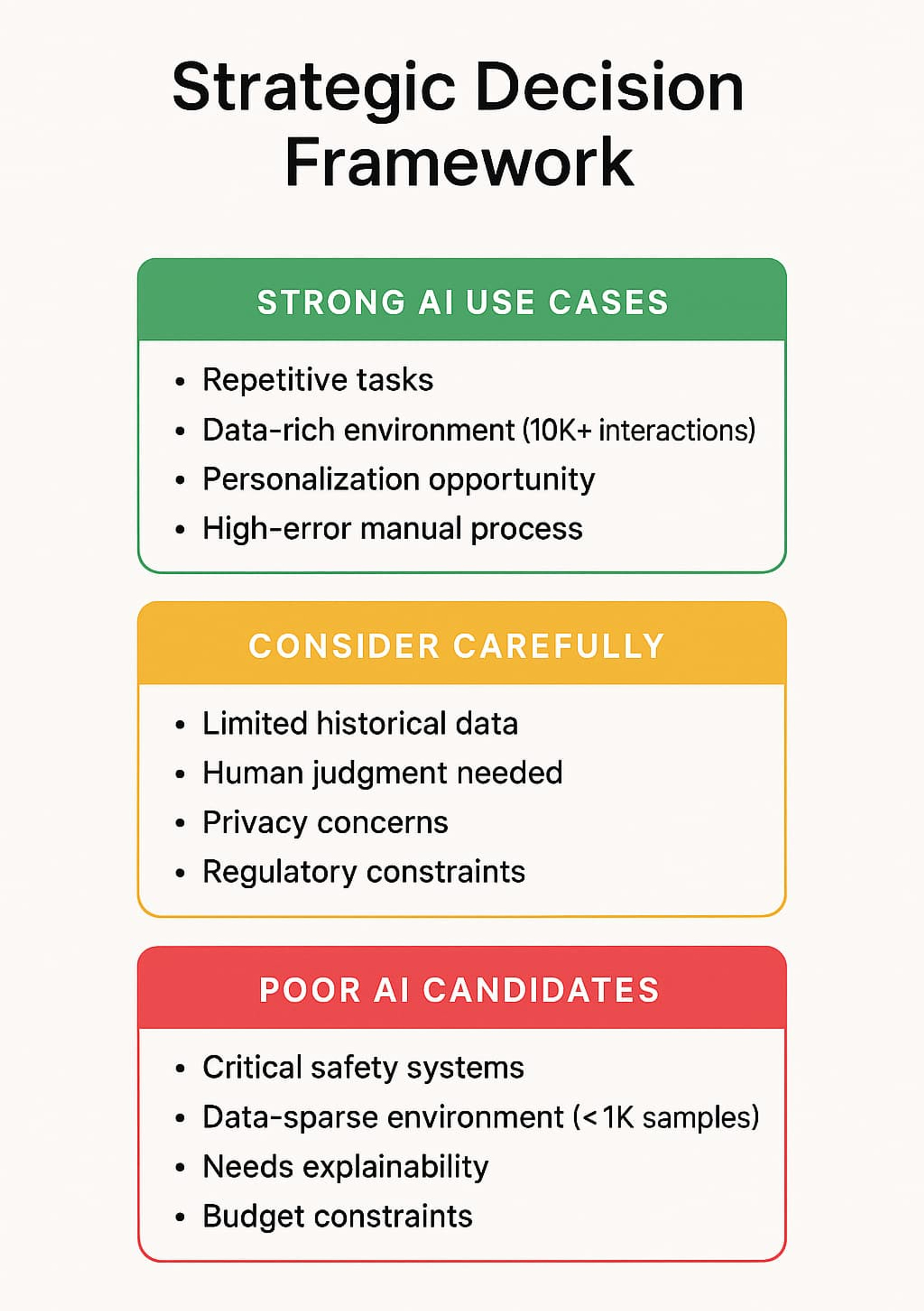
When AI Might NOT Be the Right Solution
Consider alternatives when:
- The problem is well-served by simpler rule-based approaches
- Available data is insufficient for effective training
- The cost of error is extremely high (safety-critical applications)
- Explainability requirements are strict (regulatory contexts)
- Implementation timeline doesn't allow for training and optimization
Future of Artificial Intelligence in Mobile Apps
AI + Augmented Reality
The combination of AI with AR creates possibilities in retail, industrial maintenance, education, and real estate applications.
AI for Accessibility Features
AI can improve application accessibility through:
- Real-time captioning services
- Object recognition for visually impaired users
- Voice navigation adapted to speech patterns
- Cognitive assistance features
Predictive Maintenance Using AI
Industrial and IoT applications can benefit from predictive capabilities for equipment monitoring, maintenance planning, and asset management.
Trends to Watch: What's Next for Founders
- No-code AI tools simplifying development
- AI co-pilots providing in-app guidance
- Privacy-preserving techniques enabling sensitive applications
- Multimodal AI combining vision, voice, and text
- Neuro-symbolic approaches bringing reasoning capabilities
Implementation Roadmap
Phase 1: Foundation (Months 1-3)
- Identify specific business problems AI can address
- Establish baseline metrics for evaluation
- Begin data collection and preparation
- Evaluate build vs. buy options for your use case
Phase 2: Initial Implementation (Months 3-6)
- Develop/integrate MVP AI functionality
- Implement in controlled environment (beta)
- Establish feedback mechanisms
- Train team on maintenance requirements
Phase 3: Optimization (Months 6-12)
- Expand to full user base
- Refine models based on real-world data
- Measure impact against baselines
- Optimize for performance and resource usage
Phase 4: Expansion (Months 12+)
- Extend AI capabilities to additional use cases
- Implement more sophisticated models
- Integrate across more user touchpoints
- Develop predictive rather than reactive capabilities
If you're considering how AI could fit into your mobile roadmap, start by identifying specific business problems it could solve, rather than implementing technology for its own sake.
FAQs
How is AI used in mobile apps?
AI transforms mobile apps through personalization engines, conversational interfaces, visual recognition systems, and predictive analytics. The key business value comes from automation of routine tasks, enhanced user experiences, and data-driven insights.
Where is AI used in apps?
Industries adopting AI include retail, financial services, healthcare, entertainment, and enterprise software. The technology crosses vertical boundaries, with implementation determined more by use case than industry.
What is the future of AI in mobile apps?
The horizon includes improvements in on-device processing power, multimodal AI combining vision/voice/text, and edge AI for disconnected environments. We're moving from isolated AI features to more comprehensive intelligent systems.
How expensive is it to integrate AI in mobile apps?
Implementation costs vary widely based on complexity: from basic recommendation systems to advanced custom solutions. Initial development costs should be weighed against ongoing maintenance, optimization, and API expenses. Consider both direct costs and team resource requirements.
How do you measure ROI from AI in apps?
Effective measurement tracks improvements in conversion rates, support ticket volumes, user session metrics, churn rates, and efficiency metrics like task completion time. More sophisticated measurements might include impact on Net Promoter Score and customer lifetime value.