Claude Max Plan: Pricing, Limits, and Is It Worth It
Claude Max is Anthropic's power-user subscription. It sells in two tiers: $100 a month for 5x Pro's usage, $200 a month for 20x. The multiplier scales your capacity inside a rolling five-hour session window, and it is not a promise of twenty times everything. A separate weekly limit sits on top of it. Below: what each tier costs, where the limits still bite, and who the math works for.
Where Max Sits in Claude's Plan Lineup
Max is the top individual plan. Below it, Pro at $20 a month covers everyday use and already includes Claude Code and Cowork. Above it, Team and Enterprise add seats, SSO, admin controls, and central billing. Max sits between the two: one person, no admin surface, and the largest usage allowance you can buy without a seat-based contract.
What it adds over Pro is capacity (5x or 20x per session) and higher output limits. Fable 5 and Fable 5.1 are also standard parts of Max, while Pro users pay for those two models out of usage credits.
Plan | Price | Headline capability |
|---|---|---|
Free | Core chat, web search, file creation, memory | |
Pro | At least 5x Free's usage per session. Includes Claude Code, Cowork, projects, research, and extra models | |
Max 5x | 5x Pro's usage per rolling 5-hour session. Higher output limits, priority access at peak (details) | |
Max 20x | 20x Pro's usage per rolling 5-hour session. Identical feature set to Max 5x | |
Team | Premium seats get 5x standard. Adds SSO, central billing, enterprise search, and admin controls | |
Enterprise | Team features plus SCIM, audit logs, role-based access, and custom retention |
Claude Max Pricing
Claude Max costs $100 per month for the 5x tier and $200 per month for the 20x tier. Pro, for comparison, is $20 billed monthly or $17 a month on an annual plan, which bills as $200 up front. Max is monthly only. There is no annual discount on either Max tier.
Feature-wise, the two tiers are identical. Same models (Fable, Opus, Sonnet, Haiku), same context window, 1M tokens for Fable 5.1, Opus 5, and Sonnet 5 in chat, 500K for the 4.x models, 200K for the rest, same priority access at high traffic times, and same early access to new features. The only thing the extra $100 buys is capacity. If you are choosing between them, you are deciding how much you use Claude, not what you can do with it.
Those are web-subscription prices. Buying through the App Store or Google Play can cost more, and Anthropic states that prices and plans are subject to change.
Max 5x vs. Max 20x
Anthropic does not publish a message count or an hours-per-day figure for either tier, and any article that gives you one is guessing. What it does publish is the ratio: 5x or 20x Pro's usage per five-hour session, with a separate weekly limit across all models.
So think in sessions rather than messages. Max 5x gives you five Pro-sized sessions' worth of headroom in every five-hour window. Max 20x quadruples that again. That is enough to keep an agentic Claude Code loop running through most of a working day on Sonnet.
The split, plainly: if you use Claude heavily in chat and dip into Claude Code a few times a week, 5x is enough. If you run Claude Code for several hours most days on Opus or Fable, or run multiple parallel Sonnet sessions, that is the 20x case. Not much in between needs the $200 tier.
What “20x” Actually Means
Two limits govern your account, and they behave differently.
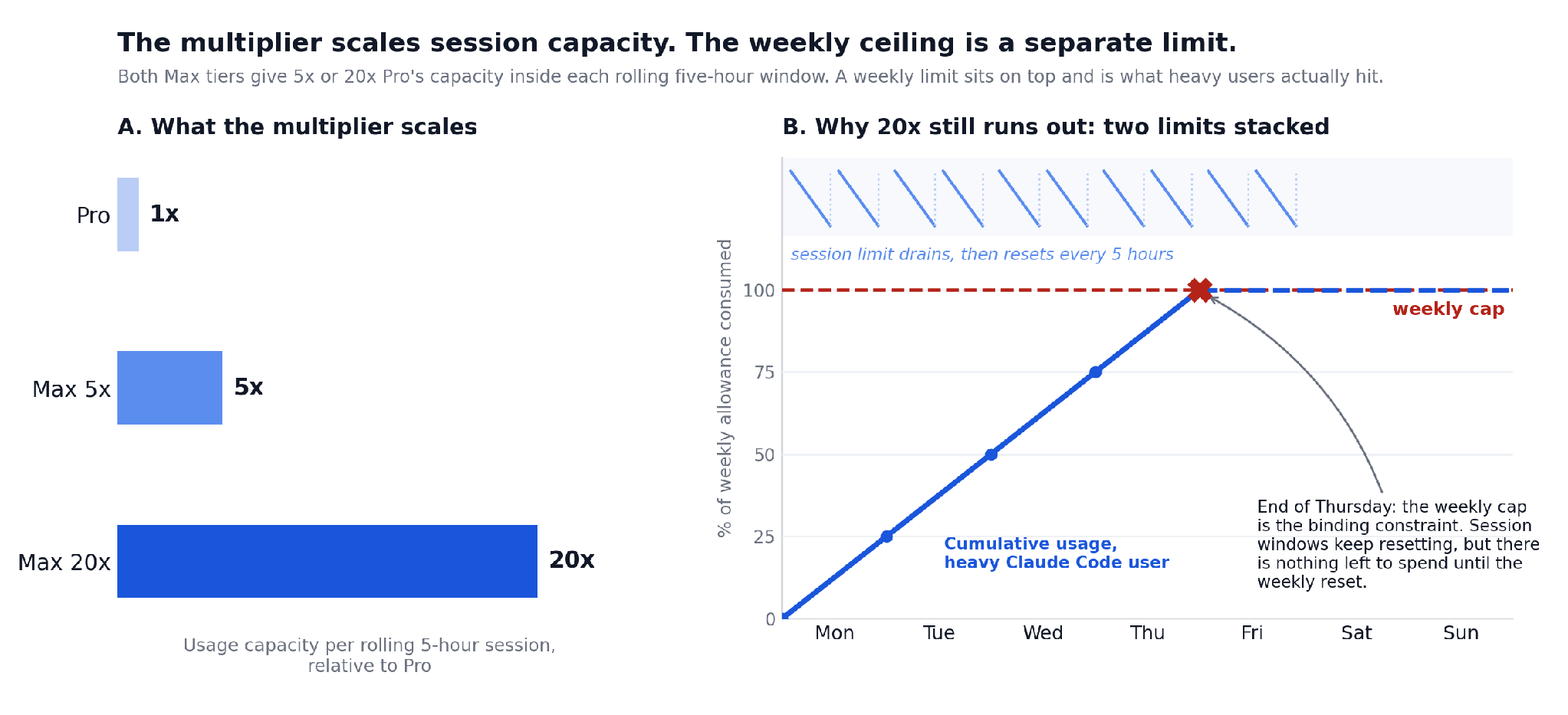
The first is the session limit. It runs on a rolling five-hour window and resets when the window rolls. This is the limit the multiplier applies to. Max 20x gives you twenty times Pro's allowance inside that window.
The second is the weekly limit, and this is where the marketing framing and the product part ways. Max plans carry a weekly cap that applies across all models. It resets at a fixed time assigned to your account, not at the moment you started using Claude, and you get your full allowance each cycle. Anthropic tracks it as two counters in Settings, then usage: one for Opus, one for everything else. It also states that it may limit usage in other ways, including weekly and monthly caps and per-model or per-feature restrictions, at its discretion.
That second limit is why 20x does not mean twenty times the value for every buyer. Session capacity scales twentyfold. The weekly ceiling does not scale in steps, and for anyone running long agentic sessions, the weekly ceiling is the constraint that binds.
One more thing worth knowing before you buy: it all draws from a single pool. Claude on the web, the desktop app, mobile, Cowork, and Claude Code spend the same allowance. A morning of Claude Code work reduces what is left for chat that afternoon.
Since 26 March 2026, the session limit has also been draining faster during peak hours. Anthropic adjusted the five-hour windows so that weekdays between 5am and 11am PT (1pm to 7pm GMT) burn allowance more quickly, and left weekly limits alone. Thariq Shihipar, an engineer working on Claude Code, put the figure at roughly 7% of users hitting session limits they would not have hit before and suggested shifting token-heavy background jobs to off-peak hours. The change was posted on X rather than announced formally, which matters if you are budgeting against published numbers.
If you are comparing Claude Code with other coding agents partly on how they meter usage, our Cursor vs Claude Code comparison covers the difference between a shared subscription pool and per-request pricing.
So both things are true at once. For a lot of Max subscribers, 20x is headroom they will never touch, and 5x or even Pro is the honest recommendation. For the developers who bought 20x specifically to stop being interrupted, the weekly cap and the peak-hour adjustment are real constraints that no multiplier describes.
Usage Limits in Practice
Hitting a limit looks different depending on where you are when it happens.
In the Claude apps, you get a notification that you have reached your session usage limit, with the reset time. In Claude Code, you get a “limit reached, resets at” message. Either way, you have three options: wait for the reset, switch to a lighter model with the /model command, or turn on usage credits and keep working at standard API rates.
Usage credits are worth setting up before you need them. They are prepaid; they bill at standard API rates, and you can set a monthly spend cap plus auto-reload thresholds in Settings, then Usage. There is a $2,000 daily redemption limit. Credits cover chat and Claude Code alike. If you subscribed through a mobile app store, you have to enable it on the web version.
Model choice moves the needle more than most people expect. Opus costs several times more per turn than Sonnet, and Sonnet more than Haiku, so leaving Opus selected for routine work is the fastest way to drain a limit. Fable is a separate case. On Max, it is included but capped at 50% of your weekly limit, and it consumes that limit faster than other models. Once you exhaust the Fable share, you either switch models or pay credits.
Two Claude Code habits do most of the work here. Run /clear between unrelated tasks, because every previous message is resent on every turn, and a session that has wandered through three problems pays for all three. And ask for a plan before wide changes, since a few hundred tokens of plan are cheaper than a wrong 400-line diff generated twice. Anthropic's own usage limit best practices cover the chat-side equivalents, mainly batching related questions and keeping reference material in projects where it gets cached.
None of this is theoretical. Anthropic tightened Claude Code limits in July 2025 without telling users, then announced formal weekly rate limits later that month for Pro and both Max tiers. In March 2026, the peak-hours change came. The pattern to plan around is that these limits move.
Claude Pro vs. Max: Which Do You Need?
Pro | Max 5x | Max 20x | |
|---|---|---|---|
Price | |||
Session capacity | Baseline | ||
Weekly limit | Yes, across all models, with a separate Opus counter | Yes, across all models, with a separate Opus counter | |
Model access | Fable, Opus, Sonnet, Haiku | Same | Same |
Fable 5 and 5.1 | |||
Priority at peak traffic | Yes | Yes | Yes |
Claude Code suitability | Occasional sessions | Daily use, a few hours | Sustained multi-hour agentic sessions |
Admin, SSO, central billing | No | No | No |
Who it fits | Everyday chat plus light coding | Developers who code with Claude daily | Heavy Claude Code and Opus-first workflows |
Casual daily use stays on Pro. If you chat with Claude most days, run the occasional research task, and open Claude Code a few times a week, Pro's allowance holds, and $20 is the right price.
Daily Claude Code work is the reason to move to Max, and it is the single clearest signal in this whole decision. If you open a terminal session most mornings and Claude Code is part of how you ship, Max 5x at $100 removes the friction, and you will rarely see a limit.
Sustained multi-hour agentic sessions are the 20x case. Long-running loops, refactors spanning dozens of files, Opus-heavy planning, and several parallel sessions. If that is your week, $200 is your tier. If it is not, it is not.
Engineering managers should note that Max is an individual plan with no admin surface. No central billing, no SSO, no usage analytics across people. Ten developers on Max means ten personal subscriptions and ten expense reports. Team plans exist for that reason: $20 per seat per month on an annual plan for a standard seat, $100 per seat for a premium seat carrying 5x standard usage, plus SSO and central administration.
Max vs. the API: When Pay-as-You-Go Wins
The trade is capped spend against capped usage. Max fixes your bill at $100 or $200 and hands you a limit you can hit. The API has no usage limit and no fixed bill: you pay per token, currently $2 in and $10 out per million tokens on Sonnet 5, $5 and $25 on Opus 5, and $10 and $50 on Fable 5.1. Cache reads run at a fraction of those rates, which matters more than the headline numbers for long coding sessions.
Predictable heavy individual use favors Max, because you are buying insurance against a bad month. Spiky use favors the API, and so does anything automated: CI jobs, batch pipelines, agents running unattended, and work where a five-hour window for resetting is beside the point because the job runs when it runs. Teams are a third case, where seat features and spend controls usually matter more than the token math. The Codex vs Claude Code comparison goes deeper into how the two billing models play out in day-to-day agent work.
Is Claude Max Worth It?
Here is a worked example you can recalculate with your own numbers.
Take a developer doing four to five hours of Claude Code a day, twenty workdays a month, on Sonnet 5. Assume a heavy day sends roughly 12M cached input tokens, 800K fresh input tokens, and 400K output tokens. At Sonnet 5 rates, that come out as
Component | Volume | Rate | Cost |
|---|---|---|---|
Cached input (cache reads) | 12M tokens | $2.40 | |
Fresh input | 800K tokens | $1.60 | |
Output | 400K tokens | $4.00 | |
Per day | about $8.00 | ||
Per month (20 workdays) | about $160 |
So $160 a month metered against $200 for Max 20x. That is close enough that 20x is not the obvious win people assume for Sonnet-only work, and Max 5x at $100 is the better buy if it holds you. Cache writes add a dollar or two a day, which does not change the conclusion.
Run the same day on Opus 5, and the picture flips. Cache reads at $0.50 per million come to $6.00, fresh input at $5.00 comes to $4.00, and output at $25.00 comes to $10.00. That is about $20 a day, roughly $400 a month, and Max 20x pays for itself twice over. The same holds for anyone working primarily in Fable 5.1 at $10 and $50 per million tokens.
Adjust the token assumptions to match your own work rather than trusting ours. Claude Code's /cost command reports actual token and dollar usage per session on API billing, which is the fastest route to a real number.
Where the math clearly does not work: anyone who uses Claude mostly in chat, anyone who codes a few hours a week rather than a few hours a day, and any team past two or three people, where Team seats and central billing are worth more than raw individual capacity. Cowork shifts this a little for non-developers running multi-step file and document work, and our Claude Cowork overview covers what that surface is actually good for.
Final Thoughts
Claude Max is $100 a month for 5x Pro's usage and $200 for 20x. The multiplier scales session capacity inside a rolling five-hour window, not your weekly ceiling, which is why a developer can pay for 20x and still hit a wall on a Thursday afternoon. Buy 5x if you code with Claude daily, 20x if you run long agentic sessions or work Opus-first, and stay on Pro if neither describes you.
If you are picking a plan for a team rather than for yourself, the question changes shape. Max buys one engineer a lot of headroom and gives you no way to see how it is being spent, because there is no shared billing and no usage analytics across people. Team seats give you both, and a lower ceiling per person. Most engineering groups we work with end up mixing all three: premium Team seats for the people who live in Claude Code, standard seats for everyone else, and API keys for anything that runs unattended in CI.
We build on Claude in production at Leanware, on client codebases, and on our own, so we have had to make these calls with real budgets. If you are working out how to equip your engineers or how to put Claude behind a product feature, talk to us about your setup.
Frequently Asked Questions
How Much Does Claude Max Cost?
Claude Max costs $100 per month for Max 5x and $200 per month for Max 20x, billed monthly only. Both tiers carry the same models, features, and priority access. The extra $100 buys usage capacity alone: 5x or 20x Pro's allowance per rolling five-hour session.
What's the Difference Between Claude Pro and Claude Max?
Same product, different ceiling. Pro is $20 a month and covers everyday use. Max is $100 or $200 and gives 5x or 20x Pro's usage per five-hour session, plus higher output limits and priority access when traffic spikes. For daily Claude Code work, that capacity is the deciding factor.
What Do the 5x and 20x Multipliers Actually Mean?
They describe usage capacity relative to Pro inside each rolling five-hour session window, not unlimited access. A separate weekly limit applies across all models and resets at a fixed time tied to your account, so session capacity and weekly capacity are two different constraints.
Does Claude Max Remove Usage Limits?
No. Max raises the limits substantially but does not remove them, and sustained Claude Code work can still exhaust the five-hour session allowance and the weekly cap. At the cap, you can wait for the reset, switch to a lighter model, or enable usage credits and continue at API rates.
Is Claude Max Worth It for Developers?
If you run Claude Code for several hours most days, yes. A heavy day metered at Sonnet 5 costs roughly $8, about $160 a month, which puts Max 5x at $100 clearly ahead. The same work on Opus 5 runs near $400 a month, and Max 20x pays for itself.