What a Real AI Implementation Roadmap Contains (and How to Tell If Yours Is Usable)
Ask for an AI implementation roadmap and you usually get one of three documents: a vendor deck, a maturity assessment, or a template based plan.
None of those is necessarily useless. The problem is that they are rarely built from analysis of your actual systems, integrations, workflows, and data.
Those factors determine what can be implemented, what it will cost, and whether it will generate a return.
The question most operators are trying to answer is simple: given my operation, what should we automate first, what should we buy, and what should we wait on?
A usable roadmap answers those questions. Most do not.
Let's look at what a real AI implementation roadmap contains, and how to tell whether the one you've been handed is actually usable.
Why most AI roadmaps handed to operators aren't usable
Most AI roadmaps fail for the same reason: they rank opportunities before analyzing the systems, integrations, and data that determine what is actually feasible.
A vendor deck is a sales artifact. A maturity model describes how companies in a category or industry generally adopt AI. A template based roadmap applies generic best practices. None of them starts with a detailed analysis of your operation.
A roadmap is only useful if it tells you what to do first in your operation, with your systems, at your data quality, and given your transaction volumes.
That requires direct analysis of how work moves through the business, how systems exchange data, and where data quality issues appear. Without that analysis, a roadmap can describe AI opportunities in the abstract, but it cannot reliably rank them based on what your operation can actually support.
The result is a document that looks reasonable on paper but often falls apart during implementation.
What a stack specific AI implementation roadmap is (and is not)
A stack specific AI implementation roadmap is a technical planning document built from direct analysis of your systems, workflows, integrations, and data. It ranks automation opportunities by ROI, identifies which can be implemented today, recommends where existing software is a better fit than custom development, and flags opportunities that should wait until a prerequisite is met.
It is not a software inventory. It is not a market analysis. It is not a readiness assessment or maturity scorecard. Those documents can be useful, but none of them tells you what to build first.
The factor that most often determines whether an opportunity is buildable is how systems actually exchange data. Engineers sometimes refer to this as integration topology.
A roadmap that ignores this reality will produce rankings that look compelling but fail during implementation. An opportunity may appear to have the highest ROI on paper, yet depend on data that is incomplete, inaccessible, or unreliable once you examine how records actually move between systems.
That is why a roadmap must be built from the stack itself, not from industry benchmarks or a vendor's capability list.
Section one: the baseline audit
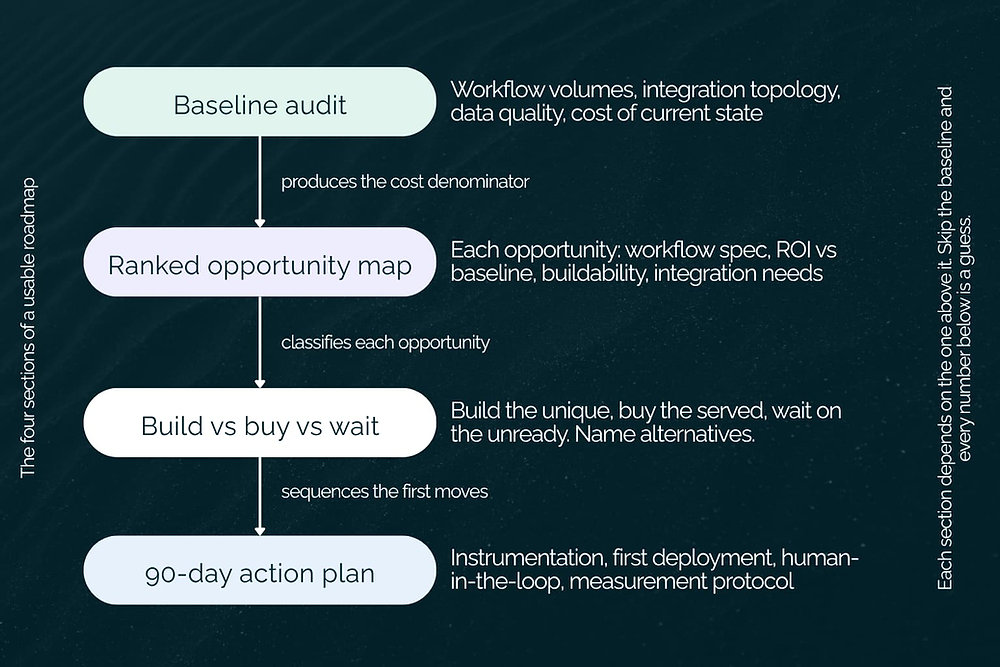
Every usable roadmap starts here, because every ROI projection downstream depends on it. The baseline audit measures the current state of the operation directly, and it must produce four things.
A workflow inventory with actual volumes and staff time per unit measurements. Not "we process a lot of invoices," but the specific count per week and the measured minutes of staff time each one consumes from intake to system of record commit.
An integration topology showing how systems actually exchange data. This means tracing the real path a record takes between systems, not reading the vendor's integration documentation. The documented API and the working data flow are frequently different things, and the difference is where implementations break.
A data quality assessment by system, with specific attention to whether exception records live in the system or in email threads. If the exceptions that matter most are being resolved in someone's inbox rather than recorded in a system field, no model can be trained on them until that data is captured.
A cost of current state for each workflow. This is the denominator for every ROI projection in the rest of the document. Without it, every percentage improvement downstream is a claim, not a calculation.
A simple test: if the roadmap you received does not cite baseline numbers from your actual operation, the opportunity rankings in it are not grounded in anything. They are estimates applied to a generic operation that resembles yours.
Section two: the ranked opportunity map
With the baseline established, the roadmap ranks specific automation opportunities. Each entry in the map must contain four elements, and the absence of any one of them reduces the entry from a recommendation to a suggestion.
A workflow description specific enough for an engineer to scope. "Improve exception handling" is not a workflow description. "Route inbound carrier invoices that fail three way match to a review queue, classify the failure type, and pre populate the dispute record with the contract rate and the billed rate" is a workflow description. The difference is whether an engineer can read it and estimate the build.
An ROI projection derived from the baseline audit's cost measurement. A percentage improvement without a baseline number behind it is a marketing claim. "Reduce processing time 40%" means nothing until it is "reduce processing time from the measured 14 minutes per invoice to roughly 8 minutes, against a volume of 2,000 invoices per month."
A buildability determination classifying each opportunity as buildable today, buildable after a prerequisite, a fit for existing software, or deferred. This is the classification that turns a list of ideas into a sequence of actions.
The integration requirements specifying which systems the automation reads from or writes to, and the mechanism for each. "Reads PO data from the ERP via its REST API, writes match results to the AP module, escalates exceptions to a review queue in the existing ticketing system" is an integration requirement. "Integrates with your systems" is not.
A roadmap that presents opportunities without buildability determinations is a strategy document. It tells you what is desirable without telling you what is achievable, which is the part you actually needed.
Section three: the build vs buy vs wait recommendation
This is where vendor produced roadmaps fail most reliably, because the vendor's incentive is to recommend build for everything. A roadmap produced by someone with no product to sell makes a different call on each opportunity, and the three determinations are concrete.
Build when the workflow's volume and uniqueness exceed what existing software can follow. Custom development is justified when the logic is specific to your operation (your carrier contracts, your BOM structure, your client specific billing rules) and no off the-shelf tool encodes that logic.
Buy when the workflow is high volume, low uniqueness, and already served by a tool at a price a custom build cannot beat. Customer support triage is the clearest example: tools like Intercom Fin, Zendesk AI, and HubSpot Breeze handle common support automation well, and building a custom equivalent rarely makes financial sense. A "buy" determination must name the specific alternatives considered. A recommendation to buy without named alternatives is not a defensible recommendation, because the reader cannot evaluate whether the right options were weighed.
Wait when the data is not ready, the technology has not reached production reliability for the use case, or the volumes do not justify the cost yet. A "wait" is not a failure to find an opportunity. It is a judgment that the opportunity exists but the conditions to capture it do not, and acting now would produce a system that degrades or a cost that does not return.
The discipline that distinguishes a real recommendation from a sales pitch is naming the alternatives considered for every "buy" and "wait" call. Without that, the determination is an assertion.
Section four: the 90 day action plan
The final section sequences the first moves. A real 90 day plan specifies four things, and the most commonly skipped one is the first.
The instrumentation phase that closes data gaps before any model is trained. This is the step whose absence most reliably produces production failures. If the exception records the model needs are sitting in email threads, the first phase captures them into a structured field. Skipping this and training on incomplete data produces a model that works in the demo and fails in production.
The first deployment target, scoped tightly enough that an engineering team can execute without a re scoping conversation. "Automate AP" is not a deployment target. "Deploy three way match automation for the top five vendors by invoice volume, auto approving within a 2% variance tolerance and escalating everything else" is a deployment target.
The human in the loop specification naming where staff review AI output before it commits to a system of record. This identifies exactly which decisions require human sign off and at what threshold, before the automation writes anything irreversible.
The measurement protocol stating what gets measured, at what interval, against which baseline. This is what makes the month three review meaningful, because it compares production results against the numbers the baseline audit established.
A plan that goes straight from deployment to autonomous operation, with no instrumentation phase and no human in the loop specification, has not been written by someone who has watched a production rollout fail. The failures happen at exactly the steps such a plan omits.
What separates a usable roadmap from a vendor slide deck
You can evaluate any roadmap you have been handed against five tests. Each is a single question, and a document that fails any of them is weaker than it appears.
Baseline measurements are present for every ranked workflow, drawn from your actual operation rather than industry averages.
The integration mechanism is specified by system, not described as "integrates with your ERP."
Build vs buy vs wait determinations are present, with named software alternatives for every "buy" call.
The 90 day plan is detailed enough for an engineering team to execute without a re-scoping conversation.
At least one "wait" determination is present, because a roadmap with no waits has almost certainly not been produced by someone who looked at the data.
Common reasons operators receive roadmaps that don't clear this bar
Three structural patterns explain most of the documents that fail the tests above. None of them reflects bad intent; each reflects who produced the document and what they were equipped to do.
The vendor produced roadmap is structured around product capabilities. The build vs buy determination always favors build, alternatives are never named, and integration requirements are written in the vendor's terminology rather than the reality of your systems. It is a competent sales document doing the job it was built for.
The consulting firm roadmap without engineering competence describes your business process correctly. The buildability determinations are not grounded in integration analysis, because the people who wrote it could describe the workflow but could not evaluate whether your API produces trainable data. The 90 day plan reads as a project management document rather than a technical specification.
The template based internal roadmap ranks opportunities by what AI is generically supposed to be good at. The ROI projections use industry averages rather than measurements from your operation, because no one measured your operation.
The evaluation framework in the previous section is the diagnostic. Run any of these three documents through the five tests and the gaps become visible.
Your Next Move
A usable AI implementation roadmap is an engineering document produced from direct analysis of the stack, and most operators never receive one because producing it requires an engineer who has spent time inside the operation, not a consultant working from a framework or a vendor working from a product catalog.
The AI ROI Assessment is how Leanware produces that document: two weeks, a senior engineer working directly with your team, a baseline audit of your actual systems, a ranked opportunity list with ROI projections grounded in those baselines, build vs buy vs wait determinations with named alternatives, and a 90 day action plan an engineering team can execute. It is a paid engagement, and 50% of the fee is credited toward the build if you proceed within 30 days. Start with the AI ROI Assessment.
Frequently Asked Questions
What's the difference between an AI implementation roadmap and an AI implementation guide?
A guide describes a general process you follow yourself. It tells you how to think about the exercise: assess your data, pick a use case, run a pilot. A roadmap is a document specific to your stack, produced by someone who has audited your systems, measured your baselines, and ranked opportunities by what your integrations can actually support. A guide tells you how to think about the work. A roadmap tells you what to do first, what to buy, and what to wait on, for your operation specifically.
How do I know if the AI roadmap I already have is usable?
Apply four tests to the document in front of you. It should cite baseline measurements from your actual operation, not industry averages. It should specify integration requirements by system and mechanism, not as "integrates with your ERP." It should make build vs buy vs wait determinations with named software alternatives for any "buy" call. And its 90 day plan should be specific enough for an engineering team to execute without re-scoping. If any of the four is missing, what you have is a strategy document, not an implementation roadmap.
Why does producing a real AI implementation roadmap require an engineer?
The core of the roadmap is the buildability determination: whether a specific workflow can be automated given your current data quality and integration topology. That is an engineering question. A consultant can describe your business process accurately without being able to evaluate whether your system's API produces trainable data, or whether your exception patterns will cause a production deployment to degrade over time. This is what distinguishes a roadmap from a maturity assessment, which scores your organization without ever making that determination.
How long does producing an accurate AI implementation roadmap take?
Roughly two weeks for one to three departments in scope with a four-to-six system stack. It requires direct access to the systems and to the people running the workflows, not just a review of documentation. Compressed timelines, a few days or a single discovery call, produce roadmaps based on what the team reports rather than what the data shows, and the gap between the two is usually where the real problems live. Larger scope extends the timeline proportionally.
How is an AI implementation roadmap different from an AI readiness assessment?
They answer different questions. A readiness assessment asks "are we ready?" It scores dimensions like data governance and change management capacity against a maturity model and produces a readiness score with a list of gaps. A roadmap asks "what do we do first?" It assumes the organization is going to act and produces the specific sequence: automate this, buy that, wait on the third thing, and here is the 90-day plan to start. A readiness assessment is useful when leadership is still deciding whether to commit. A roadmap is what you need once the decision to act has been made.