Grok 4.6: Benchmarks, Pricing, and What It Means for AI Agents
xAI released Grok 4.6 on August 12, 2026. It is not a new foundation model. It is a post-training upgrade on the same 1.5-trillion-parameter base as Grok 4.5, and that is exactly what makes it interesting: the gains come entirely from better supervised fine-tuning and reinforcement learning, at the same price as before. For teams evaluating models for agentic workloads, it changes the cost-performance math without changing the integration surface.
This article covers what shipped, what the benchmarks actually show, where the model fits, and what the release signals for anyone running AI agents or multi-step AI workflows in production.
What shipped
Grok 4.6 targets sustained, multi-step work rather than single-turn peak performance. According to xAI's announcement, the release "builds on Grok 4.5 with a particular focus on long-running agents and more ambitious interactive and visual work." The concrete claims:
- Better coherence across many steps on research, information analysis, unfamiliar codebases, and turning broad ideas into working applications.
- Improved self-testing and verification on longer trajectories, meaning the model checks its own work more reliably as sessions grow.
- Stronger first-pass structure on interactive and visual projects.
- Denser, more collaborative progress updates, which early users say suits synchronous "ask small, inspect, continue" workflows.
The key specifications, from xAI's developer docs:
Property | Value |
|---|---|
Model name | grok-4.6 |
Parameters | 1.5T (same foundation as Grok 4.5) |
Context window | 500,000 tokens |
Knowledge cutoff | February 1, 2026 |
Modalities | Text and image input, text output |
Reasoning effort | Low, medium, high (default), xhigh |
Tools | Function calling, web search, X search, code execution |
Pricing | $2.00 / 1M input tokens, $6.00 / 1M output tokens |
Fast variant | Twice the standard price |
xAI recommends prompt caching for multi-turn and agent loops, and context compaction for long tool-heavy sessions. Both matter in practice: agent workloads are dominated by repeated context, and caching discipline is often the difference between a viable unit cost and an unviable one.
How xAI got the gains without a bigger model
The release is a case study in post-training headroom. xAI reports a longer supplemental training run that included curated model-generated data for reasoning, high-quality engineering data, an improved optimizer, and SFT trajectories regenerated with Grok 4.5 across reasoning efforts, agent harnesses, STEM, software engineering, and knowledge work, with model-based filtering of problematic traces. On top of that sits broad agentic reinforcement learning covering knowledge work, general coding, and domain-specific environments such as kernel optimization, web development, and CAD.
Analysts read this as evidence that current foundations still have meaningful capability left to extract. For buyers, the practical implication is that model improvements keep arriving at fixed prices, which rewards architectures that can swap models without rework.
What the benchmarks show
xAI published the following comparison at high reasoning effort. Competitor numbers come from the respective developers' system cards or public leaderboards, so treat cross-vendor comparisons as directional rather than exact.
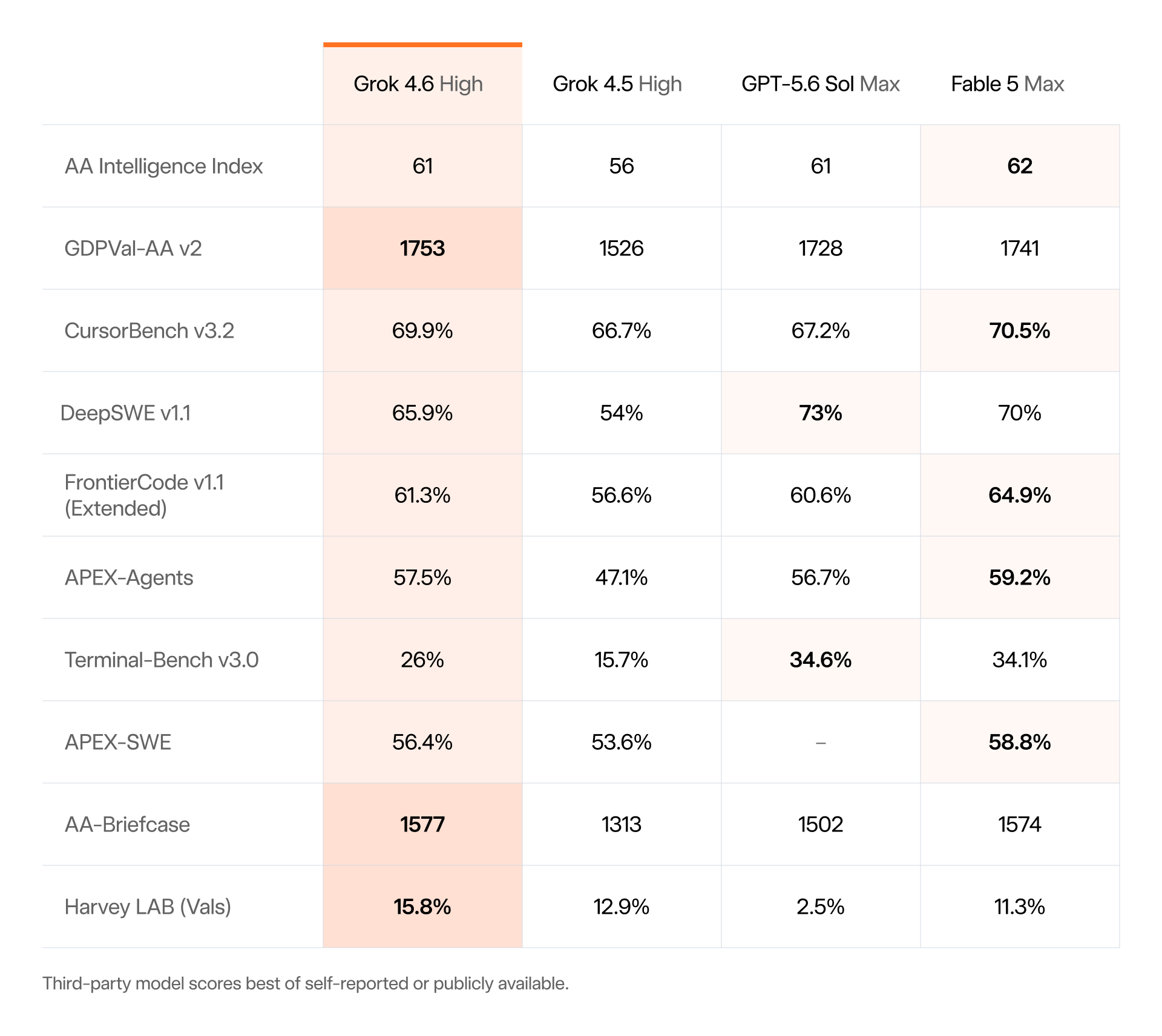
Source: xAI, published via the official @SpaceXAI account on X.
Evaluation | Grok 4.6 | Grok 4.5 | GPT-5.6 Sol Max | Fable 5 Max |
|---|---|---|---|---|
AA Intelligence Index | 61 | 56 | 61 | 62 |
GDPVal-AA v2 | 1753 | 1526 | 1728 | 1741 |
CursorBench v3.2 | 69.9% | 66.7% | 67.2% | 70.5% |
DeepSWE v1.1 | 65.9% | 54% | 73% | 70% |
FrontierCode v1.1 (Ext.) | 61.3% | 56.6% | 60.6% | 64.9% |
APEX-Agents | 57.5% | 47.1% | 56.7% | 59.2% |
Terminal-Bench v3.0 | 26% | 15.7% | 34.6% | 34.1% |
APEX-SWE | 56.4% | 53.6% | not reported | 58.8% |
AA-Briefcase | 1577 | 1313 | 1502 | 1574 |
Harvey LAB (Vals) | 15.8% | 12.9% | 2.5% | 11.3% |
A fair reading of this table, combining xAI's numbers with Artificial Analysis commentary:
Where it leads or ties. Grok 4.6 joins the frontier on the composite Intelligence Index at 61, matching GPT-5.6 Sol and trailing Anthropic's top models by one to two points. Its standout area is agentic knowledge work: it leads the shown set on GDPVal-AA and Harvey LAB, and posts a strong AA-Briefcase score with efficient turn and token usage. Independent analysis places it on the intelligence-versus-cost Pareto frontier.
Where it trails. The model does not dominate coding. It sits behind GPT-5.6 Sol and Fable 5 on DeepSWE and well behind both on Terminal-Bench, which are relevant benchmarks precisely for the long-running coding agents xAI is positioning around. Observers also noted that the vendor table emphasizes wins, which is standard practice but worth keeping in mind.
The consistent story. Solid gains over Grok 4.5 across every listed benchmark, frontier-competitive on practical agent workloads, at roughly 60 percent lower headline pricing than Claude Opus and Fable-class or GPT-5.6 Sol models. The value proposition is price-performance on sustained work, not benchmark supremacy.
Elon Musk amplified the cost argument at launch, sharing an Artificial Analysis cost-to-run comparison and calling Grok 4.6 "objectively #1 when considering intelligence, speed & cost". The framing is the vendor's, but the price gap the chart shows is real.
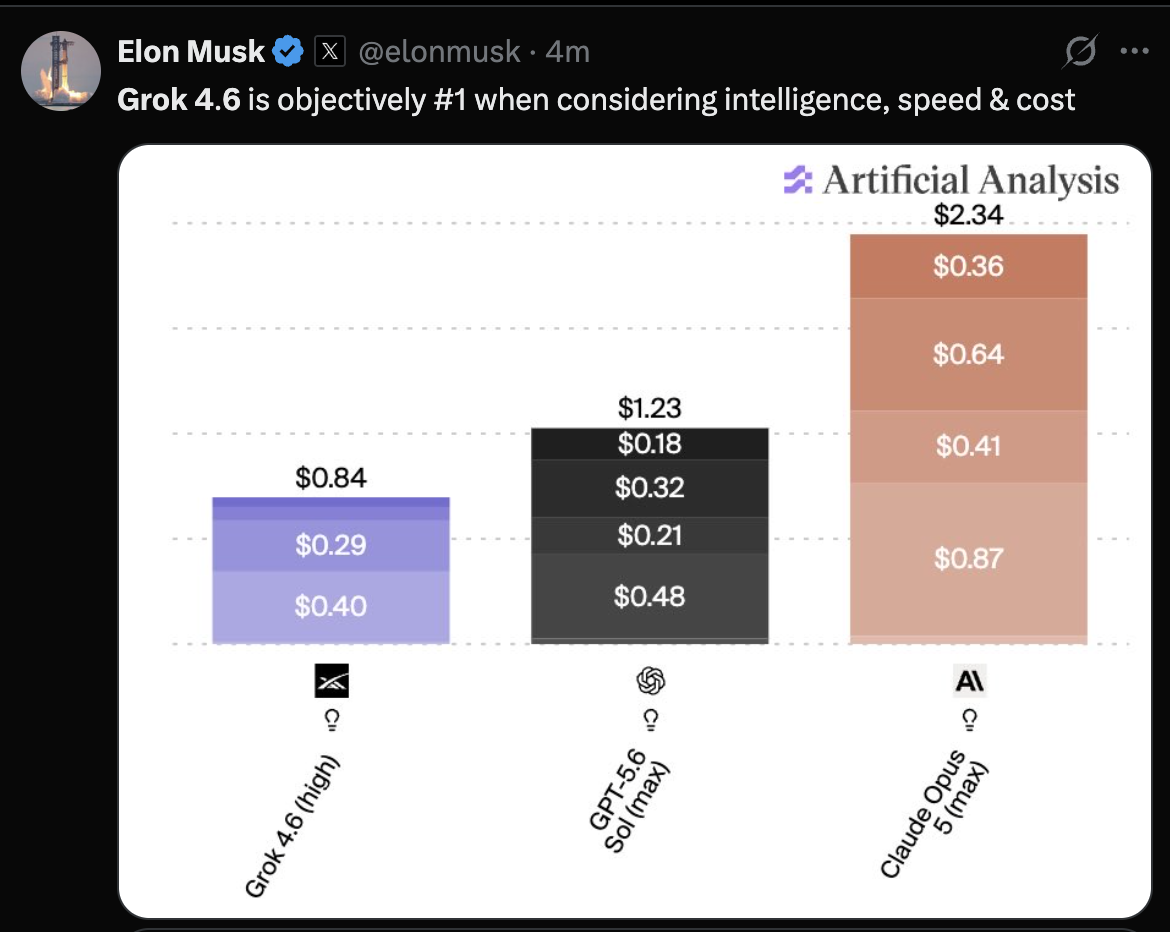
Source: Elon Musk (@elonmusk) on X; chart by Artificial Analysis.
Availability
Grok 4.6 launched immediately in Cursor (all plans), Grok Build (as the default coding agent, with CLI and API access), the xAI API under grok-4.6, and through OpenRouter, Vercel, and Cloudflare. Consumer access is rolling out through the model picker on grok.com and the Grok apps. Grok Build and Cursor include a first-week promotion of twice the included usage.
xAI has previously signaled a larger 2.1T-parameter Grok 4.7 to follow, positioned as better across the board with slightly slower serving, though no updated timeline was given at the 4.6 launch.
What this means if you are building with AI
Early reception should be treated as preliminary, but the release pattern itself carries lessons that hold regardless of how the first-week impressions settle.
Model choice is now a portfolio decision, not a loyalty decision. Grok 4.6 is strongest on agentic knowledge work and cost efficiency, GPT-5.6 leads on some deep coding benchmarks, and Anthropic's models hold the composite top. The right answer for a production system is often different models for different steps of the same workflow. As an AI Engineering Company, this is a large part of what we do for clients: matching each workload to the model that wins on that workload's actual cost and quality profile, and building so the next release slots in without a rewrite.
Long-running agents are where the frontier is competing. Every major lab is now optimizing for multi-step coherence, self-verification, and tool-loop efficiency rather than single-turn answers. That is a signal about where production value sits. If your business has processes that involve intake, triage, document handling, or multi-system coordination, purpose-built agents on these models are increasingly viable. Our AI agent development services cover exactly this shape of work: scoping the process, building the agent, and running it in production with monitoring and iteration.
Cheaper frontier tokens change what is worth building. At $2 per million input tokens with prompt caching, workloads that were marginal a year ago now clear the cost bar comfortably. Products with AI-native features that seemed too expensive to serve can pencil out. If you have a product idea that depends on sustained model usage, it is worth re-running the numbers; our AI product engineering team takes products from that feasibility question through a scoped first sprint to a shipped build.
Rapid release cadence rewards teams that can keep up. xAI shipped 4.5 in mid-July and 4.6 four weeks later, with 4.7 already signaled. OpenAI and Anthropic are moving on similar rhythms. Internal teams that evaluate a model once and freeze their stack fall behind quickly. Companies staffing up for this often find that a dedicated AI engineering team embedded alongside their own engineers is faster than hiring for skills that change quarterly.
Start from where AI actually pays off, not from the model. The least useful response to a launch like this is picking a model and then searching for a use case. The productive order is the reverse: identify the highest-return processes first, then choose the model. If you are earlier in that process, an AI readiness assessment is the structured way to find where AI moves the needle in your business before committing build budget.
The bottom line
Grok 4.6 is a solid, practical step-up rather than a landmark release. It confirms three things about the 2026 landscape: post-training alone still buys real capability, frontier-level agentic performance now costs a third of what the premium tier charges, and the labs are converging on long-running agent work as the battleground that matters. For businesses, the takeaway is less about this specific model and more about the pattern: the capability floor keeps rising and the price floor keeps falling, and the advantage goes to teams whose architecture and evaluation practices let them act on each release within weeks instead of quarters.
Benchmarks are as published by xAI on August 12, 2026, with third-party figures self-reported by their respective developers. Early user impressions reflect the first hours after launch.