How to Hire a Forward Deployed AI Engineer
Your AI agent handles test orders correctly. Getting it to process real orders inside your ERP is where the project stalls. Customer records are inconsistent, integration documentation is incomplete, and operations staff know exceptions that never made it into the requirements. Job postings call the person who fixes that a forward deployed engineer (FDE), or a forward deployed AI engineer.
A forward deployed AI engineer sits inside your operation and turns a general AI capability into a working system for your company. Born at Palantir in the early 2010s, the role is now hired by OpenAI, Anthropic, Databricks, Amazon and the large consultancies. This guide gives hiring managers the job description, the interview questions and the three ways to get one (hire, embed or contract), with what each costs and how long it takes to start.
What a Forward Deployed AI Engineer Does Inside a Company That Is Not Palantir
A forward deployed AI engineer is a production engineer embedded with one customer or one business unit who integrates an AI model or agent with that organization's systems and workflows and owns the result in production.
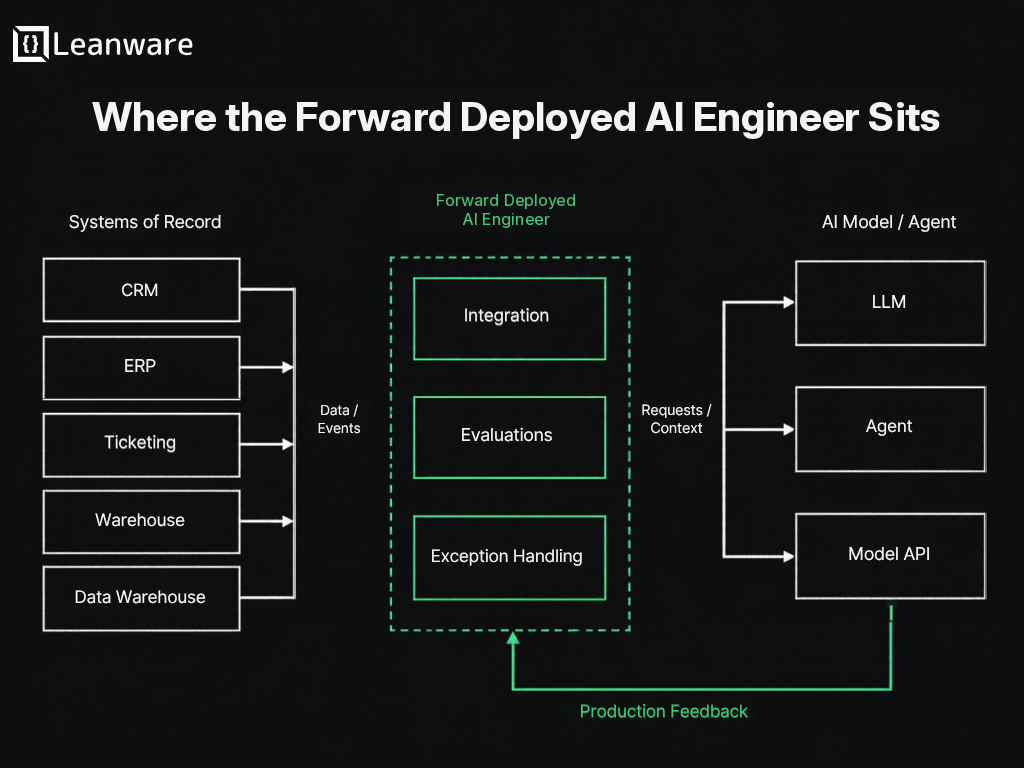
At Palantir, forward deployed engineers worked directly with customers to deploy complex data platforms, as The Pragmatic Engineer's history of the role describes. As the forward deployed engineer role spread, the same working model was applied to LLMs, agents and model APIs.
For an AI FDE, the engineering work centers on integrating with systems of record, evaluating model output against the company's data and defining what happens when the model produces an incorrect or incomplete result.
Consider a mid-sized distributor receiving orders through email, a customer portal and EDI. An AI agent extracts the order information, but the company still needs to validate customer identifiers, reconcile product codes, check quantities and submit approved orders to its ERP.
The FDE's week might begin with the operations lead explaining how employees process incoming orders. The engineer examines the ERP API, including undocumented behaviors and validation constraints. Next comes an evaluation set built from actual historical orders, covering missing SKUs, duplicate submissions, inconsistent customer records and other exceptions.
The engineer then implements the integration, monitors initial production runs and routes uncertain orders to a human review queue. Failures related to model behavior are documented and returned to the team responsible for the agent.
OpenAI's Forward Deployed Engineer job posting describes the responsibility as:
"Own technical delivery across multiple deployments from first prototype to stable production."
The posting also includes technical discovery, implementation, production adoption and feedback to product and research teams. These are relevant responsibilities when companies need to integrate AI into existing applications.
Most companies hiring for this title in 2026 are not AI vendors sending engineers out to customers. They are operating companies trying to bring the capability in, and that changes what to hire for: an engineer who learns your systems and the people who run them, and who still owns the integration after launch. Experience building a general AI product does not show that.
Forward Deployed Engineer vs Software Engineer, Applied AI Engineer, ML Engineer and Solutions Engineer: Which One the Project Needs
Choose the role based on where the work takes place and who owns the production outcome.
Role | Where they work | What they own | Hire them when | Typical mistake |
|---|---|---|---|---|
Forward deployed engineer | Inside the customer's or business unit's operation | The deployed system working in production | The AI capability exists, but fitting it to one company's workflow is the difficult part | Hiring one to build a product from scratch |
Software engineer / product engineer | On the product codebase | Features delivered to many users | You're building the product itself | Expecting them to work continuously inside one customer's process |
Applied AI engineer | On the AI layer of a product | Prompts, retrieval, evaluation and model selection | You're incorporating AI into your own product | Expecting them to conduct integration discovery with nontechnical stakeholders |
Machine learning engineer | On model training, fine-tuning and serving infrastructure | Model quality and pipelines | You have the data and need a model that does not exist yet | Hiring one primarily to connect an existing model API to an ERP |
Solutions or sales engineer | In presales engineering | Demonstrations and proofs of concept | You're selling a technical platform | Expecting them to maintain the production deployment after the deal closes |
For the distributor, a software engineer could develop an order-management application. An applied AI engineer could improve the agent's extraction and validation logic. A forward deployed engineer would be responsible for making the agent work within the distributor's ERP, business rules and exception-handling process.
Companies also use the titles AI implementation engineer, AI integration engineer and AI deployment engineer for substantially the same work. These names were common before the FDE title spread more widely.
Applied AI engineer is another title used for related in-house work at companies such as OpenAI and Anthropic. The required technical skills overlap. The practical distinction is who employs the engineer and whether the work centers on an internal product or a specific customer's deployment.
When You Need a Forward Deployed Engineer, and When You Need a Product Team Instead
Hiring a forward deployed engineer makes sense when the AI capability already exists, but integrating it into your organization's systems and workflows remains the challenge. If the work requires building a new AI product or developing capabilities that don't yet exist, a product engineering team may be the better fit. The following decision flow helps distinguish between the two.
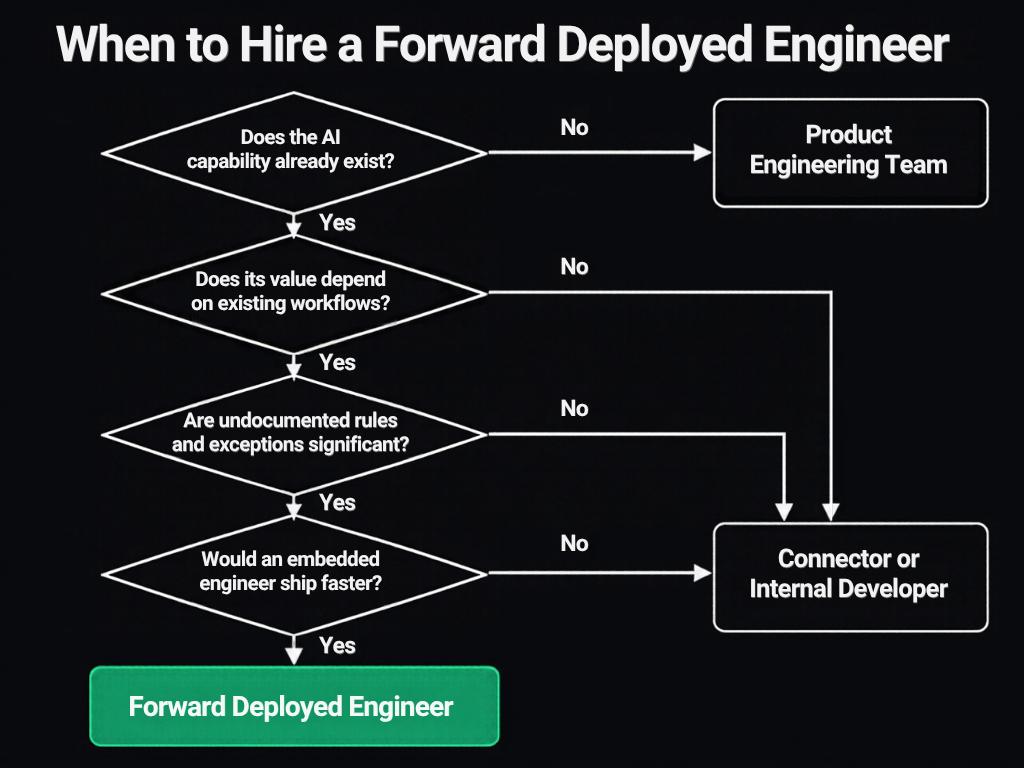
Four questions establish whether an FDE is appropriate:
- Does the AI capability already exist? The company has a model API, agent framework or vendor platform that can perform the core task.
- Does the value depend on existing systems and workflows? The AI must read from or write to the applications employees already use.
- Are undocumented rules and exceptions significant? Successful execution depends on operational knowledge that cannot be captured completely in an initial specification.
- Would an embedded engineer ship faster? Working directly with operations would resolve requirements and integration problems more quickly than a product team implementing a specification.
If all four answers are yes, an FDE is likely the right choice.
This is especially true if the order-processing agent already exists. The remaining work involves ERP integration, customer-specific rules, evaluation against historical orders and a queue for exceptions requiring human review. These requirements depend heavily on the distributor's environment.
If the company instead needs to develop the AI capability or build an order-management product for multiple customers, a software product development team is the better fit. Before development starts, Sprint 0 defines what the team is building and how the system will work, and resolves open technical questions first.
When the integration is one system and one workflow with no exceptions, neither is needed: a platform connector or an internal developer is enough. If the distributor only needed portal orders copied into the ERP, that would be the right answer.
When the company has several possible AI workflows and cannot determine which justify custom integration, Leanware's AI readiness assessment can establish the priorities. One senior engineer spends two to three weeks auditing the existing environment and identifying potential use cases. The fixed fee is scoped on the introductory call. The deliverables include a baseline audit, a ranked opportunity map and an implementation roadmap.
The assessment may support hiring an FDE, building a product, using an existing platform or postponing the implementation.
Forward Deployed AI Engineer Job Description (Copy and Adapt)
A generic posting attracts engineers who have built AI demos. A specific one attracts engineers who have kept an integration running in production. Copy the template below and adapt the mission, the systems and the workflow to your own first deployment.
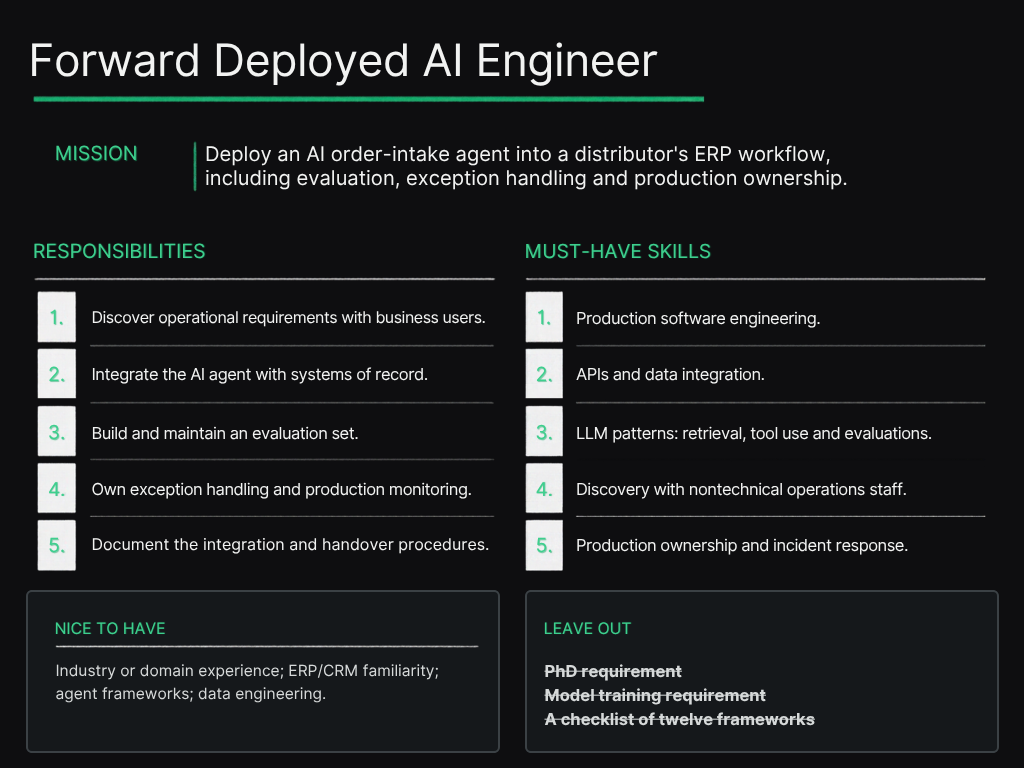
Mission
Integrate our AI order-intake agent with our ERP and existing order-processing workflows, ensuring that customer orders are validated, exceptions are handled and the deployed system can be operated reliably by our team.
Responsibilities
1. Discover and document operational requirements. Work directly with order-processing staff, the operations lead and system owners to understand how orders arrive, how they are validated and which conditions require manual intervention. Translate those conversations into documented technical requirements.
2. Integrate AI with systems of record. Implement and maintain connections between the agent, ERP, customer records and incoming order channels, including email, portal and EDI. Account for authentication, data mapping, API constraints, idempotency and failure recovery.
3. Build and maintain evaluation sets. Use representative company data to test the agent's behavior before release and after changes. Maintain an evaluation set covering normal orders, incomplete records, duplicates, conflicting fields and other operational exceptions.
4. Own exception handling and production monitoring. Define which actions the agent can complete automatically, which require human approval and how failures are surfaced. Monitor production behavior, investigate incidents and implement corrective changes.
5. Document the implementation and handover. Maintain integration documentation, operational runbooks, evaluation procedures and recovery instructions so the company can support the system after deployment.
Must-have skills
- Production software engineering: Experience designing, shipping and maintaining production systems using the company's backend languages, infrastructure and deployment practices.
- API and data integration: Experience with REST APIs, authentication, databases, data transformation, asynchronous processing and integration failure handling.
- LLM application development: Practical knowledge of retrieval, tool use, structured outputs, evaluation and the limitations of probabilistic model behavior.
- Operational discovery: Ability to interview nontechnical employees, identify undocumented business rules and turn those findings into actionable engineering requirements.
- Production ownership: Experience monitoring deployed systems, investigating failures, maintaining documentation and supporting releases after initial implementation.
Nice-to-have skills
Experience in distribution, order management or the company's operating domain is useful. Familiarity with its specific ERP or CRM can shorten discovery and implementation. Experience with agent frameworks and data engineering is valuable when the deployment involves complex orchestration or inconsistent source data.
What to leave out
A PhD is unnecessary for a role focused on integrating an existing AI capability. Model training experience should not be a requirement unless the project genuinely involves training or fine-tuning models.
Avoid listing twelve frameworks as mandatory qualifications. A candidate who has maintained a reliable integration across multiple production systems may be more valuable than someone who has experimented with every current agent library.
The trait that matters most
A strong backend engineer can implement an API integration from a complete specification. A strong FDE must also establish what the specification should contain.
That requires being comfortable as the only engineer in a room of operations staff, asking detailed questions and resolving conflicting descriptions of how the business works. There may be no product manager translating those conversations into tickets.
The same OpenAI posting asks engineers to scope work, write production-grade code and embed with customer teams through production rollout.
For the distributor, the posting should explicitly identify the ERP, the order-intake workflow and the expected production responsibilities. Those details will do more to attract qualified applicants than a long list of AI technologies.
How to Interview a Forward Deployed Engineer: Questions and What a Good Answer Contains
This section is written for the interviewer, not for candidates preparing for an FDE interview. A coding test shows whether someone can write code. It does not show how they handle an unfamiliar system, an operations lead who explains the process badly, or an integration that breaks after launch. The four stages below test those directly, using the distributor's order intake as the shared scenario.
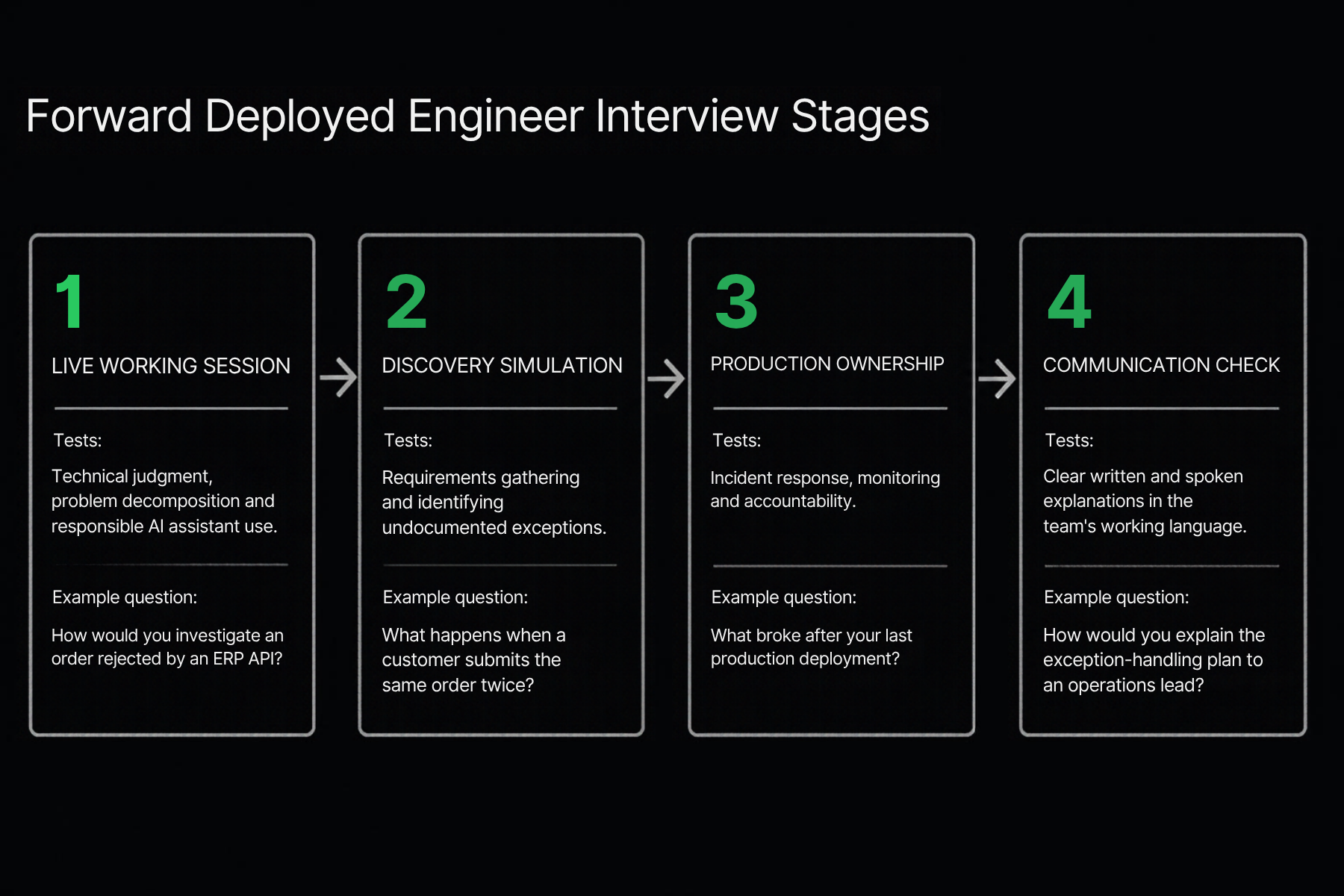
Stage 1: A live technical work session
Give the candidate an ambiguous integration problem and ask them to work through it while sharing their screen.
For example, provide a sample order payload, a partial ERP API specification and an error response that does not explain why the order was rejected.
Watch what the candidate investigates before writing code. They should identify missing information, inspect the available interfaces and establish assumptions that need verification.
Allow normal engineering tools, including an AI coding assistant. Observe whether the candidate checks generated code, questions unsupported assumptions and uses the tools to investigate rather than simply produce an implementation.
The objective is to understand how the engineer works when the available information is incomplete.
Stage 2: An operational discovery simulation
Have the interviewer play the distributor's operations lead.
Describe the order-intake process incompletely, as an employee might during an initial discovery meeting. Mention that orders arrive through email, portal and EDI, and that employees review some of them manually.
Don’t immediately explain why. The candidate should ask about duplicate orders, invalid product codes, customer-specific pricing, partial shipments, order amendments and approval requirements.
A useful outcome is a documented workflow with explicit decision points, unresolved questions and a list of exceptions requiring further investigation.
The candidate should also distinguish between rules that can be enforced deterministically and decisions that require human review.
Stage 3: A production ownership conversation
Ask the candidate to describe a system they personally shipped and supported.
The discussion should cover deployment, monitoring, incidents, recovery procedures and the changes made after observing actual production behavior.
Make sure to look for specific evidence of ownership. A candidate who can explain how a system was built but can’t describe what happened after launch likely has limited experience with the responsibility this role carries.
Stage 4: A communication check
Ask for a short written explanation of the proposed order-intake implementation and discuss it on a call.
The written response should identify the integration boundary, evaluation approach, exception-handling process and outstanding risks.
The candidate should be able to explain the same decisions to an engineering manager and an operations lead without losing technical accuracy. Assess communication in the working language of the team.
Leanware runs every engineer it places through the same four-stage process it uses for its own hires, and the client's own interview comes after it:
- English fluency
- A live screenshared technical assessment with the CTO
- A culture-fit conversation
- A final interview with the principals
Ten forward deployed engineer interview questions
1. Walk me through an integration where the documentation was wrong. How did you discover the discrepancy and resolve it?
A good answer names the system, explains how they verified actual behavior against the documentation, and describes what they recorded for future maintainers.
2. Our order-intake agent works with sample data, but the ERP rejects some production orders. What would you investigate first?
A good answer separates model extraction errors from schema validation, customer master data, authentication, API constraints and business-rule failures before proposing changes.
3. How would you build an evaluation set for an AI agent processing orders from email, portal and EDI?
A good answer starts from representative historical orders, includes normal and exceptional cases, defines the expected outcome for each and sets up a repeatable process for testing changes.
4. The agent misreads a customer's order and submits an incorrect quantity. What would you do during the first week after discovering the failure?
A good answer covers containment, correction of affected records, incident analysis, evaluation-set updates, additional approval controls and monitoring for recurrence.
5. An operations manager tells you that some orders require manual review but cannot explain the rule consistently. How would you proceed?
A good answer involves observing actual cases, comparing employee decisions, documenting exceptions and obtaining agreement on rules before automating the workflow.
6. How would you prevent the agent from submitting the same order twice?
A good answer discusses stable order identifiers, idempotent operations, duplicate detection, retry behavior and reconciliation with the ERP.
7. How would you decide which order-processing actions the agent can perform without human approval?
A good answer considers reversibility, financial impact, confidence supported by evaluations, deterministic validation and explicit approval boundaries.
8. Tell me about a production system you owned after launch. What broke, and what changed because of it?
A good answer identifies the concrete incident, its operational impact, the candidate's response and the changes made to monitoring, tests or system design.
9. The ERP API is intermittently unavailable during peak order volume. How would you keep the workflow operating?
A good answer addresses durable queues, bounded retries, backoff, idempotency, failure visibility, recovery and reconciliation after service restoration.
10. How would you explain the integration's limitations to an operations lead who expects every order to be processed automatically?
A good answer communicates the supported cases, exceptions, approval requirements and operational risks in language the business owner can use to make a deployment decision.
These questions should lead to discussion of systems the candidate has actually operated. Ask for implementation details and follow up when an answer relies on general principles without explaining how those principles were applied.
The Forward Deployed Engineering Model: Hire, Embed, or Contract (Cost and Time to Start)
The original forward deployed engineering model involves a technology vendor placing its own engineers inside a customer's environment to implement the vendor's product. The engineer works with customer systems and operators, while findings from deployments inform the vendor's product development.
An operating company can apply the same working model without hiring an engineer from the AI platform provider.
There are three ways to obtain that capability: recruit a full-time employee, embed an engineer from an outside firm or contract a consultancy to deliver and operate the implementation.
Way to get one | Time to start | Cost shape | Who manages the work | Fits when |
|---|---|---|---|---|
Full-time hire | Months of recruiting | Salary plus benefits | Your company | AI capability is central to the business, and another engineer is available to work with the hire |
Embedded engineer (staff augmentation) | Weeks | Monthly rate per engineer | Your engineering manager, day to day | You need one or two engineers, can manage their work and may eventually expand into a team |
Consultancy or managed engagement | Weeks | Fixed fee or monthly fee tied to an outcome | The consulting firm | You want the provider accountable for delivering and operating the system |
Full-time hire: When the AI capability is central to the business
A permanent FDE makes sense when the company expects AI integration to remain an important engineering responsibility over multiple years.
The distributor might eventually deploy agents across order intake, inventory reconciliation, customer support and purchasing. If those systems will require continuous development and operational ownership, an internal engineer can build knowledge that remains with the company.
A full-time hire is particularly appropriate when another engineer can provide code review, architectural continuity and support coverage.
Recruiting can take months, especially when the role requires production software engineering, LLM application experience and operational discovery skills.
For compensation context, Levels.fyi reports annual total compensation of $201,000 to $620,000 for forward deployed engineers at Palantir in the United States, with a median of $255,000 across 224 submissions (checked October 16, 2026). The figures include stock and bonus on top of base salary and reflect one employer, so treat them as a reference point rather than a market-wide salary band.
The company also bears recruiting, benefits, onboarding and retention costs.
When the AI capability is strategically central and the organization can support the role, those costs may be justified by long-term ownership.
Embedded engineer: When you need production capacity inside your team
An embedded engineer works in the client's repository, development processes and engineering organization while remaining employed by the outside firm.
This is the staff augmentation model.
Leanware places senior engineers into the client's team. Each engineer clears Leanware's own hiring process before the client interviews them. Rates start from about $6,000 a month for one full-time engineer, priced per engineer per month rather than by the hour. Time off is not billed, the Claude Team subscription the engineer uses is covered, and Leanware handles replacement. One engineer can be staffed within the 2 to 4 week window committed to under the dedicated-team model.
The client manages the engineer's work day to day.
For the distributor, that means the engineering manager sets priorities, approves the integration architecture and reviews production changes. The embedded engineer works directly with the operations lead to implement the order-intake system.
This arrangement fits companies with existing technical leadership and a defined capacity gap. The company retains control over technical decisions while avoiding a permanent hire before the long-term staffing requirement is clear.
An individual placement can also become the first seat of a dedicated development team when the work expands beyond what one engineer can manage.
The distinction between a dedicated team vs staff augmentation matters as the scope grows. An individual embedded engineer is appropriate when the client has management capacity. A larger team may require additional engineering coordination and technical leadership.
Companies evaluating a monthly retainer should establish the engineer's responsibilities, working arrangements, replacement terms and expected duration before kickoff.
Consultancy or managed engagement: When the firm should own delivery
A consultancy engagement is appropriate when the company wants a provider accountable for the implementation outcome.
For the distributor, the scope might include discovery, ERP integration, an evaluation harness, an exception queue, production monitoring and a documented handover. The consultancy manages the delivery work and is accountable for the agreed acceptance criteria.
A fixed fee may suit a defined implementation. A monthly fee tied to an operating outcome may suit a system requiring ongoing management.
Leanware's AI integration and consulting services follow an assessment, planning, integration and implementation process. The specific engagement is scoped according to the systems involved and the required deliverables.
When choosing an AI implementation partner, establish who owns production incidents, how acceptance will be tested and what documentation the internal team receives.
A managed engagement can reduce the engineering management burden, but the contract must define accountability clearly. The client still needs an internal owner for business requirements, data access and approval decisions.
The appropriate choice depends on the company's existing engineering capacity and the expected duration of the work. A full-time employee provides sustained internal ownership. An embedded engineer adds capacity under existing management. A consultancy takes responsibility for a defined delivery outcome.
The Forward Deployed Data Engineer
The forward deployed data engineer applies the same embedded working model to the data infrastructure an AI system depends on. This engineer works inside the organization to build data pipelines, warehouse models and data quality checks, often through the same operational discovery process used by an AI FDE.
For the distributor, the order-intake agent depends on accurate product records, customer identifiers and order histories. If those records are inconsistent, arrive late or are scattered across systems, the immediate engineering problem may be the data layer rather than the agent.
Two signs indicate that a forward deployed data engineer is the better first hire: the primary blocker is unreliable or fragmented data, and the AI integration cannot proceed until a dependable dataset exists.
In that case, data engineering work should establish reliable pipelines and validation before the AI integration begins.
Final Thoughts
The forward deployed engineer title is relatively new, but the underlying work of integrating technology into a company's operations is well established. The hiring decision depends on where the engineering work takes place and who will own the deployed system after launch.
If you're deciding how to staff an AI integration, describe the system and workflow you need an engineer inside of. Leanware can help determine whether an embedded senior engineer, a dedicated team or a managed engagement fits the work.
Frequently Asked Questions
What is a forward deployed AI engineer?
A forward deployed AI engineer is a production engineer embedded with one customer or business unit who integrates an AI model or agent with that organization's systems and workflows and owns the result in production. The current AI-focused role typically involves LLMs, agents and model APIs rather than the data platforms associated with the original forward deployed model.
What is the difference between a forward deployed engineer and a software engineer?
A forward deployed engineer works inside a customer's or business unit's operation and owns the deployed system's production performance. A software engineer generally works on a product codebase, developing features and systems intended for use across multiple customers or users.
Forward deployed engineer vs solutions engineer: what is the difference?
A solutions engineer typically supports presales demonstrations and proofs of concept, while a forward deployed engineer implements and owns the production system after the sale. The roles are sometimes confused because both require technical expertise and direct customer interaction.
Is an AI implementation engineer the same as a forward deployed engineer?
Yes, in practice, AI implementation engineer, AI integration engineer and AI deployment engineer often describe the same work as a forward deployed engineer. The FDE title spread from Palantir and the AI labs, while applied AI engineer is also used for related in-house engineering responsibilities.
What skills should a forward deployed engineer have?
A forward deployed engineer needs production software engineering experience in the company's stack, API and data integration skills, and practical knowledge of LLM application patterns including retrieval, tool use and evaluation. They must also be able to discover requirements directly from nontechnical operators and take responsibility for maintaining a system after deployment.
How much does it cost to hire a forward deployed engineer?
A full-time hire involves salary and benefits, with Levels.fyi reporting $201,000 to $620,000 in annual total compensation for forward deployed engineers at Palantir in the United States. An embedded senior engineer through Leanware's staff augmentation starts from about $6,000 a month per full-time engineer, with time off not billed. A consultancy engagement is priced according to the agreed implementation outcome.
How long does it take to hire a forward deployed engineer?
Recruiting a full-time forward deployed engineer generally takes months because the role combines production engineering, AI integration and operational discovery. An embedded engineer can start within weeks. Leanware's dedicated-team staffing commitment is 2 to 4 weeks from signing to a staffed kickoff, including a single-engineer placement.
What is the FDE model?
The FDE model is an engineering delivery approach in which a technology vendor embeds its engineers with a customer to implement its product within that customer's operations. The engineers feed deployment findings back to the vendor's product and engineering teams. An operating company can use a similar model by embedding an outside engineer directly into its internal team.
Sources
Gergely Orosz, What are Forward Deployed Engineers, and why are they so in demand?, The Pragmatic Engineer, August 12, 2025.
OpenAI, Forward Deployed Engineer (FDE) - SF, job posting, accessed October 16, 2026.
Levels.fyi, Palantir Forward Deployed Engineer salaries in the United States, accessed October 16, 2026.