Time and Materials Contract: Get Value From Every Hour
A time and materials contract (T&M contract) pays for hours worked at agreed rates, plus expenses, instead of a fixed price for a defined result. It fits software work where the scope changes. Clients typically carry overrun, productivity and continuity risks, so the value of every hour depends on the contract terms and who supplies the people.
If you’re an engineering manager, product manager, founder or small-business owner paying for software work, a T&M contract requires you to track both spending and progress. Whether you hire a freelancer, contractor or staff augmentation firm by the hour or month, compare the work delivered with what you paid. On an hourly contract, check each week whether that work meets your requirements.
This guide covers software work. In construction and government contracting, materials generally means supplies and associated charges with a markup. In software, it is mostly tools, cloud services and licenses.
What Is a Time and Materials Contract?
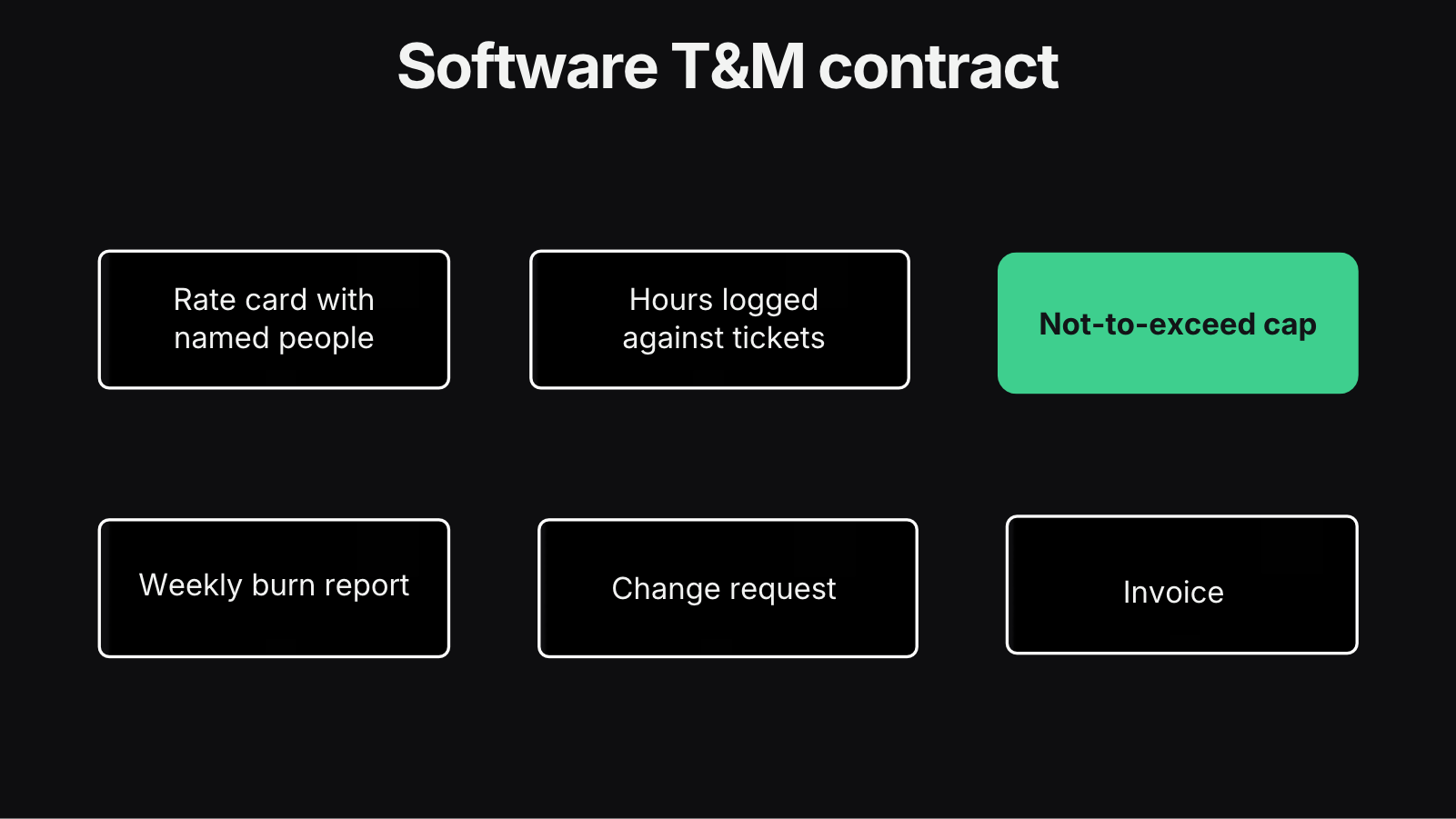
Time and materials means paying for time worked at agreed rates, plus expenses. The contract includes a rate card by role or named person, billing increments, billable activities, expenses and tools, invoicing, reporting schedules, and usually a cap.
Software work takes three forms: an hourly freelancer, an hourly agency or contractor, or a monthly rate per engineer through staff augmentation or dedicated teams. The monthly model still counts as T&M because you pay for capacity instead of a defined scope.
FAR 16.601 explains that T&M gives contractors no built-in profit incentive to control costs or work efficiency, so federal buyers must monitor performance and set a ceiling price.
This fictional T&M contract example shows what those terms look like.
Term | Example |
|---|---|
Scope | A 12-week integration with an evolving backlog. |
People | Two named engineers on the rate card. |
Rate | The hourly rate on the rate card. |
Cap | Not-to-exceed 600 hours; client and supplier review monthly. |
Billable time | Work on tickets, code review and planning. The supplier bills for the onboarding week. |
Time records | Entries tied to ticket numbers. |
Reporting | A weekly report comparing hours used with hours planned. |
Change control | Written approval for new work that changes the estimated hours or cost. |
Replacement | Either party can request a replacement; the supplier proposes a candidate for the client to interview and approve. |
IP | Assigned to the client on payment. The supplier stores the code in the client’s repository on day one. |
Exit | Written notice, then handover within the agreed written notice period. |
For other payment models, see fixed price and milestone-based billing.
The Risks a Time and Materials Contract Leaves With You
T&M offers the lowest sticker price because the supplier does not build in a premium for delivering a fixed scope. It’s an honest model for work with a changing scope. The trade-off is that you carry most of the risk, including how much useful work each billed hour produces.
Risk | Why it sits with you under T&M | What reduces it |
|---|---|---|
Budget overrun | Extra hours are billable. | A cap, an updated forecast and written approval for changes. |
Productivity | A slow hour bills the same as a fast one. | Measure work that meets your acceptance criteria every week. |
Quality and rework | You pay for hours spent fixing defects unless the contract says otherwise. | Clear acceptance criteria and code review. |
Selection | A bad hire costs you money before you notice, plus the time needed to restart. | A supplier who has already screened the person. |
Continuity | The person leaves, gets sick or takes on another client, and their knowledge goes with them. A solo contractor has a bus factor of one: the number of people who could leave before work stalls. | Documentation, code in your repository, and a supplier who can arrange a replacement and handover. |
Employment and legal | Hiring an individual directly brings responsibilities around worker classification, tax forms, local labor law and IP ownership. | A supplier that employs the engineer, plus IP terms in every contract. |
Management time | The client directs the work in every T&M arrangement. | Budget time for priorities, decisions and reviewing completed work. |
Worker classification depends on the actual working relationship, including control and independence. AI coding tools make productivity matter more because faster work saves you money under hourly billing only when the billed hours also fall.
Freelancer or Firm: Who Carries Which Risk
The staff augmentation vs freelancer decision starts with how much support you need around the person you hire. There are three ways to buy the work:
- Direct freelancer: you find, screen and contract the person yourself.
- Marketplace freelancer: platforms help you find and pay people, but screening and protection vary. As of November 2026, Upwork provides hiring tools, payment protection and dispute support, while clients review candidates and manage the work. Toptal screens candidates and offers a trial of up to two weeks. If dissatisfied, you do not pay for the trial work and can try another expert.
- Staff augmentation: a staff augmentation firm employs the engineer and places them in your team.
Day-to-day direction stays with you in all three. The contract determines how much responsibility the supplier takes.
Risk | Direct freelancer | Marketplace freelancer | Staff augmentation firm |
|---|---|---|---|
Budget overrun | You carry extra hours. | You carry extra hours within agreed limits. | You carry extra time unless capped. |
Productivity | You monitor completed work. | You monitor completed work, but platform tools help. | You monitor results; agreed senior oversight helps. |
Quality and rework | You pay unless agreed otherwise. | You pay for rework unless the contract or platform terms say otherwise. | You pay for rework unless the agreement covers it. The firm adds senior review. |
Selection | You screen and choose the freelancer. | You choose the freelancer; platform screening varies. | The firm screens the engineer; you interview and approve the placement. |
Continuity | You arrange replacement and handover. | You arrange continuity; platform replacement support depends on its terms. | Firm arranges replacement and handover as agreed. |
Employment and legal | You handle classification, tax forms and IP terms for the direct engagement. | You confirm your responsibilities under the platform’s contracting, employment and IP terms. | The firm handles employment, directly or through an employer of record; you confirm IP terms. |
Management time | You direct the work and manage the budget. | You direct the work and manage the budget. | You direct the work and manage the budget. |
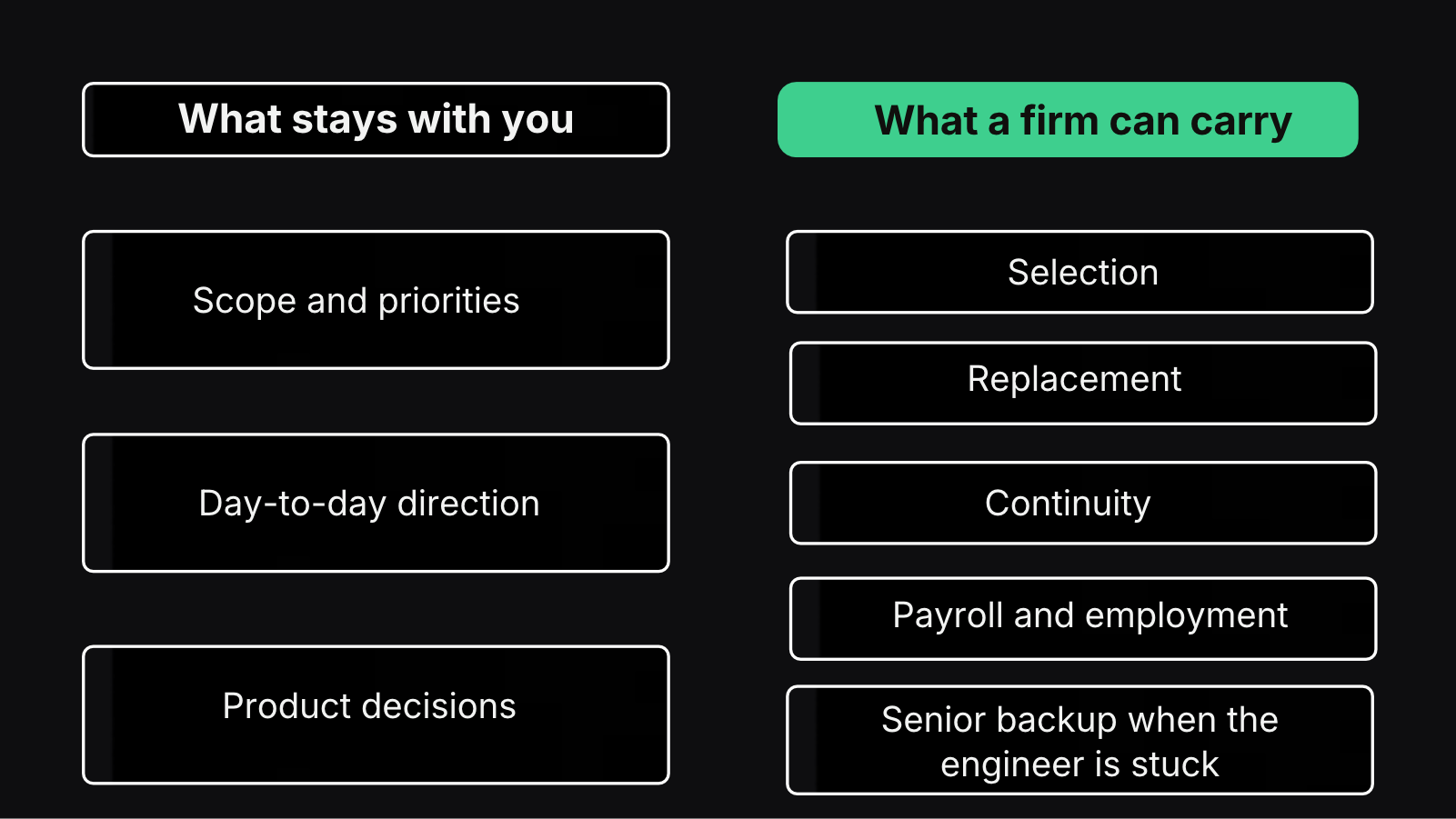
A firm’s rate pays for things the person alone cannot provide: continuity when someone leaves, oversight from a senior reviewer, help unblocking the engineer, and technical expertise beyond the person you hired. If a firm costs more, that difference is worth paying when you need those services.
Whether you choose a freelancer or staff augmentation, compare the full cost: billed time plus screening, management, rework, ramp-up and replacement. Before choosing where to find developers, decide how much you can manage internally. For broader staffing needs, compare a dedicated team vs staff augmentation.
Clauses That Make a T&M Contract Work for the Buyer
A time and materials not-to-exceed arrangement sets a spending ceiling while allowing the scope to change. The T&M not-to-exceed clause should require your written approval before work goes beyond that ceiling. A not-to-exceed contract limits your exposure, but it does not guarantee the supplier will finish the work within the cap.
A useful not-to-exceed contract also defines who does the work, what you pay for and how you leave. An NTE contract should also name the people doing the work, define billable time and explain how to end the engagement.
Clause | What to write | What it protects you from |
|---|---|---|
Not-to-exceed cap | Set overall and monthly or sprint limits. Require written approval before work beyond them. | Spending beyond your approved budget. |
Named-person rate card | Name each engineer and their rate. Require your approval for substitutions or seniority changes. | Paying the same rate for a different level of experience. |
Billable time | Define what counts, including whether onboarding, meetings and time off are billed. | Unexpected charges. |
Time records | Require ticket numbers and one-line descriptions for time entries. Alternatively, agree on a monthly rate per engineer without timesheets. | Unclear invoices and conflicting billing expectations. |
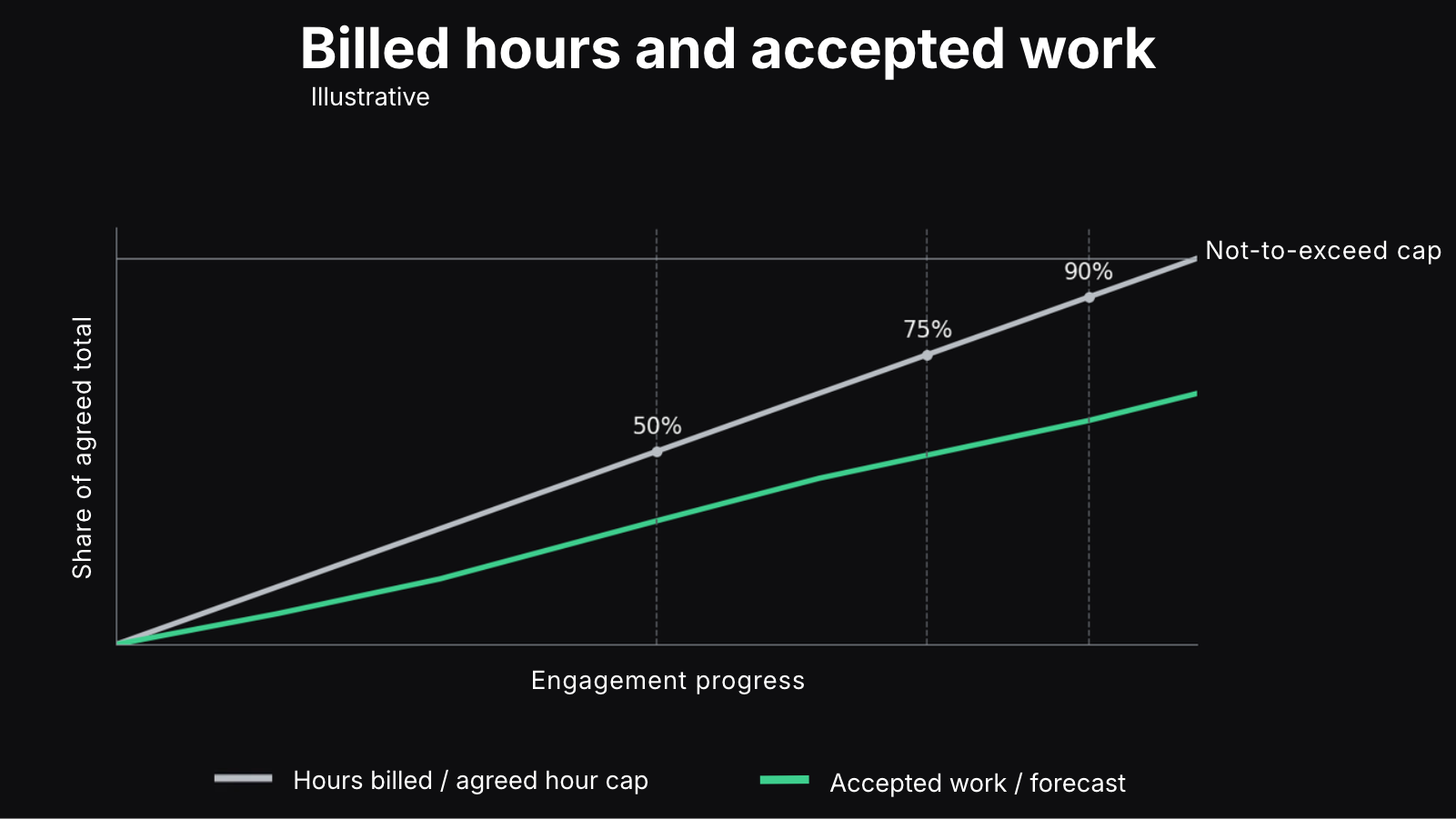
Reporting | Compare hours used with the weekly forecast. Review progress at 50, 75 and 90 percent of the cap. | Discovering too late that the budget will run out. |
Change control | Require written approval for anything that changes the forecast. | Extra work increasing cost without your agreement. |
Replacement | State who can request replacement, the process and your right to interview the replacement. | Unclear responsibilities when a placement fails. |
IP and access | Assign ownership to you on payment. Keep code in your repository and use your accounts for cloud services and tools. | Ownership disputes and dependence on supplier-controlled access. |
Conversion | If you might hire the engineer directly later, agree on buyout terms before day one. | Unexpected hiring fees or restrictions. |
Exit | Set the notice period and handover requirements, including documentation and access transfers. | Losing knowledge or access when the engagement ends. |
Measure What Each Hour Bought
An hour tells you what you paid for. Accepted work tells you what you received. Measure developer productivity by the work that meets agreed requirements each week, then compare that progress with the hours billed.
Use a weekly review to check:
- Tickets completed against acceptance criteria
- Pull requests merged after review
- Working software demonstrated by the team
- Defects found after release
- Time spent waiting for your team’s decisions
For teams with a deployment pipeline, DORA’s delivery metrics include deployment frequency, change lead time, change fail rate and failed deployment recovery time, the current measure for recovery after a failed release. These describe team delivery; do not rank individuals by lines of code or commits.
Ask how the contractor uses AI tools and who pays for them. Then check whether faster work reduces billed hours or delivers more accepted work within the agreed capacity.
Review progress when billed hours reach 50, 75 and 90 percent of the cap. If accepted work falls behind the agreed forecast at those checkpoints, stop and re-plan before authorizing more spending.
When Hiring a Freelancer Directly Is the Better Call
Hire a freelancer directly for short, simple work when you don't need a firm’s continuity, oversight, help unblocking the engineer, or expertise beyond the person you hire.
That includes a two-week task with a clear specification that someone on your team can review, a specialist you already know and trust for one narrow job, a prototype you plan to throw away, or a fixed piece of work whose result you can check yourself. In those cases, what a firm adds buys you little.
If a freelancer built your app and is no longer around, first understand what you have. A code audit helps identify what needs attention before another engineer takes over.
How Team Composition Changes Over a Long Engagement
As the work changes over a long engagement, a firm can add people or bring in different expertise. A single contractor cannot provide that range.
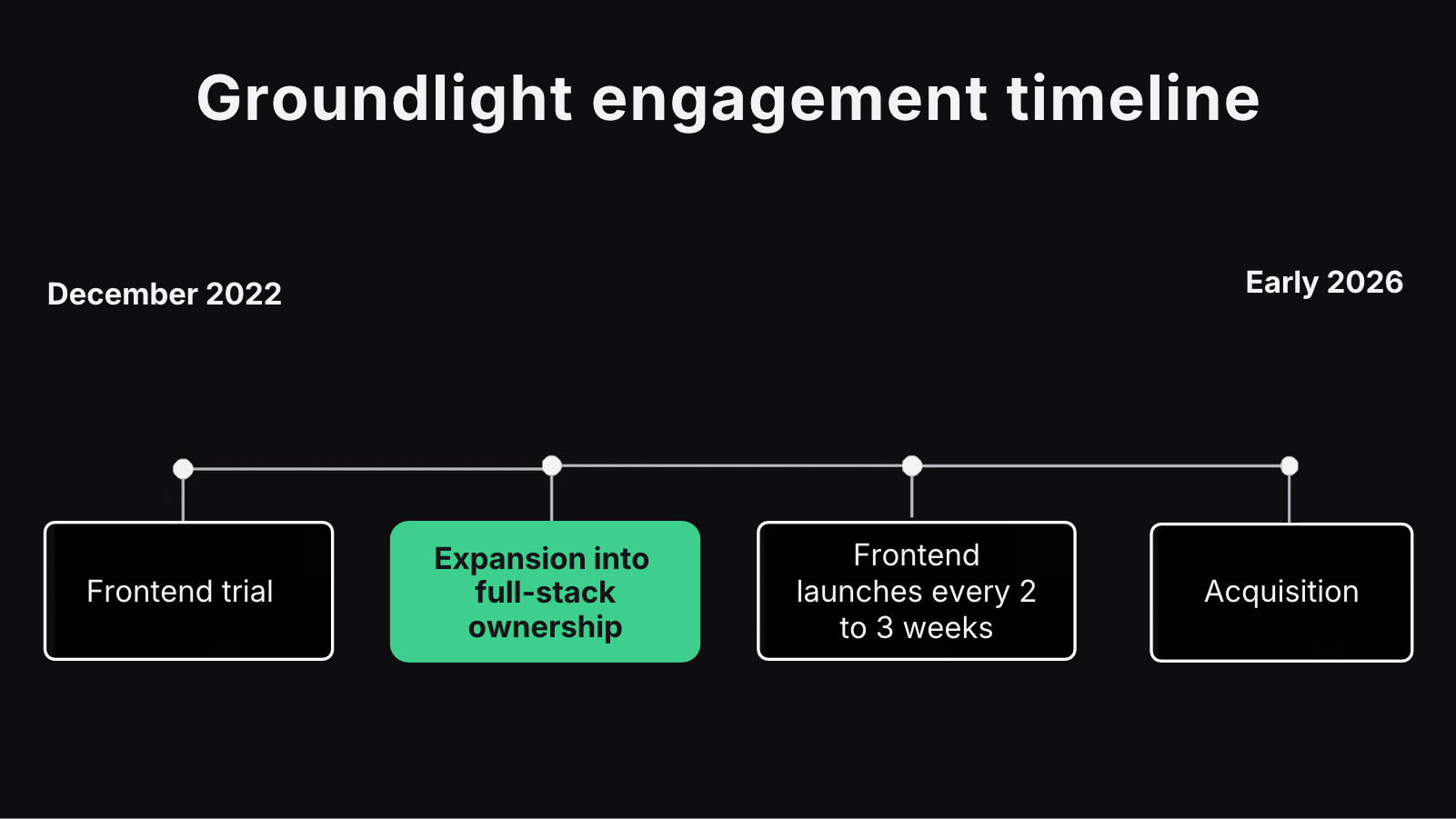
Groundlight, a computer vision SaaS for industrial safety, retained Leanware monthly from December 2022 until its acquisition in early 2026. What began as a frontend trial grew into full-stack ownership of several parts of the product, with frontend launches every 2 to 3 weeks. The point of contact rotated between engineers depending on what was shipping. As code quality held, the team worked more independently.
For Plannerd, an early-stage wedding planning SaaS, Leanware supplied engineering, product design and product ownership. The founder had a product team covering roles a single contractor could not. Headcount increased when the product needed higher throughput. When the architectural work was laid out, the team shifted toward more product-minded engineers.
How Leanware Structures Hourly-Shaped Work
Leanware prices staff augmentation per engineer per month, from about $6,000 a month for one full-time engineer. That approximate starting point varies by role and stack. Time tracking is not part of the engagement, time off is not billed, and the Claude Team subscription the engineer uses is covered.
Each senior engineer clears a technical assessment, several interview rounds and a final interview with Leanware’s C-level before the client interviews them. Nobody starts without that client interview. When a placement isn't working, Leanware flags the problem early and replaces the engineer through the same process, including the client interview. The client does not carry the cost of a bad placement. Replacement and conversion terms are set in the agreement before day one.
A dedicated development team is staffed in 2 to 4 weeks, with a senior partner who owns replacement and team composition.
You still direct the work and carry the scope, as in any T&M arrangement. When the scope can be defined, milestone-based billing moves more of that risk to the supplier.
Final Thoughts
A T&M contract fits work with a scope that can change, but getting value requires a cap on hours and a clear measure of accepted work. Your choice of supplier determines who carries selection, continuity and replacement responsibilities. Hire a freelancer for short, simple work and use a firm when you need continuity, oversight and backup. Tell us about the work and the support you need to discuss which arrangement fits.
Frequently Asked Questions
What is a time and materials contract?
A time and materials contract pays for hours worked at agreed rates, plus expenses, and suits software work where scope may change. In software, T&M engagement takes three forms: an hourly freelancer, an hourly agency or contractor, or a monthly rate per engineer through staff augmentation or a dedicated team.
What are the advantages and disadvantages of a time and materials contract?
A T&M contract offers flexibility, a fast start, and potentially the lowest sticker price because the supplier doesn't price in fixed-scope risk. The client carries most overrun, productivity and continuity risks and must spend time directing the work. Clear caps and weekly reviews help manage those risks.
What is a not-to-exceed clause in a T&M contract?
A not-to-exceed clause caps billable hours or spending and requires the client’s written approval before the supplier goes beyond that limit. It limits the client’s financial exposure but does not guarantee completion within the cap. Review progress before the limit is reached so you can adjust the scope or budget.
Who carries the risk in a time and materials contract?
The client carries most of the risk in a T&M contract, including budget overruns and productivity. A supplier that employs the engineer can take responsibility for selection, payroll, employment, replacement and continuity under the agreed terms. Scope, priorities, product decisions and day-to-day direction stay with the client.
Is it cheaper to hire a freelance developer or use staff augmentation?
A freelance developer often charges a lower hourly rate than a staff augmentation firm, but not always. Compare the total cost, including screening, management, rework, ramp-up and replacement. A freelancer is a good fit for short, simple work you can review yourself without ongoing support from a firm.
How do you measure a contractor's productivity on an hourly contract?
Measure a contractor’s productivity by the work that meets agreed acceptance criteria each week. Review completed tickets, reviewed code, working demos and defects after release. Compare that progress with billed hours against the cap, and stop to re-plan if spending outpaces the agreed delivery forecast.
When should you use a time and materials contract?
Use a T&M contract when the scope will change, or you are still discovering what the software needs to do; when you can define the scope and acceptance criteria clearly, a fixed fee or milestone-based billing is a better fit.


