Dedicated Team vs Staff Augmentation: Choosing a Software Outsourcing Model
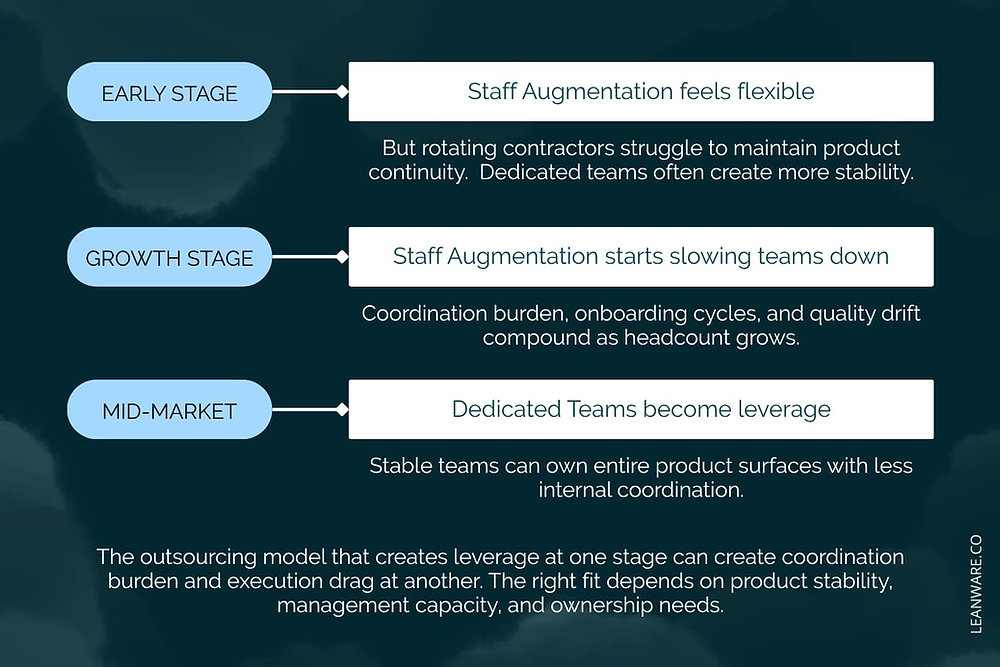
Most companies choose between staff augmentation and dedicated teams based on cost, flexibility, or speed to hire. But the model usually succeeds or fails based on something else entirely: the company’s stage.
What works for a 10 person startup can become a coordination burden at 50 engineers. A structure that creates leverage for a Series B company can become expensive overhead when the roadmap changes every few weeks.
The deciding factors are usually product stability, internal management bandwidth, and how much execution ownership the company is ready to hand off.
The Model Choice That Breaks Teams at the Wrong Stage
Staff augmentation and dedicated teams both work. The failure is in the match between model and conditions, and two failure modes recur with predictable consistency.
Companies adopt staff augmentation to increase development capacity, but each contractor adds coordination burden. Internal tech leads spend more time assigning work, transferring context, and reviewing code than building features themselves. At three or four augmented engineers, velocity often drops even as headcount increases.
Companies also adopt dedicated teams before they have enough product clarity to support one. The roadmap shifts every few weeks, priorities change mid sprint, and the team loses momentum because no product surface stays stable long enough to own properly. The engagement becomes expensive exploration instead of execution leverage.
Neither outcome reflects a bad outsourcing model. Both reflect a mismatch between the model and the company’s stage.
How Each Model Performs at Every Stage of Company Growth
Different company stages create different operational pressures, and each model responds differently to them. Three stages cover most situations where companies make this decision.
Early Stage Startups: When Staff Augmentation Feels Right but Dedicated Teams Win
Early teams gravitate toward staff augmentation because it feels lower commitment. Hire one or two contractors, point them at tasks, scale up or down as needed. The logic is sound for bounded, well defined work. It breaks when the engagement requires what early product development actually demands: architectural continuity across sprints, embedded ownership of a codebase that changes daily, and engineering coherence that a rotating set of contributors cannot maintain.
A dedicated team at this stage provides stable capacity that builds institutional knowledge over time. The same engineers working on the product for months develop context that directly improves decision quality on architecture, technical debt, and feature prioritization. Early stage products change fast, and a team with accumulated context adapts faster than a new contractor who needs two weeks to understand the codebase before contributing.
The Exception: When Staff Augmentation Does Work at an Early Stage
Staff augmentation works at an early stage under two specific conditions: the scope is bounded and well defined (a mobile app frontend, a specific integration, a defined feature with clear acceptance criteria), and the company has a strong internal technical lead who can direct contractors daily, review their output, and maintain architectural coherence across contributions.
Both conditions must be true. A bounded scope with no technical lead produces unsupervised code. A strong technical lead with an unbounded scope produces a coordination burden that consumes the lead's capacity. If either condition is missing, the exception does not apply.
Growth Stage Companies: Where Staff Augmentation Starts to Break
Growth stage companies (Series A, scaling from 10 to 50 engineers) often run staff augmentation engagements that started at an earlier stage. Three failure patterns emerge as the company scales.
Integration overhead. Internal leads spend an increasing share of their time coordinating augmented engineers: assigning tasks, reviewing code, explaining context, resolving conflicts. At four to five augmented engineers per internal lead, the coordination cost exceeds the capacity gained. The internal team moves slower despite having more people.
Knowledge fragmentation. Contractor transitions produce recurring onboarding costs. Each new contractor needs two to four weeks to reach productive velocity on the codebase. If two contractors rotate in a six month period, the company loses a month of productive capacity to onboarding alone. Multiply that across several augmented positions, and the velocity loss is substantial.
Quality drift. The engagement starts strong because the vendor placed their best available engineers. Over time, turnover happens, and replacements arrive without meaningful buyer involvement in the selection process. The replacement may be technically competent but unfamiliar with the domain, the codebase, or the team's working patterns. Quality drifts over 12 to 18 months, and the company recognizes it only after six to nine months of declining output.
The Slow Degrade Pattern: What It Looks Like From the Inside
The slow degrade pattern deserves specific attention because it is the most common and least visible staff augmentation failure at growth stage. The engagement starts well. The first engineers are carefully selected, onboarded thoroughly, and produce strong output. Six months in, one leaves. The vendor places a replacement within two weeks. The replacement is competent but takes a month to reach the previous engineer's productivity. Three months later, another transition happens. The same cycle repeats.
Over 12 to 18 months, the average quality of the augmented team drifts downward. Each replacement starts at a lower baseline because the onboarding gets less thorough as the internal team loses patience with the cycle. The codebase accumulates inconsistencies from engineers who contributed for only a few months before leaving. The vendor's selection standards relax because the best engineers are placed on newer, more competitive engagements.
This is a sourcing economics problem, not a personnel problem. The vendor's incentive structure rewards placing engineers quickly, not placing engineers who will stay for two years. Recognizing this pattern is structural, not personal, changes how companies evaluate whether staff augmentation still serves them at scale.
Mid Market Companies: The Dedicated Model as a Strategic Lever
Series B and beyond, mid market companies use dedicated teams to spin up parallel product streams with structural accountability. The advantage at this stage is that a well-structured dedicated team can own an entire product surface without continuous internal direction. The internal counterpart sets the roadmap and evaluates output. The dedicated team owns execution: sprint planning, architecture decisions within the defined surface, quality assurance, and delivery.
The accountability structure changes the relationship. A dedicated team partner commits to a selection standard (engineers are interviewed and approved by the client), a replacement mechanism (turnover is the partner's problem to solve within a defined SLA), and delivery management (the partner provides a technical lead or delivery manager who coordinates internally so the client's team does not carry that overhead).
Cost, Control, and Commitment: The Three Factors That Actually Decide the Model
Most buyers optimize on cost alone. The hourly rate comparison from month one tells a different story by month twelve when transitions, knowledge loss, and coordination overhead are factored in.
The Hidden Costs of Staff Augmentation That Scale With Headcount
Three costs compound as augmented headcount grows.
- Onboarding tax: each new or replacement contractor requires two to four weeks of reduced productivity and internal team attention.
- Coordination overhead: internal leads spend an increasing percentage of their time directing, reviewing, and context switching for augmented engineers.
- Output velocity loss: every contractor transition resets velocity on the affected workstream.
The hourly rate for a staff augmentation contractor looks favorable in month one. By month twelve, after two transitions, the accumulated onboarding cost, the lost velocity during ramp up periods, and the coordination burden on internal leads make the effective cost per productive hour significantly higher than the contracted rate.
What "Control" Actually Means in Each Model
Staff augmentation gives granular, day to day control over individual contributors. The buyer assigns tasks, reviews code, directs priorities, and manages the engineer's daily workflow. This control model demands constant internal management capacity to exercise. If the internal team does not have the bandwidth to direct contractors daily, the control is theoretical rather than operational.
A dedicated team provides structural control. The buyer owns the roadmap, sets priorities, and evaluates output. The partner owns execution: how the work gets done, how tasks are distributed, how quality is maintained within sprints. This control model requires less daily management capacity from the buyer but demands clarity on what the team should accomplish rather than how each person should spend each hour.
Match the control type to internal maturity. Teams with strong, available technical leads who want hands on direction over individual engineers fit staff augmentation. Teams that want to delegate execution and focus their internal capacity on product direction fit the dedicated model.
What Commitment Looks Like on Both Sides
Staff augmentation appears low commitment: month to month contracts, flexible headcount, no long term obligation. In practice, the coordination investment is high. The buyer trains each contractor, integrates them into workflows, and carries the cost every time a transition occurs. The low contractual commitment masks a high operational commitment.
A dedicated team requires a directional six month minimum and a roadmap that keeps three or more engineers usefully occupied. The contractual commitment is higher. The operational burden on the buyer is lower because the partner manages execution, coordination, and team stability.
Both models fail when the buyer underestimates what their side of the engagement demands. Staff augmentation fails when the buyer assumes contractors are self directing. Dedicated teams fail when the buyer assumes the partner can operate without a clear roadmap and a technical counterpart who evaluates output.
What a Well Structured Dedicated Team Actually Looks Like
A dedicated team that functions as a genuine extension of the company, rather than a staffing arrangement with a different billing structure, requires four structural elements.
Engineer selection standards. The partner sources candidates, but the buyer interviews and approves every engineer before they join the team. The buyer evaluates technical depth, domain fit, and communication quality. No engineer is placed without buyer approval.
AI fluency baseline. Engineers on the team should be productive with AI assisted development workflows: code generation, automated testing, AI powered code review. This baseline affects velocity directly and should be part of the selection criteria.
Replacement mechanism. Turnover happens. The engagement contract defines the partner's obligation: replacement within a defined SLA (typically two to three weeks), the replacement meets the same selection standard, and the partner absorbs the transition cost rather than passing it to the buyer.
Delivery management. A technical lead or delivery manager on the partner's side coordinates sprint planning, task distribution, and internal quality checks. The buyer's technical counterpart reviews output and sets priorities. The buyer does not manage individual engineers day to day.
A Decision Framework for Choosing the Right Outsourcing Model
Three internal capacity signals reveal the structural conditions that drive model fit.
Does the team have a technical lead who can direct contractors daily? If yes, and the scope is bounded, staff augmentation can work. If the technical lead is already at capacity managing internal engineers, adding contractors increases their burden without increasing their bandwidth.
Is the product scope stable enough for a rotating set of contributors? If the codebase changes significantly every sprint, new contributors cannot get productive before the context shifts again. Stable, well documented codebases absorb contractor transitions better than rapidly evolving ones.
Is the engagement horizon under six months or longer? Short engagements with defined deliverables favor staff augmentation because the coordination cost is bounded. Longer engagements favor dedicated teams because the team accumulates context that directly improves output quality over time.
Signs Your Company Has Outgrown Staff Augmentation
Four signals indicate the model is no longer producing the value it once did.
- Tech leads spend most of their time managing contractors rather than building.
- Product velocity declines even as headcount increases.
- Contractor turnover creates recurring knowledge loss and visible rework.
- Engineering coherence erodes as different contractors make conflicting architectural decisions.
Each signal traces back to a structural issue, not a personnel failure. If these patterns persist across multiple contractors and engagement cycles, the problem is usually the model, not the individuals.
Signs You Are Ready for a Dedicated Team
A dedicated team usually works best when:
- The product scope is stable enough to support six months or more of continuous execution.
- There is a technical counterpart on the client side who can evaluate output and set direction.
- The roadmap can keep three or more engineers consistently occupied.
- The company wants to delegate execution rather than manage individual contributors day to day.
When these conditions are present, a dedicated team converts internal management capacity into engineering output more efficiently than staff augmentation.
How Nearshore Context Changes the Model Calculus
Nearshore software development outsourcing benefits from timezone overlap and cultural alignment that offshore models cannot match. Shared working hours enable real time collaboration: standups, code reviews, pair programming, and rapid iteration all happen synchronously. Cultural compatibility reduces the communication friction that slows distributed teams.
These advantages apply to both models, but they compound differently. In staff augmentation, timezone and cultural alignment make each individual contractor more effective. When that contractor rotates out, the advantage resets. The next contractor starts the relationship from scratch, and the collaboration efficiency rebuilds over weeks.
Why Continuity Multiplies the Value of Nearshore Collaboration
A nearshore dedicated team accumulates shared context that staff augmentation structurally cannot preserve. The same engineers, working in overlapping hours, building the same product over months, develop the communication patterns, codebase familiarity, and domain knowledge that make nearshore collaboration genuinely productive. Contractor churn resets that advantage repeatedly. The dedicated model preserves it.
Final Thoughts
The right outsourcing model depends on management capacity, product stability, time horizon, and company stage. Hourly cost is the least reliable indicator of which model will produce better outcomes over a 12 to 18 month period.
If your tech leads are spending more time coordinating contractors than building, if contractor transitions are producing visible velocity loss, or if engineering coherence is eroding across the codebase, the staff augmentation model has stopped being efficient. The dedicated model is worth evaluating.
If neither model fits yet because the product scope is not stable enough to direct a team and the internal capacity to manage contractors is not available, the honest answer may be to invest in internal clarity before engaging any external model.
Connect with us today to evaluate whether a dedicated team or staff augmentation better fits your current stage, roadmap, and engineering capacity.
Frequently Asked Questions
What is the main risk of software development outsourcing through staff augmentation?
The primary risk is coordination overhead that compounds with headcount. Each augmented engineer requires daily direction, code review, and context transfer from the internal team. At four to five contractors, the internal tech lead's capacity is consumed by management rather than building. The hourly rate looks favorable, but the effective cost per productive hour rises significantly over 12 months when transitions and knowledge loss are factored in.
How do I know when to outsource a dedicated software development team instead of adding contractors?
Four conditions signal readiness: the product scope is stable enough to direct a team for six months, a technical counterpart on your side can evaluate output, the roadmap supports three or more engineers working continuously, and you want to delegate execution rather than manage individual tasks. If all four are present, the dedicated model converts management capacity into engineering output more efficiently.
How long should a dedicated team engagement last to produce value?
A directional minimum of six months. The first month covers onboarding and team calibration. Months two and three produce accelerating output as the team builds codebase knowledge and domain context. By month four, the team operates with significantly less internal direction than month one. Engagements shorter than six months rarely justify the onboarding investment for either side.
What happens if an engineer on a dedicated team leaves?
In a well-structured engagement, the partner owns the replacement process. The contract defines an SLA (typically two to three weeks), the replacement meets the same selection standard the buyer originally approved, and the partner absorbs the transition cost. The buyer is involved in approving the replacement but does not carry the sourcing or onboarding burden.
Why not just hire full time engineers instead of outsourcing software development?
Hiring is the right long-term answer for core product engineering. The timeline is the problem. Recruiting a senior engineer in the US takes three to six months from job posting to productive contribution. A nearshore dedicated team reaches productive velocity in four to six weeks. For companies that need capacity now while hiring catches up, or for product surfaces that do not justify permanent headcount, the dedicated model delivers faster time-to-value at lower total commitment.