What Is Context Engineering? A Guide to AI Context Windows
If you have shipped something with an LLM and watched it behave unreliably in production, the most common explanation is not the model. It is what the model received. The model saw the wrong documents, or too many irrelevant ones, or a conversation history that had grown past the point where attention mechanisms can track it reliably.
So, the fix people reach for is prompt iteration which changes the instruction layer. The fix that actually works is context engineering, which changes the information pipeline.
Context engineering is the discipline of deciding what goes into an LLM's context window, in what form, at what time, and through which retrieval and compression mechanisms. Teams that formalize it eliminate an entire class of production failures that prompt tuning alone cannot address.
If you're already building with LLMs, this article will give you a precise understanding of context engineering, the core patterns behind it, and how it fits into the broader AI product stack.
Why Most LLM Applications Break Before the Model Does
About 95% of enterprise generative AI pilots fail to deliver measurable P&L impact, according to "The GenAI Divide: State of AI in Business 2025" by Challapally, Pease, Raskar, and Chari at MIT Project NANDA, based on a review of more than 300 public AI initiatives, 52 structured interviews, and 153 survey responses from enterprise leaders.
The gap between a prototype that works in a demo and a system that holds up under production load is, in most cases, an information problem. The model receives incomplete data, irrelevant context, or more tokens than it can attend to effectively. It produces outputs that are technically plausible but operationally wrong. The team iterates on the prompt.
The prompt gets longer. Behavior improves marginally, then regresses when traffic patterns change. This is not a prompting problem. It is a context engineering problem, and most teams do not have the discipline in place to address it.
The Production Context Gap
Every LLM inference call is stateless. The model has no memory of previous requests and no inherent awareness of your system's state, your user's history, or the document processed three steps earlier in the workflow. Everything the model needs to produce a reliable output must be present in the current context window, and that window is a hard constraint measured in tokens.
Current frontier models advertise large windows. GPT-5.4 and Claude Opus 4.6 both support 1 million tokens; Gemini 3.1 Pro offers 2 million. Those are technical ceilings, not operating budgets.
Long-context benchmarks like RULER (2024) and HELMET (2024) found that most models' effective context length, the range where accuracy holds on realistic multi-document tasks, falls well short of the advertised window.
A realistic production payload makes this easier to see. A 10,000-word conversation thread is roughly 13,000 tokens of clean English text. Add structured JSON from tool calls, API responses, timestamps, and metadata, and that thread can occupy two to three times as many tokens.
A RAG system retrieving five document chunks at 500 tokens each, combined with a system prompt, conversation history, and tool definitions, can consume 20,000 to 30,000 tokens per request before the model generates any output. The composition of that context is the result of design decisions about what information to include, retrieve, and preserve.
From Prompt Engineering to Context Engineering: What Changed
Prompt engineering involves designing the instructions a model receives: the wording of the task, the formatting of examples, and the placement of constraints. It remains an important part of building LLM applications, but it primarily shapes the instruction layer rather than the information the model has available.
Context engineering focuses on the upstream decisions: what information enters the context window, in what form, at what time, and through which retrieval and compression mechanisms. The two disciplines complement each other rather than compete. As LLM applications become more complex, context engineering addresses challenges that prompt iteration alone often cannot solve. A deeper comparison of the two is worth its own treatment.
Context Engineering Defined: What It Actually Means for AI Product Teams
Context engineering is the discipline of designing what information goes into an LLM's context window, in what form, at what time, and through which retrieval and compression mechanisms.
It is often confused with several related concepts, but each serves a different purpose. Prompt engineering designs the instruction text inside the context. Fine-tuning adjusts the model's weights using training examples. RAG architecture manages how relevant information is retrieved. Context engineering sits above all three by determining what the model sees in the first place.
Many AI product teams spend more time on prompt iteration because it is easier to test and produces immediate feedback. Context engineering typically involves changes to retrieval pipelines, memory systems, and data flow, making it a broader architectural concern.
The Components of a Context Engineering System
A context engineering system has five functional components.
Context window management is the runtime accounting system that tracks how many tokens each part of the payload consumes and enforces priority rules when the budget is tight.
Retrieval systems fetch relevant information at inference time: vector databases, keyword indexes, structured database queries, or combinations. Leanware's work on RAG architecture and AI agent development covers the retrieval layer in more detail.
Ranking and relevance scoring determines which retrieved chunks are included in the context and in what order, which is what separates a well-engineered RAG system from one that stuffs chunks in without prioritization.
Compression and summarization reduces the token cost of historical information while preserving what the model needs for the current task.
Execution state tracking carries task state across multi-step agent workflows, storing intermediate outputs, tool results, and decision history in a form the model can use at the next step.
What Context Engineers Actually Design
Context engineering requires teams to balance latency, cost, retrieval quality, and token budget. Consider one example: storing raw conversation history versus using summarized history.
The detail that changes the math: conversation history is resent to the model on every turn, not once per session. A support assistant handling 1,000 sessions per week, averaging 40 turns per session with history growing to around 16,000 tokens by session end, processes roughly 8,000 tokens of history on the average turn. That is 320,000 input tokens per session and around 320 million per week for history alone.
At Claude Sonnet 4.6's input price of $3 per million tokens, that is roughly $960 per week, or about $50,000 per year, before the system includes retrieved documents, system prompts, or tool context. Compressing older turns into an 800-token summary while keeping the last few turns at full fidelity brings the average per-turn history to around 3,000 tokens, cutting the history cost by roughly 60%, about $30,000 per year in this example. That saving justifies building and maintaining a summarization pipeline. At lower volumes or shorter sessions it may not, which is exactly the kind of tradeoff context engineering makes explicit instead of discovering on the invoice.
Teams also decide where different types of memory should live (in-context, an external vector store, or a structured database), how to rank retrieved chunks with similar relevance scores, when to compress long conversation histories, and how to structure system prompts as dynamic components instead of static text reused across every request.
The Context Window as an Engineering Constraint and Design Surface
The better way to think about the context window is not as a limitation to work around, but as one of the primary design surfaces of an LLM application. Because the context window has a finite token budget, teams must decide what information to include, retrieve, summarize, or discard. Those decisions shape application behavior, latency, and cost.
Peer-reviewed research also shows that where information sits inside the window changes how reliably models use it. Liu et al.'s "Lost in the Middle: How Language Models Use Long Contexts" (TACL 2024) measured multi-document question answering accuracy as the relevant document moved through the input and found a U-shaped curve: models perform best when the key information appears at the beginning or end of the context and degrade significantly when it sits in the middle. The size of the effect varies across models, but the implication for context assembly is direct. Where teams place retrieved documents, conversation history, and system instructions is an engineering decision with measurable consequences, not an afterthought.
VELC-Bench (2026): Verification accuracy by information position within the context window. Source: AIMultiple.
Model | Beginning | Middle | End |
GPT-5.5 | 85.3% | 96.9% | 82.2% |
Gemini 3.1 Pro | 85.3% | 78.3% | 76.3% |
Gemini 3.5 Flash | 76.5% | 75.4% | 64.0% |
Claude Sonnet 4.6 | 76.5% | 75.6% | 76.3% |
Qwen 3.6 Plus | 85.3% | 21.3% | 69.7% |
Kimi K2.6 | 79.4% | 78.3% | 75.9% |
GLM 5.1 | 79.4% | 78.3% | 76.1% |
MiniMax M2.7 | 80.9% | 78.2% | 73.2% |
GPT-5.4 Mini | 82.4% | 75.0% | 76.5% |
Token Budget Allocation and Priority Queues
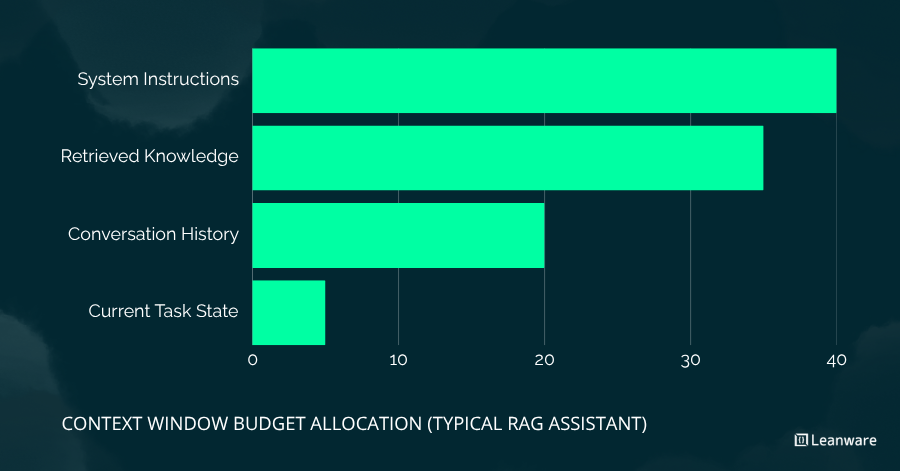
LLM applications often allocate the available context window across several components instead of filling it on a first-come, first-served basis. Common components include system instructions, retrieved documents, conversation history, and the current task state. The exact allocation depends on the application's architecture and priorities.
Example token budget allocation for a multi-turn assistant with retrieval. Illustrative only.
Context Component | Example Allocation | Purpose |
System instructions | ~40% | Behavioral rules, constraints, and application logic |
Retrieved knowledge | ~35% | RAG chunks selected for the current request |
Conversation history | ~20% | Recent or summarized interactions |
Current task state | ~5% | Tool outputs and intermediate results |
These proportions are examples rather than recommended defaults. A customer support assistant that relies on a large documentation base may allocate more of the context window to retrieved knowledge. A coding assistant with extended conversations may reserve more space for conversation history. The important consideration is deciding how the available context is allocated before constructing the final prompt.
Some applications also adjust these allocations at runtime. For example, they may reserve more space for retrieved documents for knowledge-intensive queries or expand conversation history for follow-up discussions. This dynamic allocation provides additional flexibility, but it also requires more routing logic and context management than using the same allocation for every request.
Sliding Windows, Hierarchical Prompts, and Context Continuity
Three main patterns address long conversations where raw history exceeds the token budget.
Sliding windows retain the most recent N tokens and discard the rest. Simple to implement, no latency overhead, and compatible with any LLM. The cost is permanent loss of early context. If a user set a constraint in the first message and that message is now outside the window, the model cannot access it.
Hierarchical summarization compresses older conversation segments into summaries while keeping recent turns in full. This preserves meaning at the cost of summarization latency and a compounding risk: a hallucination in a summary propagates through every subsequent turn in that session.
Session-level memory stores persist structured information from previous conversations in an external database and inject it into fresh contexts on demand. This works well for long-running user relationships where preferences and prior decisions need to persist across sessions. It requires a schema for what gets stored and a retrieval strategy for what gets injected.
Core Context Engineering Patterns in Production AI Products
Retrieval Augmented Context Injection
In a RAG pipeline, a query retrieves relevant chunks from an external knowledge store at inference time. Those chunks are ranked, deduplicated, and injected into the context window alongside the system prompt and conversation history.
The engineering decisions that determine whether RAG holds up in production:
Query formulation converts user input into an effective retrieval query. For multi-turn conversations, the query must incorporate conversation history, not just the current message. Bad query formulation retrieves irrelevant chunks even from a high-quality knowledge base.
Semantic retrieval uses vector embeddings to find chunks with similar meaning rather than keyword matches. Embedding model quality and indexing strategy determine what the retrieval system can find.
Chunk ranking scores retrieved results by relevance and selects the top N that fit the token budget. Skipping ranking means taking the first N chunks regardless of quality.
Deduplication removes semantically similar chunks. A naive RAG system retrieves five chunks, three of which contain essentially the same passage from the same document, wasting token budget without adding information.
Persona and Role Injection as Structured Context
Multi-user AI products require different behavioral constraints for different users or context types. The naive implementation embeds role text as free-form strings in the system prompt, written differently each time a new use case is added. As the number of roles grows, behavior becomes inconsistent and testing becomes difficult.
The structured alternative treats persona and role definitions as versioned context blocks injected into the system prompt from a configuration layer. When the role changes, the context block changes. The prompt template stays constant. This makes behavior testable: you can run regression tests against specific role configurations and attribute behavior changes to specific version bumps rather than to prompt drift.
Context Compression: Summarization and Selective Retention
Long-running sessions accumulate history faster than the token budget can accommodate. The three main strategies:
Extractive summarization selects the most important sentences from conversation history and discards the rest. Fast and low-cost; loses context that does not surface in individual sentences.
Abstractive summarization generates a compressed representation using a secondary model call. Preserves semantic meaning more reliably at the cost of an additional inference call per compression event.
Importance-weighted retention scores each turn by relevance to the current query, retaining the highest-scoring turns at full fidelity and compressing or discarding the rest. More accurate than either pure approach; requires a relevance scoring step before context assembly.
Tiered memory combines approaches: working memory holds the last N turns at full fidelity, a compressed summary covers prior turns, and a long-term memory store holds facts and preferences that persist across sessions.
How Context Engineering Changes the AI Product Development Lifecycle
Context as a Testable Artifact
When context is explicitly designed, version-controlled, and logged, AI product behavior becomes testable in a way that prompt iteration alone cannot achieve. You can run a specific context configuration against a test suite, confirm expected behavior, and catch regressions before production. When behavior changes after a deployment, you compare context configurations and attribute the change to a specific difference, rather than trying to determine whether the model changed, the prompt changed, or something upstream changed.
Most teams are logging model outputs and debugging backward from what the model said to why the model said it.
Debugging and Observability in Context-Engineered Systems
A production-grade AI product can be debugged. A prototype-level integration cannot. The observability primitives that context engineering enables: full context payload logging at inference time (not just inputs and outputs, but the complete assembled context), retrieval decision tracing (which chunks were retrieved, what their relevance scores were, which were included and which were dropped), and token budget utilization monitoring across request types.
A well-engineered system shows consistent budget utilization within designed parameters: system instructions at 38-42% of tokens used, retrieved knowledge at 33-37%, history at 18-22%. When history climbs to 40% or retrieved knowledge collapses to 10%, the budget management logic is not enforcing the designed allocation. That signal is specific and actionable. A system without this observability surfaces a degraded accuracy metric and gives you nothing else to work with.
Context Engineering Across Teams: Who Owns It
No standard role title covers context engineering yet, and that is exactly why it goes unowned in many organizations. The position worth stating plainly: context engineering needs one explicit owner with a cross-functional mandate. Distributing it across teams and hoping it gets covered is how it fails.
The role requires three competencies that rarely sit in one function: ML knowledge to evaluate retrieval quality, backend engineering depth to build retrieval and memory infrastructure, and product context to know what information matters for the tasks the system solves. Assign it to a pure ML engineer and you get strong model evaluation on top of a weak retrieval pipeline. Assign it to a backend engineer and you get reliable infrastructure that retrieves the wrong information. Assign it to a product manager and you get well-defined user requirements that nobody translates into context design decisions. Distributed ownership produces all three failure modes at once, because each function optimizes its own layer and no one is accountable for what the model actually sees.
The fix does not require a new job title. It requires naming one person who owns the pipeline end to end (how information is retrieved, filtered, compressed, and assembled before it reaches the model) and giving them the authority to make the tradeoffs between retrieval quality, latency, token budget, and user experience. Whether that person sits in ML, backend, or product matters less than the fact that the mandate is explicit.
Context Engineering and the Stack: Tools, Frameworks, and Infrastructure
Orchestration Layer: LangChain, LlamaIndex, and Custom Pipelines
Orchestration frameworks abstract the wiring between retrieval systems, context assembly, model calls, and output handling. LangChain provides a component library for chains, agents, memory management, and retrieval integration. LlamaIndex focuses on the data layer: ingestion pipelines, index construction, and query routing for RAG systems. Both accelerate early-stage development significantly.
Both also add a maintenance surface that grows as requirements diverge from what the framework was designed for. Custom pipelines give full control over context assembly logic at the cost of building what the framework would have provided. Custom pipelines are the right choice when the context logic is novel enough that the framework's abstractions do not map onto it cleanly, or when retrieval latency requirements are tight enough that framework overhead matters. Frameworks are right when the use case fits the standard RAG or agent patterns and development velocity is the primary constraint.
Vector Stores and Memory Architecture
Vector databases are the long-term memory layer in a context engineering system. They store embedding representations of documents, conversation segments, or structured facts, and retrieve the most semantically similar entries in response to a query embedding.
Embedding strategy determines retrieval accuracy. OpenAI's text-embedding-3-large, Cohere's embed-v3, and open-source models like BGE-large differ in accuracy, cost, and latency.
Indexing involves tradeoffs between approximate nearest neighbor indexes (HNSW, IVF), which trade accuracy for speed, and exact search, which is more accurate and slower. The right choice depends on corpus size and latency requirements.
Retrieval latency varies by deployment model. Pinecone reports that many customers see sub-100ms latencies in production, including network overhead. Self-hosted alternatives like Weaviate can reach comparable latency depending on hardware and tuning Chroma is fast for development and smaller deployments but lacks the operational features of managed services for high-throughput production use.
Evaluation Infrastructure for Context Quality
Most teams evaluate model output. Fewer evaluate context quality. These are different things, and teams that evaluate both catch a class of failure that the others debug in production.
Context quality evaluation asks: given a query, did the retrieval system return the right information? Output quality evaluation asks: given what the model received, did it respond correctly? A model can produce a plausible output from irrelevant context, pass an output quality check, and still be wrong for the actual query. That failure only surfaces in context quality evaluation.
RAGAS provides context recall, context precision, and faithfulness metrics as CI/CD-integrated checks. Context recall measures whether the correct information was retrieved. Context precision measures whether the retrieved information was relevant. Faithfulness measures whether the model output is grounded in the retrieved context. TruLens provides similar metrics with a different interface and monitoring dashboard. Running these checks in CI means a PR that degrades retrieval quality fails the pipeline before it ships.
Signs Your Context Management Approach Needs to Evolve
As LLM applications grow, the original context management approach may no longer work as well. Common signs include:
Retrieval returns irrelevant chunks for queries that previously produced reliable results, suggesting the retrieval strategy has not kept pace with changes to the knowledge base.
Agent behavior becomes inconsistent across similar sessions, suggesting the application is not preserving or retrieving the right information.
Token costs increase faster than usage because conversation history, retrieved documents, or other context continues to grow.
Behavior changes appear without a corresponding model update or application deployment, making the context pipeline a reasonable place to investigate.
When more than one of these patterns appears, it is often useful to review how the application retrieves, prioritizes, compresses, and assembles information before sending it to the model. In many cases, improvements to the context pipeline can have as much impact as changes to prompts.
Next Steps
Context engineering helps teams build more reliable LLM applications by making the context pipeline an explicit part of the system design. Decisions about retrieval, memory, token allocation, and context assembly all influence how the model performs in production.
If you're a funded startup building an LLM application, the context pipeline gets designed before the build starts, not patched after launch. Leanware's Sprint 0 is a two-to-four-week paid discovery engagement that produces a closed scope with acceptance criteria, a sized build roadmap, repository and infrastructure scaffolding, and the foundational design system. Retrieval strategy, context assembly, state management, and observability are scoped as part of that work. The deliverable is yours whether or not the build proceeds. If you're a funded startup hitting these bottlenecks before or during a build, contact us today!
Frequently Asked Questions
What is context engineering and how does it differ from prompt engineering?
Context engineering is the discipline of designing what information goes into an LLM's context window: which data is retrieved, how it is ranked and compressed, and how token budget is allocated across system instructions, retrieved knowledge, conversation history, and task state. Prompt engineering designs the instruction text within the context. Context engineering designs the information pipeline that determines what the model sees at all. The two operate at different layers of the stack.
What goes into an LLM's context window in a production AI application?
A production context window typically contains a system prompt with behavioral instructions, retrieved knowledge chunks from a vector store or document index, compressed or windowed conversation history, and the current task state if the system is agentic. Each component competes for token budget, and the allocation between them is a design decision with measurable effects on output quality and inference cost.
How do teams manage context when conversation history exceeds the token limit?
Three main approaches: sliding windows (retain the last N tokens, discard the rest), hierarchical summarization (compress older turns into a summary while retaining recent turns at full fidelity), and session-level memory stores (persist structured facts to an external database and inject them into fresh contexts on demand). Each trades off simplicity, cost, and information loss differently. Most production systems use a combination: sliding windows for recent history and external stores for long-term user facts.
Who owns context engineering on an AI product team?
One person should, explicitly. No standard role title covers it yet, which is why it goes unowned in many organizations. The role needs ML knowledge to evaluate retrieval quality, backend depth to build retrieval and memory infrastructure, and product context to know what information matters for the tasks the system solves. Assigning it by default to one existing function produces predictable gaps: strong evaluation with weak pipelines, or reliable infrastructure that retrieves the wrong information. Name the owner and make the mandate cross-functional.
What tools are used to evaluate context quality in LLM applications?
RAGAS provides context recall, context precision, and faithfulness as metrics for context quality evaluation. TruLens provides similar metrics with a monitoring dashboard interface. Both can be integrated into CI/CD pipelines to catch retrieval quality regressions before they ship. Running output evaluation alone, without context quality evaluation, misses the class of failure where the model produces plausible text from irrelevant context.