How Generative AI for Regulatory Compliance Works in MGA Audits and FINRA Exam Prep
Compliance teams at MGAs and FINRA-registered firms spend a lot of time gathering documents, cross-checking records, and preparing evidence for audits and examinations. Deciding whether a policy complies with requirements or whether supervisory procedures were followed still requires human judgment. Collecting and organizing the information does not.
This is where generative AI for regulatory compliance can help. Using retrieval-augmented generation (RAG), AI generates responses based on the firm's own documents and includes traceable citations instead of relying only on model knowledge.
Let's look at how RAG supports MGA audits and FINRA exam preparation, what it takes to implement it in a regulated environment, and where human review remains essential.
Why Generic AI Falls Short for MGA and FINRA Compliance Workflows
A plain language model generates responses based on its training data. It does not know your binding authority agreement, your written supervisory procedures, or your prior audit findings. When you ask it a compliance question, it produces text that sounds accurate and may be completely wrong for your specific firm's documents.
There is no citation pointing to the source, no way to verify the claim against the actual policy language, and no audit trail showing how the response was generated.
That creates a problem in regulated workflows. An MGA responding to a carrier audit needs to cite the relevant agreement. A broker-dealer preparing for a FINRA examination needs to show that a summary matches the original records. Without traceable sources, AI-generated responses are difficult to verify and may not meet compliance requirements.
The Compliance Document Problem: What Regulators Actually Retrieve
MGA audits and FINRA examinations rely on information spread across many documents. An MGA may need binding authority agreements, underwriting guidelines, carrier manuals, and prior audit findings. A FINRA examination may require written supervisory procedures, trade records, supervision logs, and business communications.
Finding the right information is not always a keyword search problem. A single compliance question may require information from several documents that use different language. Semantic retrieval solves this by searching for meaning instead of exact words. For example, it can find the relevant section of a binding authority agreement even if the query doesn't match the document's wording exactly.
How RAG Architecture Handles Regulatory Document Retrieval
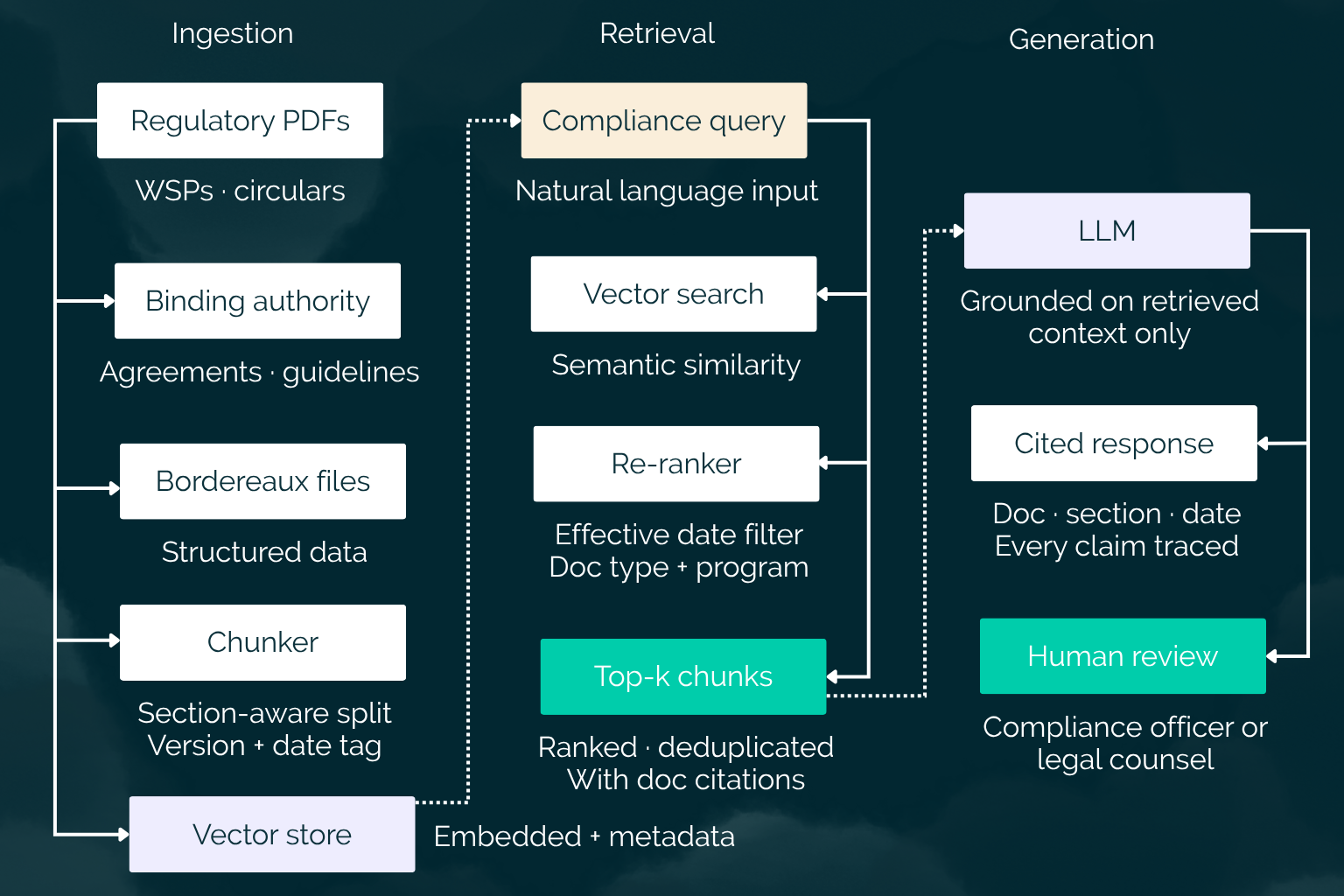
RAG runs in three stages: ingestion, retrieval, and generation. In a compliance context, each stage has requirements that go beyond a standard RAG implementation.
Ingestion: Building a Compliance-Ready Knowledge Base
Ingestion is where the firm's documents are processed into a searchable knowledge base. For a compliance deployment, that means chunking long regulatory documents in a way that preserves section context rather than splitting mid-clause, embedding those chunks into a vector store, and tagging each chunk with metadata: document type, effective date, regulatory category, and version number.
Version control is a non-negotiable requirement here. An MGA's binding authority agreement specifies submission deadlines and audit rights; when that agreement is updated, the new version must be ingested with an effective date and the prior version retained and date-stamped rather than overwritten.
A FINRA examination covers a defined examination period. If the firm's WSPs changed mid-period, the system needs to answer questions about what the WSP said on any given date within that window. An ingestion pipeline that overwrites prior versions rather than versioning them cannot support that requirement.
For a practical MGA implementation, the knowledge base includes: carrier guidelines per program, binding authority agreements, internal underwriting procedure manuals, prior audit findings and responses, regulatory circulars relevant to lines written, and state-specific surplus lines requirements. For a FINRA-registered firm, the knowledge base covers WSPs, correspondence archives, trade records, account documentation, and any prior examination correspondence.
Retrieval: Matching Audit Queries to the Right Regulatory Evidence
When a compliance question is submitted, the retrieval layer converts it into a vector query, searches the embedded knowledge base, ranks the results by relevance, and returns the best matches for generation.
Re-ranking is especially important in compliance workflows. Embedding similarity alone may return an outdated document or the wrong carrier agreement. Re-ranking uses metadata such as document type, effective date, and program to identify the most relevant document within the correct scope.
Many compliance questions also require cross-document retrieval. A carrier audit request, for example, may require information from a binding authority agreement, a prior audit response, and current bordereaux data. The retrieval layer should return all relevant sources together.
Generation and Citation: Producing Examination-Ready Responses
The generation stage uses only the retrieved context to produce a response. Every statement should include citations to the source document, section, and effective date.
A RAG-generated response does not replace the firm's recordkeeping obligations. It helps compliance teams locate and organize the relevant evidence more quickly. Before sharing any response with a regulator, carrier, or auditor, a qualified compliance officer or legal counsel should review the citations and confirm the interpretation.
RAG for MGA Carrier Audits: A Workflow Walkthrough
A carrier requests evidence that binds over the past twelve months stayed within delegated authority limits, claims handling followed agreed procedures, and bordereaux submissions were accurate and timely.
Without a RAG system, the compliance team reviews the binding authority agreement, gathers bordereaux files, cross-references bind records, and prepares an evidence package. If documents are spread across multiple systems or the audit period covers updated agreements, this process can take days.
With a RAG system built on the firm's compliance knowledge base, the team asks the audit questions directly. The system retrieves the relevant binding authority clauses, bordereaux records, and supporting documents, then generates a cited summary that highlights records requiring further review. The compliance team verifies the citations, reviews any exceptions, and prepares the final evidence package.
RAG speeds up document retrieval, cross-document retrieval, and citation generation. Human review remains essential for regulatory interpretation, judgment calls, and final approval before anything is shared with a carrier or regulator.
Bordereaux Reconciliation and Policy Document Cross-Referencing
Timely and accurate bordereaux submissions are a standard requirement in binding authority agreements. A RAG system can retrieve the relevant agreement clauses alongside structured bordereaux data. For example, it can retrieve the claims authority limit from the agreement and compare it with the reserve levels reported in the claims bordereaux.
This requires the RAG layer to connect to both unstructured document stores and structured data sources. A document-only RAG system can retrieve policy language, but it cannot compare that language with operational data. The retrieval layer needs access to both.
Audit Trail Logging: What the System Must Record
A compliance-grade RAG system should log every query, retrieved chunk, and generated response, along with the timestamp, user, and source documents used. This creates an audit trail that supports insurer audits and regulatory recordkeeping requirements.
Role-based access controls are equally important. Users should only retrieve documents they are authorized to access. Those permissions should be enforced during retrieval rather than after the response is generated.
RAG for FINRA Exam Prep and RIA Supervision
FINRA Rule 4511 requires firms to preserve books and records and produce them when requested during an examination. For firms that store records across email archives, shared drives, trading platforms, and compliance systems, finding the right information can take significant time.
A RAG system indexed on retained communications, trade records, supervisory documentation, and WSPs speeds up document retrieval without changing the firm's recordkeeping obligations. It can also generate a summary that cites the relevant documents, but compliance or legal counsel should review that summary before it is submitted.
Supervising Written Supervisory Procedures with RAG
Between examinations, compliance teams can use RAG to search WSPs with natural-language questions. The system retrieves the relevant procedure and cites the current effective version, helping staff work from the latest guidance.
The same knowledge base also supports supervisory documentation by showing which procedures were in place and providing the supporting evidence when needed.
FINRA Rule 4511 and Books and Records Retrieval
FINRA Rule 4511 applies to business communications, including emails, instant messages, and social media, that firms are required to retain. A RAG system indexed on those records can retrieve relevant communications across multiple systems instead of requiring separate manual searches.
Access to communication records should follow role-based access controls and information barrier policies, with those restrictions enforced during retrieval.
Integration Depth: What Compliance-Ready RAG Actually Requires
A proof-of-concept RAG system might upload a few PDFs to a vector store and demonstrate semantic search. A compliance-ready deployment requires much more, and the gap between the two is where most RAG development projects succeed or fail.
It should include role-based access controls, encryption in transit and at rest, versioned document ingestion, and a human-in-the-loop review before any generated content is shared with a regulator or auditor.
These are architectural decisions made during the build, not features added later. They shape the system's overall compliance posture.
Connecting RAG to Existing Compliance Tech Stacks
Most MGAs and RIAs already use document management systems, compliance platforms, and industry-specific CRMs. A custom RAG system connects to those systems through APIs instead of replacing them.
For MGAs, that may include SharePoint or Google Drive, email archives, and policy administration systems such as Applied Epic, EZLynx, or HawkSoft. For RIAs and broker-dealers, it may include Wealthbox or Salesforce, compliance management platforms, and trading systems. The RAG layer provides a single query interface while documents remain in their existing systems.
Choosing the Right LLM and Vector Database
Model and vector database selection affects the compliance posture of the entire deployment. Key considerations include:
Data residency: whether the LLM API call crosses a jurisdictional boundary matters for firms with data localization requirements. A firm handling EU client data under GDPR needs to know whether their compliance documents are being sent to an API endpoint outside the EU, and whether that transfer is permissible under their data handling agreements.
Model transparency: for audit purposes, the firm should be able to describe what model produced a given generated response, what version of that model, and what retrieval inputs it used. This information belongs in the audit log for every inference call.
Vector database metadata filtering: the vector store must support filtering by document effective date and regulatory category, not just by semantic similarity. Pinecone, Weaviate, and pgvector all support metadata filtering at query time; the specific implementation depends on corpus size, latency requirements, and whether the firm's existing infrastructure already runs a database that pgvector can extend.
Self-hosted options: firms with strict data handling requirements that preclude sending documents to a third-party LLM API can run open-source models (Llama, Mistral) on their own infrastructure. This adds engineering complexity but eliminates the data transfer question entirely.
Measuring Compliance Outcomes: What Good RAG Performance Looks Like
Standard RAG performance metrics such as BLEU scores and perplexity do not reflect operational compliance value and should not be the primary evaluation framework for a compliance deployment. The metrics that matter are:
Retrieval precision: for a defined set of test compliance queries, does the system return the correct document sections? This is tested pre-deployment by running queries against known-correct answers and measuring the percentage of test cases where the correct section appears in the top-k results. A system that scores well on this test for questions like "What are the delegated claims authority limits under the Carrier X binding authority?" is performing as required. A system that retrieves the right document type but the wrong section, or the right section from a superseded version, is not.
Citation accuracy: does the cited source actually support the generated claim? This is verified by a reviewer who checks each citation against the source document. In pre-deployment testing, every generated response in the test set should be verified this way. Post-deployment, a sampling protocol that reviews a percentage of production queries on a defined schedule maintains confidence that citation accuracy has not degraded.
Examination response cycle time: measure the time from examination request receipt to evidence package delivery against a documented baseline from before deployment. The baseline must be established before deployment from actual historical data, not from industry averages. Time savings cannot be claimed without a documented baseline specific to the firm.
Compliance officer time allocation: track the hours compliance staff spend on document retrieval versus regulatory judgment. The objective of the system is to shift time from retrieval to analysis. If the ratio is not shifting after 60 days of production use, the retrieval precision or knowledge base coverage requires attention.
Final Thoughts
RAG changes the economics of compliance work in one specific way: it moves hours from document retrieval to regulatory judgment. The requirements covered above (versioned ingestion, cited generation, cross-document retrieval, access controls enforced at retrieval time, human review before anything reaches a regulator) are what make that shift real in an MGA or FINRA-registered environment. A system missing any one of them is a demo, not a compliance tool.
The next step for this architecture is already visible. Real-time regulatory ingestion, where new circulars, rule amendments, and carrier bulletins enter the knowledge base as they publish rather than in periodic batch updates, shortens the window between a rule change and the moment staff work from current guidance. And agentic compliance monitoring, where the system runs recurring checks (bordereaux against authority limits, communications against supervision procedures) and flags exceptions for human review instead of waiting for a query, moves the workflow from audit preparation to continuous audit readiness. Both extensions sit on the same foundation this article describes: get the versioning, citations, and human sign-off right first.
Your Next Move
If your team spends hours finding documents, cross-checking records, and preparing audit responses, RAG can help reduce that manual work. But it only works well when it's built around your existing documents, systems, and compliance process.
As you evaluate a solution, look beyond the AI model. Ask how documents are versioned, how information is retrieved, and how citations and access controls are handled. Those details determine whether the system supports a real compliance workflow.
If you're evaluating a custom RAG solution for your MGA, RIA, or FINRA-registered firm, book a qualification call and walk us through where document retrieval slows your team down.
Frequently Asked Questions
How are sensitive regulatory documents protected once they are indexed in a RAG system?
A compliance-grade RAG system uses encryption in transit and at rest, role-based access controls, and audit logging for every query and retrieved document. These controls are built into the system from the start. They help firms meet recordkeeping and audit requirements while maintaining a clear record of who accessed what information and when.
What happens to the RAG system when a regulation changes mid-cycle?
A compliance-ready RAG system uses versioned document ingestion. New documents are added with an effective date while previous versions are retained. That allows the system to answer questions based on the policy or procedure that applied at a specific point in time. Updates should be reviewed and approved before they are added to the knowledge base.
Can RAG-generated responses be submitted directly to regulators or auditors?
No. RAG helps retrieve information and draft responses, but a qualified compliance officer or legal counsel should review and approve every response before it is shared with a regulator, carrier, or auditor.
How long does implementation take for a mid-size MGA or RIA firm?
The timeline depends on the quality of the firm's existing document infrastructure and the scope of the project. For a single workflow with well-organized documents, implementation typically takes 8 to 12 weeks. More complex environments may require additional discovery before development begins.
How do I know whether our existing compliance management platform already does what RAG would add?
Ask it a question that requires information from multiple documents. For example: "Does our binding authority agreement for Carrier X allow delegated claims authority above $50,000, and do our current claims bordereaux show any exposure in that range?"
If your team still has to open multiple documents and combine the information manually, a RAG system can improve that workflow. If your platform already provides a cited, cross-document answer, review its knowledge base coverage and access controls before deciding whether a custom implementation is needed.