How 3PL Operations Software Handles Multi-Channel Intake Across WMS, TMS, ERP, and EDI
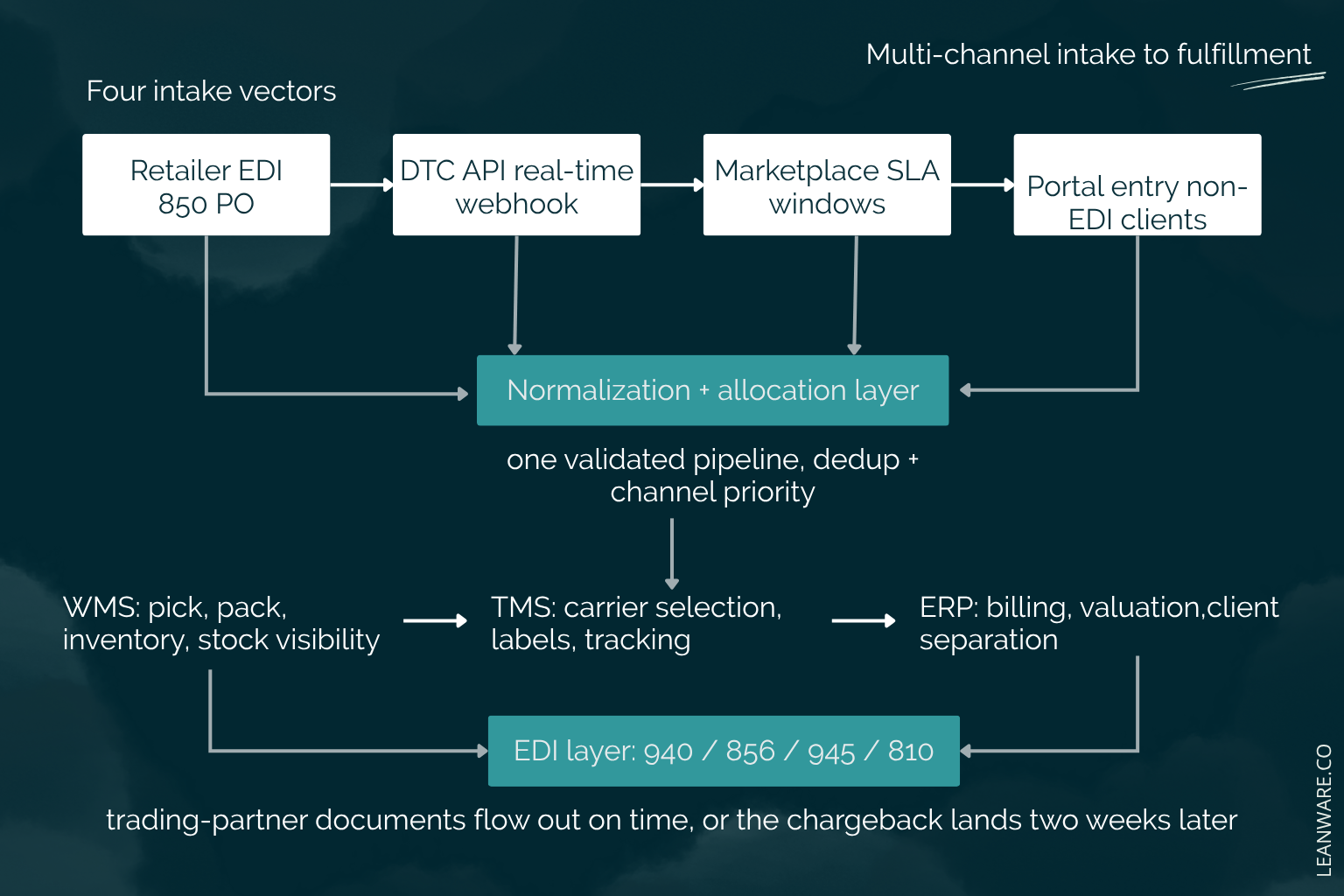
The thing that decides whether a 3PL can absorb its next client is not warehouse square footage or headcount. It is integration depth across the stack. A mid-size 3PL running four clients across six intake channels does not struggle because it lacks people. It struggles because a retail purchase order arrives by EDI, a DTC order arrives by API, a marketplace order arrives through a feed, and a fourth client keys orders into a portal, and all four have to land in the same WMS, reconcile against the same ERP, and ship through the same TMS without colliding.
The 3PL operations software handling that convergence, the way the WMS, TMS, ERP, and EDI layers actually exchange data, is where the real capacity ceiling sits.
This is an architectural breakdown of how multi-channel intake works at that stack depth: what the four intake vectors demand, where the handoffs break under load, and what separates a 3PL that onboards a new channel in days from one that needs two weeks of IT time and watches its order accuracy drop for the next two months.
What Multi-Channel Intake Actually Means in a Modern 3PL Stack
Multi-channel intake is a routing and sequencing problem, not a marketing phrase. An order entering the operation has to be identified by type, validated against inventory, and routed to fulfillment, and the path it takes differs entirely depending on where it came from. Four intake types dominate at this scale: EDI retail purchase orders from large retailers, API-driven orders from e-commerce platforms, marketplace feeds with their own SLA windows, and manual portal submissions from clients without EDI or API capability.
The operational stakes are concrete. Each channel carries a different data schema, a different validation requirement, and a different fulfillment trigger, and a 3PL running three or more of them simultaneously has to architect the routing so that orders do not collide on shared inventory, ship late against a retailer's routing guide, or stall in a queue because no system owned them on arrival. 3PLs at this scale recognize the pattern: the order volume is manageable, but the channel variance is what generates the exceptions.
The Four Intake Vectors a 3PL Must Route Simultaneously
Each vector enters the stack at a different point, gets validated by a different system, and triggers fulfillment through a different path.
Retailer EDI arrives as an 850 purchase order, typically lands first in the EDI middleware or directly in the WMS through an integration, and validates against inventory before generating a warehouse shipping order. The sequencing requirement is strict because the retailer's routing guide dictates label format, ship windows, and ASN timing.
DTC API and webhook orders arrive in real time from a Shopify or similar storefront, hit the WMS through an API connection, and trigger fulfillment immediately. Speed is the priority, and the customer expects same-day or next-day movement.
Marketplace integrations (Amazon, Walmart Marketplace) carry SLA windows with direct financial consequences for misses. They often arrive through a channel manager or direct integration and require inventory synchronization tight enough that the marketplace listing reflects true availability.
Manual portal entry comes from clients without EDI or API capability. A user enters the order into a portal, and that order must route into the same WMS-ERP-TMS pipeline as every other channel without a human re-keying it at the handoff.
The routing matrix that resolves these four without order collision is what a mid-size 3PL must architect deliberately. The most common gap shows up where one channel's orders bypass the validation the others go through, which is where overselling and mis-shipment originate.
Why a Single WMS Is Not Enough Without ERP and EDI Backbone
A WMS-only environment creates data islands, and the failure is easiest to see at the billing cycle. An EDI retail purchase order enters the WMS, the order ships, and the movement data sits in the WMS. If that data does not flow back to the ERP, invoicing cannot close, because the ERP is where client billing lives. The finance team waits on WMS exports, reconciles them by hand, and the billing cycle stretches across days it should not need.
The EDI transaction types make the gap concrete. A 940 warehouse shipping order tells the WMS to ship. A 945 warehouse shipping advice confirms what shipped. An 856 advance ship notice tells the retailer the shipment is coming, and it has to go out on time and match what actually ships.
When the WMS is not connected to the ERP and the EDI layer, the failure modes stack up in sequence: billing that cannot close because movement data is stranded, ASNs that go out late because nothing triggered the 856 on time, and chargebacks that hit two weeks later because the retailer caught the late ASN before anyone internally flagged it. The WMS did its job. The absence of the backbone around it is what produced the penalties.
The Integration Architecture Behind High-Performance 3PL Operations
The stack is one connected loop, not a list of tools. An order enters through an intake channel, the WMS validates it against inventory and manages the physical fulfillment, the TMS selects the carrier and produces compliant labels, the ERP records the financial transaction and holds the client billing terms, the EDI layer exchanges the required documents with trading partners, and the customer portal gives non-integrated clients a window into all of it. Data has to move between each layer in near real time for the loop to hold.
Before integration depth is achieved, the loop runs on manual bridges: someone exports from the WMS and imports to the ERP, someone watches an email thread to confirm an ASN went out, reporting arrives a day late because it has to be assembled by hand across systems. After integration depth is achieved, the order flows from intake to fulfillment to invoicing to document exchange without a person carrying data across a system boundary.
A senior ops leader can evaluate their own environment against that standard by asking a single question at each handoff: does the data cross this boundary automatically, or does a person move it?
WMS as the Operational Core: What It Controls and What It Cannot
The WMS owns the physical operation: picking, packing, inventory placement, returns processing, and real-time stock visibility. It is the system of record for what is in the building and what is moving through it, and at a multi-channel 3PL it is the core that intake routes into and fulfillment flows out of.
Its limits are equally precise. The WMS does not own transport cost allocation, financial reconciliation, or client billing. When a client demands cross-system reporting that combines movement data with cost and margin, or when a billing cycle requires transport spend that lives in the TMS and contract terms that live in the ERP, a WMS-only 3PL hits a configuration ceiling.
No amount of WMS configuration produces data the WMS was never designed to hold. This is a statement about system responsibility, not a flaw in any WMS platform.
TMS Role in Multi-Channel Outbound: Carrier Selection, Rate Logic, and Tracking
The TMS sits at the output end of the intake-to-fulfillment chain, and its carrier selection logic differs by channel. DTC orders prioritize speed and cost. Retail purchase orders require carrier and label compliance specific to the retailer's routing guide, where the wrong carrier or label format becomes a chargeback. Marketplace orders carry SLA windows where a missed delivery date has a direct financial penalty.
When the TMS is disconnected from the WMS, 3PLs operating at this channel volume typically see outbound error rates climb at exactly the moments volume spikes, because the carrier selection is running on stale or manually transferred order data. When the connection operates in real time, the TMS selects the carrier as the order is ready to ship, applies the channel-specific label and compliance rules automatically, and writes tracking back into the pipeline so the WMS, ERP, and customer portal all reflect the same shipment status.
ERP as the Financial and Compliance Layer in 3PL Multi-Client Environments
The ERP is the system of record for client billing, inventory valuation, compliance documentation, and financial analytics. In a multi-client 3PL, it has to maintain client-level separation, because a shared ledger breaks at the first audit. When one client's auditor asks for their financial records, the 3PL has to produce that client's data cleanly, without manual extraction from a commingled ledger, and client-level separation in the ERP is what makes that possible.
The operational pain before ERP integration is familiar to any finance lead at a multi-client 3PL: billing cycles that stretch across days because movement data arrives late from the WMS, invoices that require manual reconciliation against transport spend and contract terms, and the slow erosion of client trust when invoice accuracy lags quarter after quarter. Client-level ERP separation is a structural requirement for a multi-client operation, not an accounting nicety.
EDI vs. API: Choosing the Right Protocol by Channel Type
EDI and API solve the same problem for different partners. EDI is standardized, batch-processed, and required by large retailers, and it breaks when a mapping breaks, which means it demands a maintenance discipline. API is real-time, preferred by e-commerce and marketplace clients, and requires versioning discipline to stay stable as platforms update.
Factor | EDI | API |
Processing | Batch | Real-time |
Required by | Large retailers | E-commerce, marketplaces |
Failure mode | Mapping breaks silently | Version changes break the connection |
Strength | Retail compliance standard | Speed and immediacy |
Mature 3PLs run both and build a middleware layer that abstracts the protocol away from the fulfillment workflow, so the operations team is not managing the difference between EDI and API at the order level. Being protocol-exclusive in either direction carries a competitive cost: a 3PL running only EDI cannot onboard a Shopify-native brand without a visible integration gap, and a 3PL running only API cannot serve Walmart. The decision to run both is an architectural commitment with direct consequences for which clients the 3PL can win.
The Customer Portal as the Intake Interface for Non-EDI Clients
The portal is the intake channel for clients that have neither EDI nor API capability, and it has to do real operational work: accept orders, surface inventory visibility, display shipping status, and generate reports on demand. For these clients, the portal is not a convenience feature layered on top of the real integration. It is the primary integration layer, and its design determines whether the client relationship scales or stalls.
The architectural requirement is that portal-sourced orders route into the same WMS-ERP-TMS pipeline as every other channel without creating a manual processing bottleneck at the handoff. If a person has to take a portal order and key it into the WMS, the portal has not solved the intake problem, it has relocated it. A well-designed portal writes the order directly into the same validated pipeline that EDI and API orders flow through.
Multi-Channel Inventory Logic: How 3PL Operations Prevent Overselling and Stock Collision
Consider a single SKU that a retail purchase order, a DTC order, and a marketplace request all reserve within the same fulfillment window. Without allocation logic in the WMS to resolve the contention, the operation oversells, and the failure is not a picking error that better-trained staff would avoid. It is an allocation architecture failure, because three channels were allowed to claim the same unit with no system arbitrating the priority. An ops executive who has lived through stock collision knows the aftermath: the scramble to source replacement inventory, the chargeback from the retailer whose order could not be filled, the marketplace metric that drops because the SLA was missed.
3PLs managing three or more intake channels encounter this the moment channel volume rises, and the resolution is allocation logic configured before the collision, not exception handling after it.
Unified SKU Management Across B2B, B2C, and Marketplace Channels
A unified SKU master across every active channel is the precondition for trustworthy inventory. When SKU management is siloed, the failures are predictable: duplicate SKUs that represent the same physical item, mismatched counts between systems, and phantom stock that survives in one system after it has been depleted in another. An order routes against the phantom stock, and the operation oversells.
Consolidating SKU management is a configuration problem before it is a technology problem. It requires WMS configuration changes so every channel maps to the same SKU record, and ERP master data alignment so the financial system and the operational system agree on what each SKU is. Until that alignment is done, the unified inventory record is not trustworthy, and no allocation logic built on top of it will hold.
Real-Time Allocation Rules and Channel Priority Logic
Allocation rules encode client-defined channel priorities. A common example: a retail purchase order holds a contractual first claim on available inventory before any DTC order is released against that SKU. These rules live in the WMS and interact with contract terms that live in the ERP, so the WMS knows which channel wins when two orders contend for the same unit.
When allocation rules are wrong or missing, the consequence does not appear in real time. The chargeback shows up two weeks later, when the retailer whose contractual priority was violated catches the short shipment. Getting the priority logic right at configuration time is what prevents the penalty that would otherwise surface long after the order shipped.
Onboarding a New Channel: What 3PL Operations Must Configure Before Go-Live
Onboarding speed is a competitive metric in 3PL sales cycles. A prospect comparing two 3PLs frequently chooses the one that can commit to a shorter activation timeline, because every week of onboarding is a week the prospect's orders are not flowing. Before a new intake channel goes live, the operation has to configure EDI trading partner setup, WMS workflow configuration, ERP billing rules, label and compliance templates, and portal provisioning.
What makes the timeline short is reusable infrastructure: pre-built templates, tested EDI maps, and WMS workflow configurations that carry over from one client to the next. What makes it long is manual mapping and custom development for each retailer's routing guide, where every onboarding starts from scratch.
EDI Trading Partner Onboarding: Testing, Mapping, and Go-Live Validation
EDI onboarding runs through a defined sequence: identify the trading partner, map the required documents (850 purchase order, 940 warehouse shipping order, 856 ASN, 945 shipping advice, 810 invoice), run test transaction cycles, resolve mapping errors, and certify for go-live. Managed manually, this is time-consuming because each document type has to be mapped to the partner's specific implementation and tested until it passes certification.
The architectural decision is in-house EDI versus a third-party EDI network. In-house EDI offers full control over the maps and the timeline but requires sustained IT investment to build and maintain. A third-party network accelerates onboarding through pre-built connections but introduces a dependency on that network's coverage and uptime. The choice carries long-term cost implications either way, and it should be made deliberately rather than defaulted into.
WMS Workflow Configuration for Channel-Specific SLAs and Label Requirements
Each new channel requires WMS customization: pick-pack sequences, cartonization rules, label formats, pack slip templates, and routing guide compliance. Retailer compliance requirements have to be configured into the WMS before the first shipment, because an error discovered after the shipment goes out becomes a chargeback rather than a correction.
WMS configuration is not a one-time task. Retailer requirements evolve, routing guides get updated, and a 3PL without a maintenance process finds its configurations drifting out of compliance quietly. The drift is invisible until a chargeback cycle surfaces it, at which point the operation has already shipped non-compliant orders for however long the drift went unnoticed. A maintenance process that tracks routing guide changes against WMS configuration is what keeps the drift from becoming a penalty.
Operational KPIs That Multi-Channel 3PL Teams Must Track by Intake Source
The metrics that matter at this stack depth have to be tracked at the channel level, because an aggregate number hides which channel is failing. The core set: order accuracy rate, on-time shipment rate, EDI transaction error rate, intake-to-fulfillment cycle time, and chargeback rate by retail trading partner.
These KPIs live across different systems. On-time shipment lives in the TMS, order accuracy in the WMS, EDI transaction error rate in the middleware layer, and chargeback data in the ERP or the retailer's portal. Surfacing them in one view requires an ERP or BI layer that pulls across all of them, which is why a functional ops dashboard at this depth is not a single screen pulled from one system. It is a structured reporting layer that consolidates data from every system in the loop into one view an ops director can act on.
Chargeback Prevention: How Integration Depth Reduces Retailer Penalties
Chargebacks are the direct financial consequence of integration gaps, and each common trigger traces to a specific system failure. A late shipment traces to the TMS being disconnected from the WMS, so carrier selection ran late. An incorrect label traces to WMS misconfiguration against the retailer's routing guide. A missing ASN traces to an EDI failure in the 856 transaction.
Before the architectural fix, chargeback resolution consumes real staff hours: pulling transaction logs to prove what happened, disputing the deduction with the retailer, and correcting the root cause so it does not recur. That labor is a recurring cost that scales with chargeback volume. Closing the integration gaps that produce the chargebacks reduces both the penalties themselves and the staff time spent resolving them, and the improvement is directional but real: fewer gaps mean fewer chargebacks mean fewer hours lost to disputes.
Final Thoughts
Integration depth across WMS, TMS, ERP, EDI, and the customer portal is what separates a 3PL that scales on architecture from one that scales on headcount and manual exception handling. The integration debt a 3PL carries becomes a competitive disadvantage in concrete ways: it slows channel onboarding, raises chargeback costs, and delays billing cycles, and every one of those shows up in a sales cycle or a client renewal conversation.
AI ROI compounds on top of a strong operational stack. The multi-channel intake-to-fulfillment workflow described here, where orders converge from four vectors and have to route, allocate, and ship without collision, is exactly where AI agents most reliably produce measurable return for a 3PL that already has this stack profile.
The right way to find out where that return is highest is an AI ROI Assessment that maps your actual stack, your channel mix, and your exception patterns against where automation pays back fastest.
Frequently Asked Questions
What is the difference between a WMS shipping module and a real TMS?
A WMS shipping module handles basic label generation and carrier handoff for straightforward outbound, which is adequate when carrier selection is simple. A real TMS owns carrier selection logic, rate shopping across carriers, channel-specific compliance rules, and tracking write-back. At multi-channel volume where DTC orders optimize for cost, retail orders require routing-guide-compliant carriers, and marketplace orders carry SLA penalties, the WMS module hits its ceiling because it was not built to arbitrate those competing rules. The distinction matters most when carrier costs and compliance penalties start affecting margin.
How long should onboarding a new EDI trading partner take?
It depends on whether the infrastructure is reusable. With tested EDI maps for the standard transaction set (850, 940, 856, 945, 810) and reusable WMS workflow configurations, a new retail trading partner can go live in days to a couple of weeks. When every map is built from scratch and the retailer's routing guide requires custom WMS configuration, the same onboarding stretches to several weeks of IT time. The variable is not the partner; it is whether the 3PL invested in reusable onboarding infrastructure before the partner arrived.
Why does multi-client billing lag when the WMS is not integrated with the ERP?
Billing closes in the ERP, but the movement data that billing depends on lives in the WMS. When the two are not connected, someone exports movement data from the WMS and reconciles it manually against contract terms and transport spend in the ERP, which takes days and introduces errors. Integrating the WMS movement data into the ERP in near real time lets the billing cycle close on schedule with accurate invoices, which is also what protects client trust over time.
How do allocation rules prevent overselling across channels?
Allocation rules in the WMS arbitrate which channel claims inventory when multiple orders contend for the same SKU in the same fulfillment window. They encode client-defined priorities, such as a retail purchase order holding contractual first claim before DTC orders are released, and they interact with contract terms held in the ERP. Without these rules, three channels can each reserve the same unit, the operation oversells, and the chargeback or SLA penalty surfaces two weeks later. The rules have to be configured before the collision, because they cannot be applied retroactively.
Where do AI agents produce the most measurable ROI in a 3PL operation?
AI agents produce the clearest return on the multi-channel intake-to-fulfillment workflow, because that is where document variability, multi-system data joins, and exception handling concentrate. An agent that normalizes intake across EDI, API, and portal channels, handles the exceptions that currently route through email, and maintains a documented decision trail addresses exactly the labor that scales with volume. The return is highest for 3PLs that already have an integrated stack, because the agent builds on clean system connections rather than compensating for broken ones. An AI ROI Assessment maps where that return is highest against a specific operation.