3pl Technology: What Actually Works for SMB Operators
Your WMS handles inventory. Your TMS handles shipments. Your EDI layer handles document exchange with clients who each use different formats. Your billing software calculates storage and handling charges based on rate cards that differ by client, and the data it needs lives across all three systems. Between those systems, your team runs on email, spreadsheets, and institutional knowledge that no one has documented.
That inter system gap is where 3PL operations lose the most time and money. AI built for enterprise supply chains assumes unified data and dedicated IT teams. AI built for single system SaaS assumes the friction lives inside one product. Neither assumption holds at a $10M to $40M 3PL running 10 to 30 clients with different SKU logic, SLAs, and billing rules simultaneously.
What Makes 3PL Operations Different From Generic Supply Chain
A 3PL does not manage one supply chain. It manages a portfolio of client supply chains, each with its own inbound rules, storage requirements, outbound SLAs, carrier preferences, and billing structures.
That multi client complexity compounds at every layer of the operation and is the reason enterprise AI tools and single system SaaS features consistently fall short.
The System Stack That Actually Runs a Mid Size 3PL
A $10M to $40M 3PL typically runs on five to seven core systems that were never designed to work together.
WMS (3PL Central/Extensiv, Deposco, Made4net, or Excalibur) manages inventory, receiving, picking, packing, and shipping. It holds the most granular operational data but often lacks the integration depth to share it cleanly with other systems.
TMS (MercuryGate, Kuebix, or a lightweight routing tool) handles carrier selection, load planning, and shipment execution. The TMS and WMS rarely share data in real time at SMB scale.
EDI layer (SPS Commerce, TrueCommerce, or direct connections) exchanges documents with clients and carriers. Every new client means new EDI mapping, new testing, and new format handling. The global 3PL market is projected to reach $1.3 trillion by 2026, and much of the integration complexity driving that growth flows through EDI.
Billing software (often built into the WMS or run separately in QuickBooks/NetSuite) calculates charges using rate cards that differ by client, service type, and surcharge schedule.
Spreadsheets fill every gap between these systems. Exception tracking, onboarding checklists, rate comparison sheets, and client specific SOPs all live in files that one or two people maintain.
This fragmentation is structural. It exists because each system was selected to solve a specific problem, and no single vendor covers the full 3PL operating model.
Why Enterprise Supply Chain AI Doesn't Transfer to SMB 3PLs
Enterprise supply chain AI assumes a unified data lake where inventory, transportation, and financial data are normalized and queryable from a single platform. It assumes an IT team that can build and maintain integrations. It assumes data governance processes that enforce consistency across systems.
Most SMB 3PLs have none of these. Their data lives in five systems with different schemas, different update frequencies, and different levels of API maturity. The AI that works in this environment operates across these systems as they actually exist, not as a data architecture diagram suggests they should.
Where AI Actually Creates Value Inside a 3PL Operation
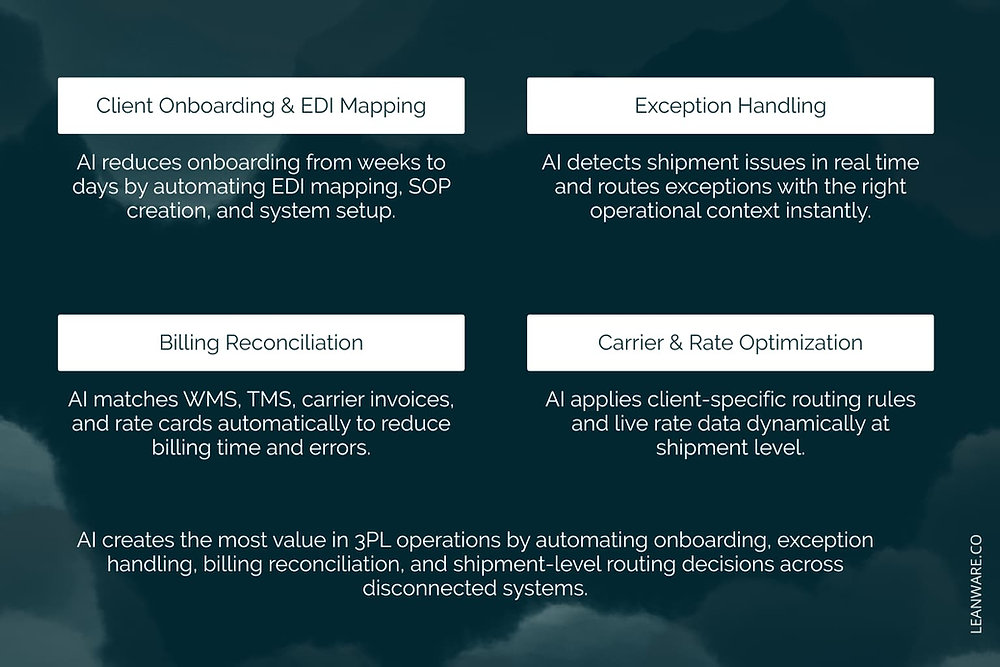
Four workflows account for the majority of manual labor cost and error exposure in a mid size 3PL. Each one involves data and decisions that span multiple systems.

New Client Onboarding and EDI Mapping
Onboarding a new client at a mid size 3PL costs $15,000 to $40,000 in staff time per client. The work includes EDI mapping (translating the client's document formats into formats the WMS and billing system can process), SOP creation (documenting the client's receiving, storage, and shipping requirements), system configuration (setting up the client in the WMS, TMS, and billing system), and testing (validating that EDI documents flow correctly end to end).
At 18 new clients per quarter, onboarding consumes a significant portion of operations and IT staff capacity. An AI agent that handles intake documentation, drafts EDI mappings based on the client's format samples, and generates SOP templates from the onboarding questionnaire compresses a two week cycle into three to four days. Setup runs in the low twenties of thousands, monthly service in the mid thousands, with payback at month three based on staff hours recovered.
Inbound and Outbound Exception Handling
Exceptions are the operational tax that no system eliminates. Damaged inbounds, carrier mismatches on outbound shipments, short ships, SLA breaches, and inventory discrepancies all require investigation, communication, and resolution. At most 3PLs, this happens through email chains and manual TMS or WMS pulls. The ops team scrolls through messages, cross references data across systems, and decides what to do based on experience.
An AI agent monitoring EDI feeds and WMS event logs detects exceptions in real time: a carrier delivering to the wrong dock, an ASN that does not match the PO, a shipment that missed its SLA window. The agent routes each exception to the right person with the relevant data already pulled from the affected systems. Resolution happens in hours instead of days because the investigation step is automated.
Multi Client Billing Reconciliation
Rate cards differ by client. Surcharges change monthly. Billing data lives across the WMS (storage and handling), TMS (transportation charges), and carrier invoices (accessorial fees). Manual reconciliation at a $10M to $30M 3PL runs 5 to 10 days per month. The finance team pulls data from each system, cross references charges against rate cards, resolves discrepancies, and generates invoices.
An AI agent that reads rate cards, pulls activity data from the WMS and TMS, matches carrier invoices against shipment records, and flags discrepancies for review compresses the billing cycle from days to hours. The operational value is in accuracy as much as speed: billing errors erode client trust and create revenue leakage that compounds silently.
Carrier and Rate Shopping at the Shipment Level
Most mid size 3PLs handle carrier selection through a basic TMS module or manual rate comparison. The TMS selects carriers based on lane and service level but ignores client specific rules: preferred carriers, prohibited carriers, margin targets that vary by account, and negotiated rates that live in a spreadsheet outside the TMS.
An AI agent that applies per client carrier rules at shipment time, checking the client's rate card, carrier preferences, and margin targets before routing, removes the manual step without requiring a TMS rebuild. The agent operates across the TMS data (rates and availability) and the client's contractual rules (stored in whatever system or spreadsheet they currently live in).
What 3PL Technology Actually Means in 2025 and 2026
Every WMS and TMS vendor is adding AI features. The question for a 3PL operator is whether those features reach the workflows that cost the most, which almost always live between systems rather than inside one.
Platform Native AI Features in Existing 3PL Technology
WMS vendors are shipping slot optimization (recommending putaway locations based on velocity and pick path efficiency), pick route optimization (sequencing picks to minimize travel time), and demand based labor planning. TMS vendors are adding carrier recommendation engines and predictive ETAs.
These features improve single system efficiency. They do not reach friction that lives between systems: the gap between what the WMS knows about inventory and what the billing system needs to calculate charges, the gap between what the TMS knows about shipments and what the EDI layer needs to send the client, or the gap between what arrives at the dock and what the ASN said would arrive.
Where Custom Built Agents Fill the Gap
Custom agents apply when the workflow crosses more than two systems, involves client specific logic, or requires audit logging that the SaaS vendor does not provide.
The EDI onboarding case is the best example.
At 18 new clients per quarter, the onboarding workflow spans the EDI platform, the WMS, the billing system, and the ops team's documentation. No single vendor's AI feature covers that span. A custom agent that ingests client documentation, generates EDI mappings, creates WMS configurations, and drafts SOPs operates across all four systems. Setup in the low twenties of thousands, monthly in the mid thousands, payback at month three.
A multi channel intake agent handling inbound exception routing across three carrier systems, the WMS, and a customer facing status tracker presents a similar case. At 600 orders per day, the volume justifies an agent that monitors all five data sources and routes exceptions automatically. Setup in the high teens of thousands, monthly in the mid three thousands, payback at month four.
How SMB 3PLs Are Actually Implementing AI Right Now
The pattern across mid size 3PLs adopting AI follows a consistent sequence: start with the most expensive workflow, prove the ROI, then expand.
Starting With a Single High Cost Workflow
The 3PLs getting value from AI pick one workflow with a measurable per unit cost or a high exception rate and build there first. EDI onboarding and exception routing are the two strongest starting points because the costs are quantifiable (staff hours per onboarding, resolution time per exception), the baseline is easy to establish, and the improvement is visible within 60 to 90 days.
The idea is simple: start with a workflow where you can clearly measure the before and after impact, so the ROI is backed by real operational data instead of demo projections.
The Integration Reality: Why Implementation Takes Longer Than the Demo
Demos run on clean, normalized data. Real 3PL implementations require mapping data across systems with different schemas (the WMS stores SKUs one way, the billing system stores them another). They require handling non standard EDI formats from clients who are still running legacy translators. They require working around undocumented WMS API limitations that only surface during integration testing.
None of this is insurmountable. Setting accurate expectations upfront prevents the disillusionment that kills AI projects after month two. A realistic timeline for a first agent in a 3PL environment is 6 to 10 weeks from scoping to production, with the first two weeks dedicated to data mapping and integration testing.
Build vs. Buy vs. Wait
Build when the workflow spans more than two systems, requires client specific logic (SLAs, EDI formats, rate cards), and the baseline per unit cost is measurable. This is the path for onboarding, exception handling, and billing reconciliation at scale.
Buy when the friction is isolated to a single WMS or TMS, the vendor already offers the feature (slot optimization, pick routing, carrier recommendation), and shipment volume justifies the vendor's pricing tier. Platform native AI makes sense when the problem lives inside one system.
Wait when the feature is on the vendor's roadmap within six months and the integration footprint keeps switching costs low. If the WMS vendor is shipping an exception management module in the next release and the workflow does not cross into billing or EDI, waiting costs less than building.
Measuring AI ROI in a 3PL Context
ROI projections without a measured baseline are marketing materials, not business cases. Measurement in a 3PL context means tracking specific workflow metrics before and after the agent goes live.
Establishing the Baseline Before Any AI Is Built
A baseline for a 3PL workflow includes staff hours per client onboarding (from intake to first live shipment), cost per exception (time to detect, investigate, and resolve), days in the billing cycle (from activity close to invoice delivery), error rate on billing (disputes per invoice period), and carrier selection compliance (percentage of shipments routed per client rules).
These numbers must exist before deployment. Without them, the month four measurement is a comparison against nothing, which makes the ROI story impossible to defend internally.
What Good Looks Like at Month Four
Measured at the workflow level, strong implementations produce consistent results by month four.
Onboarding: EDI mapping cycle drops from roughly two weeks per client to three to four days. Staff time on onboarding decreases 60 to 70%.
Billing reconciliation: Cycle compresses from 5 to 10 days to 1 to 2 days. Invoice dispute rate drops measurably because charges are validated against rate cards automatically before invoices go out.
Exception handling: Resolution time decreases and the volume of exceptions handled without human escalation increases. The ops team reviews agent resolved exceptions rather than investigating every one from scratch.
Results vary by WMS data quality and EDI format complexity. Firms with cleaner data and more standardized client formats reach these benchmarks faster.
Choosing an AI Partner for Your 3PL Operation
The evaluation criteria that matter for a 3PL operator center on integration depth, baseline measurement discipline, and engagement structure.
Questions to Ask Any AI Vendor Before Signing
Five questions quickly reveal the difference between vendors who understand 3PL operations and those selling generic AI solutions.
- How do you handle workflows that span multiple systems like WMS, TMS, EDI, and billing?
- What does your baseline measurement process look like before any build starts?
- Can you show ROI measured against a real operational baseline from a previous engagement, not projected from a demo?
- When a carrier updates their EDI spec mid engagement, who handles the update and what does it cost?
- Before scoping a build, how do you determine which workflow is worth automating first?
That last question is especially important. Vendors with a structured discovery process usually answer it with a defined assessment, fixed fee, and clear deliverables. Others answer with some version of “we’ll figure that out during the engagement,” which often means the discovery work has not been clearly defined yet.
What a Productized Engagement Looks Like vs. Open Ended Consulting
A productized engagement has a fixed scope discovery phase that produces a documented workflow analysis, a specific build recommendation, and a measurement plan. The deliverable exists whether or not the engagement continues. The accountability structure is clear: here is what we found, here is what we recommend, here is how we will measure it.
Open ended consulting charges by the hour, scopes as it goes, and defers measurement until the engagement is well underway. The accountability structure is different: the client pays for time, and the vendor delivers what the time allows.
For a 3PL operator evaluating a first AI build, the productized model reduces risk because the discovery deliverable has value independent of the build decision.
Final Thoughts
3PL environments are multi system by design. The biggest operational costs usually come from the gaps between those systems: handoffs, reconciliations, and exception handling that no single vendor’s AI feature fully covers. AI built for this environment works across the stack as it actually operates.
The right first step is identifying which workflow produces the clearest payback. That is a two week, fixed fee engagement that maps the workflow, establishes the baseline, and scopes the build before any commitment to development.
Start with our AI Workflow Assessment to identify the highest impact automation opportunity in your operation and build from a measurable baseline.
Frequently Asked Questions
How long does it take to get an AI agent running in a 3PL environment?
A first agent typically reaches production in 6 to 10 weeks from scoping to live operation. The first two weeks cover data mapping, integration testing, and baseline measurement. Development and iterative testing take 4 to 8 weeks depending on the number of systems involved and the complexity of client specific rules. EDI format variability and WMS API maturity are the primary timeline drivers.
Can my existing WMS and TMS handle AI, or do I need to replace them?
You do not need to replace them. Custom agents connect to existing systems through APIs, database connections, or structured data exports. The agent sits on top of your current stack and operates across it. Platform-native AI features inside your WMS or TMS handle single-system optimization well. Custom agents handle the cross-system workflows (onboarding, billing reconciliation, exception routing) that platform features do not reach.
How do I estimate ROI before committing to a build?
Start by measuring the current cost of the workflow you want to automate: staff hours per client onboarding, cost per exception resolved, days in the billing cycle, and error rates. Those numbers form the baseline. A fixed-fee assessment maps the workflow, establishes that baseline, and projects the improvement based on the agent's scope. Without that baseline, any ROI projection is a guess.
What does integration complexity actually look like in practice?
It depends on the maturity of your systems. Modern WMS platforms with REST APIs integrate directly. Older systems may require adapter layers or structured data exports. EDI integration complexity scales with the number of client formats and the age of the translation layer. The most common surprises during implementation are undocumented API limitations and non-standard EDI formats from legacy trading partners. A two-week scoping phase identifies these issues before development begins.
When should I build a custom agent versus using a platform feature?
Build when the workflow crosses more than two systems and involves client-specific logic that the platform cannot configure (custom rate cards, client-specific carrier rules, multi-format EDI handling). Use the platform feature when the improvement lives inside a single system (pick path optimization, slot assignment, carrier recommendations within the TMS). The build-vs-buy decision maps directly to where the friction lives: inside one system or between several.