Invoice Processing Automation for 3PL and Manufacturing: How AI Handles Multi-System Reconciliation
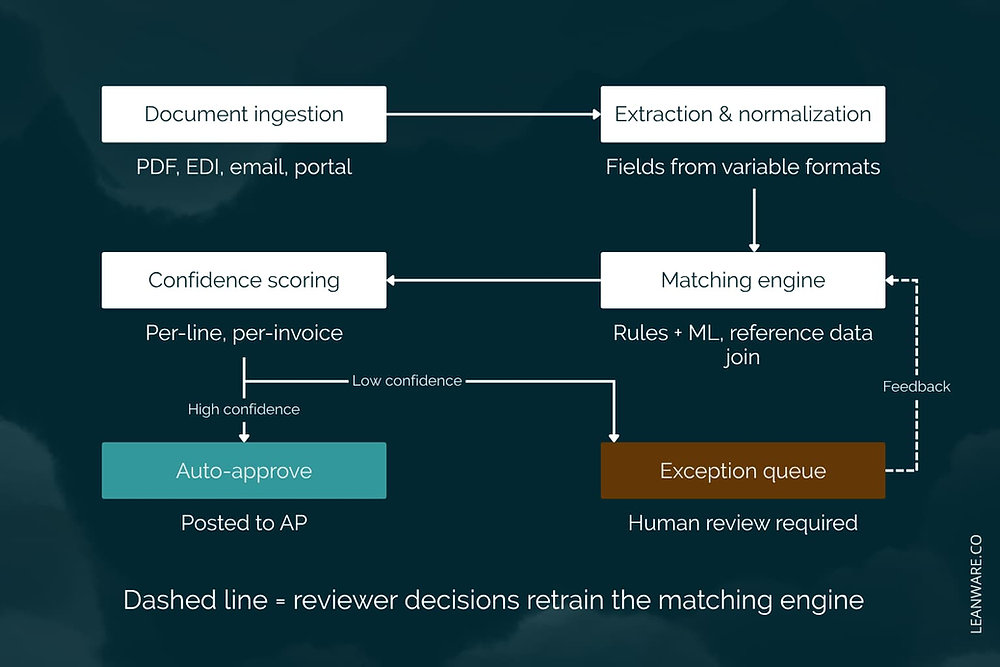
The problem in multi system invoice reconciliation is not data entry volume. A single carrier invoice may reference shipment data in the TMS, contracted rates in a pricing table, and fuel surcharges maintained elsewhere. Reconciling that invoice often requires pulling together data from multiple systems before any line item can be approved or disputed.
For job shop manufacturers, the details differ but the challenge is similar. A supplier invoice may involve partial receipts, substituted parts, or negotiated pricing adjustments. The required information exists, but it is often spread across multiple records and workflows.
Invoice processing automation, as it is commonly sold, focuses on extracting structured data from documents. Reconciliation, however, also requires validating invoice data against contracts, operational records, pricing rules, and business context.
Let’s see how AI supports carrier contract validation and BOM aware matching in 3PL and manufacturing environments, and where generic AP tools often fall short.
Why Generic AP Automation Falls Short for Complex Operations
Rule based AP tools are built around a clean version of the three way match: take a purchase order, compare it to a goods receipt, compare both to an invoice, and approve if the numbers agree. That logic works well for direct materials procurement with consistent supplier invoice formats, standard unit of measure conventions, and purchase orders that map one to one with deliveries.
The moment the operation introduces carrier contracts with accessorial charge schedules, multi modal freight billing, or BOM hierarchies with approved substitutions, the rule based model breaks. Not because the rules are wrong, but because the rules assume a flat, well structured data environment that does not exist in these operations.
Carrier invoices arrive in formats that vary by carrier: some as X12 EDI 210 files, others as PDFs with proprietary line item structures, others as portal exports with non standard column headers. A fuel surcharge on an LTL invoice is billed differently by a regional carrier than by a national one, and the validation logic has to account for both. A detention charge may or may not be authorized under the carrier contract depending on whether the dwell time exceeded the contracted free time, which is a number that lives in the TMS event log, not in the invoice. Generic AP tools have no mechanism for accessing that log or applying that logic.
On the manufacturing side, an ERP's standard three way match breaks as soon as a BOM revision changes a part number, a supplier ships from a secondary location, or an assembly is partially delivered across two invoices. The ERP records the PO and the receipt. It does not carry the approved substitution logic or the split shipment resolution that makes the invoice matchable. The match fails, the exception queue grows, and the accounts payable team spends hours manually resolving cases that have a deterministic answer if the right data sources are consulted.
The structural gap is not a configuration problem. It is a domain knowledge problem. The matching logic has to understand carrier contract structures, freight billing conventions, BOM hierarchies, and multi system data relationships. That understanding cannot be configured through a settings panel. It has to be built into the pipeline.
The Hidden Complexity: What Multi System Reconciliation Actually Involves
Before getting into the vertical specific logic, here's what reconciliation looks like at the system level.
A typical 3PL reconciliation stack touches five to seven systems: a WMS that records warehouse events, a TMS that records freight moves, an EDI translator that converts carrier messages, one or more carrier portals for invoice download, a rate management system or spreadsheet containing contracted rates, a billing platform that generates customer invoices, and an ERP or accounting system that books payables. None of these systems were designed to talk to each other for the purpose of invoice validation. Each one was purchased to serve a specific operational function.
A job shop manufacturer's stack looks different but presents the same fragmentation: an ERP holding POs, BOM structures, and receipts; a procurement platform managing approved vendor lists and contract pricing; a supplier portal for invoice submission; and potentially a separate document management system for engineering change orders. The data for making a match determination is distributed across all of them.
Data Sources That Feed the Reconciliation Pipeline
The pipeline must ingest and normalize data from structurally different sources before any matching logic can be applied.
Carrier invoices arrive as a mix of X12 EDI 210 transaction sets, PDF documents with proprietary layouts, email attachments, and portal exports. The same carrier may bill differently for LTL versus FTL moves. A PDF invoice from a regional LTL carrier may express accessorial charges as a table of codes that only maps correctly to human readable descriptions through the carrier's own tariff document.
An EDI 210 from a national carrier encodes the same information in qualifier value pairs that require translation before they are comparable to the contracted rate.
Reference data includes contracted rate tables (which themselves may exist as spreadsheets or within a rate management system), carrier tariff schedules, shipment event records from the TMS (origin, destination, service level, dwell times, weight, dimensions), and goods receipt records from the WMS. A shipment ID in the TMS and a freight reference number on the carrier invoice may refer to the same physical move with no shared key. Linking them requires fuzzy matching on origin/destination pairs, pickup date windows, and weight ranges.
For manufacturing, the reference data set includes PO line items, BOM structures with part hierarchies, goods receipt records with quantity and lot information, approved vendor lists with alternate part number mappings, and contract pricing tables that may include tiered volume discounts and validity date ranges.
Where Discrepancies Originate and Why They Compound
Discrepancies between invoiced amounts and expected amounts come from several distinct sources, and they interact.
Quantity mismatches occur when invoiced quantities differ from received quantities because of partial receipts, short shipments, or over deliveries that were accepted but not formally documented. A quantity mismatch on one line does not only affect that line's amount; if the invoice bills a lump sum freight charge based on total weight, the freight amount becomes incorrect as soon as any line quantity is wrong.
Unit of measure conversion errors surface when a supplier invoices in one unit (e.g., kilograms) against a PO written in another (e.g., pounds). Many ERP configurations handle this through a conversion factor stored on the item master. When that factor is outdated or the conversion is applied inconsistently, the invoice amount appears to differ from the PO amount even when the physical quantities are equivalent.
Accessorial charges not present in the original PO are the most common source of carrier invoice disputes in 3PL operations. A residential delivery surcharge applied to a commercial address, a liftgate charge for a stop that was prescheduled as dock delivery, or a detention fee that exceeds the contracted free time threshold: each of these appears on the invoice as a legitimate line item, and each one requires validating against a data source that was not part of the original PO.
Upstream mismatches compound downstream. A partial receipt that is not resolved in the ERP produces a quantity mismatch that triggers a manual review. The reviewer resolves the quantity question but misses a unit of measure conversion issue on another line. The approved invoice is later flagged during a carrier audit because the freight charge was calculated on incorrect weights. One unresolved upstream data problem generates multiple downstream exceptions across multiple review cycles.
Part 1: AI Driven Carrier Invoice Reconciliation for 3PL Operations
Carrier billing is a domain specific problem. A carrier invoices for a freight move, and the invoice includes a base linehaul charge, a fuel surcharge calculated against a published index, and zero or more accessorial charges for non standard service conditions. Validating that invoice means checking whether the move actually occurred, whether the service level matches what was contracted, whether the fuel surcharge rate is current, and whether each accessorial charge was authorized under the terms of the carrier agreement.
At 50 carrier invoices per week, a skilled dispatcher can handle this manually. At 300 per week, across a mix of LTL, FTL, parcel, and intermodal moves with six or eight different carriers, the work cannot be done at the required accuracy level without automation. The question is whether the automation can actually apply the carrier specific logic, not just extract fields from the invoice document.
Matching Carrier Invoices to Shipment Records
The first step in carrier reconciliation is linking each invoice to the shipment it covers. For EDI capable carriers, a PRO number or BOL reference typically allows a direct lookup in the TMS. For carriers whose invoices arrive as PDFs or portal exports, the link must be established through fuzzy matching on available fields.
A well built matching engine starts with direct key lookups and falls back through a sequence of matching strategies when a direct match fails. The fallback sequence might look like: match on PRO number, then on BOL number, then on origin ZIP code plus destination ZIP code plus service date plus weight range, then on origin/destination pair plus approximate date range. At each step, the engine assigns a confidence score to the proposed match. High confidence matches proceed to the next validation stage. Low confidence matches go to the exception queue with the matched candidates ranked by confidence, along with the fields that could and could not be confirmed.
This process is more reliable than rule based string matching because it tolerates the variability in how carriers express the same information. A carrier that writes "FRE REF: 4892-B" and another that writes "PRO# 00489210B" may both be referencing trackable shipment identifiers, but a rule based extractor looking for a specific field label will fail on one of them. A trained extraction model recognizes both as reference numbers regardless of the label.
Validating Accessorial Charges Against Contract Terms
Accessorial charges are the most dispute prone element of a carrier invoice. Common accessorial types include liftgate pickup or delivery, residential delivery surcharge, detention (time beyond contracted free dwell time), fuel surcharge (calculated as a percentage of linehaul based on a weekly index), inside delivery, and address correction charges. Each carrier defines and prices these differently, and the applicable charges for any given shipment depend on the contract terms negotiated with that carrier.
AI applies the validation logic as follows: for each accessorial line item on the invoice, the engine identifies the charge type, looks up the contracted rate or validation rule for that charge type under the applicable carrier agreement, and calculates the expected charge. For detention, that calculation requires the dwell time recorded in the TMS event log. For fuel surcharge, it requires the index rate in effect on the shipment date. For residential delivery, it requires confirmation that the delivery address is residential, which may require an external address classification lookup.
The output is an expected versus billed comparison per line. Matches within a defined tolerance are auto approved. Discrepancies above the tolerance threshold are flagged as disputes with supporting detail: the contracted rate, the index source, the TMS event record, and the calculated expected amount. A dispute package with that level of documentation reduces the back and forth with carriers because the claim is supported by the carrier's own data.
Handling Multi Carrier, Multi Mode Complexity
A 3PL operation handling LTL, FTL, parcel, and intermodal freight does not bill or reconcile across all modes the same way. LTL invoices include freight class and weight based linehaul charges. FTL invoices are typically rate per mile or flat rate against contracted lanes. Parcel invoices are structured around package weight, zone, and service level with a dense set of accessorial surcharges that vary by carrier program. Intermodal invoices combine rail rates, drayage charges, and equipment fees.
A single normalization path that forces all invoice types into a common data structure loses the mode specific context required to validate the charges. The pipeline needs carrier specific and mode specific modules that preserve the billing logic appropriate to each. An LTL carrier's fuel surcharge is calculated differently from a parcel carrier's fuel surcharge, and both differ from what appears on an intermodal invoice. Those differences are not edge cases; they are how the billing is structured.
A custom built pipeline can maintain separate logic modules per carrier and update them when a carrier changes their billing practices or rate structure. A fixed logic SaaS tool cannot make that update without a product release cycle, which means periods where the carrier's current billing practices are not accurately validated.
Exception Management and Human in the Loop Escalation
Carriers do not expect 100% straight through processing on invoices in complex operations. What matters is that the exceptions that reach human reviewers are well characterized: the reviewer should know exactly what information was found, what was expected, where the discrepancy is, and what evidence supports a dispute.
An exception queue built around this principle contains invoice lines flagged with a dispute type (unauthorized accessorial, rate mismatch, shipment not found, quantity discrepancy), the expected versus billed amounts, the reference records consulted during validation, and a confidence score for the proposed resolution. Reviewers can approve, dispute with the generated documentation, or override and record a reason.
Override decisions are the most valuable feedback signal in the system. When a reviewer approves a charge that was flagged as unauthorized, or disputes a charge that was auto approved, that decision updates the model's understanding of how that specific carrier's invoices should be handled. Over time, exception rates decline not because the AI becomes more aggressive about auto approval but because it becomes more accurate about which cases genuinely require human review.
Part 2: AI Invoice Matching for BOM Driven Purchase Orders in Manufacturing
The standard three way match logic built into ERP systems was designed for direct materials procurement with well structured POs: a specific part number, a specific quantity, a specific unit price, one supplier, one delivery. That logic works correctly for a meaningful share of manufacturing procurement. It fails consistently on the cases that matter most: complex assemblies with multi supplier component sourcing, approved substitutions driven by engineering changes, and partial deliveries invoiced on different schedules.
The ERP holds the purchase order and the goods receipt. It has the data. What it lacks is the matching logic to handle these exception patterns, and that gap generates the exception queue that AP teams spend hours resolving manually. AI extends the three way match to cover these cases natively, without requiring the ERP to be replaced or reconfigured.
BOM Structure and Its Impact on Invoice Matching Logic
A manufactured assembly's BOM is a hierarchy: the finished assembly at the top, sub assemblies one level down, component parts at the leaf nodes. A single customer order may require purchasing components from multiple suppliers, with the supplier for any given component determined by the approved vendor list for that part. When a supplier invoices for components, their invoice references their part numbers, which may not match the internal part numbers in the ERP's item master.
Phantom items add another layer of complexity. A phantom item is a logical assembly in the BOM that does not exist as a stocked item; its components are pulled directly into the parent assembly. When a supplier invoices for components that correspond to a phantom sub assembly, the ERP's three way match logic may not find a direct PO line for those components because the PO was written at the phantom assembly level.
Revision controlled part numbers are a further complication. An engineering change order may update a component specification and assign a new internal part number while the physical part remains unchanged. A supplier continuing to reference the old part number on their invoice is billing correctly for the right part, but the ERP's match logic fails because the part numbers do not agree.
The matching logic has to understand the BOM structure, maintain the mapping between internal part numbers and approved supplier part numbers (including superseded numbers), and recognize phantom items as pass through rather than stockable components. That understanding has to be built from the client's actual ERP data, not from a generic template, because BOM structures and part numbering conventions vary significantly across manufacturers.
Handling Partial Receipts, Substitutions, and Split Shipments
Three patterns account for the large majority of BOM related invoice exceptions in job shop environments, and each requires a different resolution path.
Partial receipts occur when a supplier ships and invoices a portion of an open PO line because they cannot meet the full quantity in one shipment. The ERP records the partial receipt and keeps the PO line open. When the invoice arrives, the three way match logic flags it as a quantity mismatch because the invoiced quantity does not equal the PO quantity.
The correct resolution is to match the invoice against the partial receipt record, close the matched portion of the PO line, and leave the remainder open. AI identifies this pattern by checking for open PO lines with partial receipts where the invoiced quantity is equal to or less than the received quantity, and routes these to auto approval rather than the exception queue.
Approved substitutions occur when a buyer authorizes a supplier to ship an alternate material or part number due to availability constraints. The ERP records the receipt under the substitute part number (if the receiving team updates the receipt correctly), but the supplier invoices under their original quoted part number. The match fails on part number. AI resolves this by consulting the approved substitution log in the ERP or procurement system, confirming that the substitution was authorized, mapping the supplier part number to the internal substitute part number, and applying the agreed pricing for the substituted part.
Split shipments occur when a single PO line is fulfilled by multiple suppliers or by a single supplier across multiple shipments, producing multiple invoices against one PO line. Three way match logic treats each invoice independently and flags all but the first as over billing. AI tracks cumulative invoiced quantity against the open PO quantity, approves each invoice that does not cause the cumulative total to exceed the PO quantity, and flags any invoice that would push the total over the authorized amount.
Integrating with ERP and Procurement Systems for Real Time Validation
The matching logic is only as current as the data it reads. A partial receipt posted to the ERP at 2pm needs to be visible to the matching engine before the next invoice batch runs at 4pm. An approved substitution entered in the procurement platform needs to be reflected in the match rules before the supplier's invoice arrives. Low latency data access is not a performance preference; it is an operational requirement.
The integration architecture connects the AI layer to the ERP through an API or a scheduled data pipeline, depending on what the ERP exposes. Modern ERP platforms with REST APIs allow near real time data sync. Legacy ERP configurations may only support database level queries or file based export, which introduces a time lag. The pipeline design has to account for the ERP's actual integration capabilities, not an idealized API surface.
Most off the shelf invoice automation tools assume a modern, well documented API surface. When the ERP is a legacy system with limited or non standard integration options, those tools fail at the integration layer before the matching logic is ever applied. This is where custom builds produce value that platforms cannot replicate: the integration is built to the actual system, not to a supported connector list.
Procurement platforms that maintain approved vendor lists and contract pricing need to be part of the integration as well. An approved vendor list entry that maps a supplier's part number to an internal part number is exactly the reference data the matching engine needs to resolve substitution cases. Pulling that data at match time, rather than maintaining a separate copy that may be stale, is the right architecture.
Cost Variance Analysis and Tolerance Thresholds
Every invoice matching system needs a tolerance framework: a defined range within which a billed amount is treated as acceptable without manual review, and a threshold above which it requires human approval regardless of match confidence.
Tolerance thresholds are typically defined as a percentage of the PO line value or as an absolute dollar amount, whichever is smaller. An invoice that falls within tolerance on every line is auto approved. An invoice with one or more lines above the tolerance threshold routes to the exception queue. The threshold values are set during implementation and calibrated against the client's risk tolerance and historical variance distribution.
Longitudinal variance tracking adds strategic value beyond the transaction level match. When a supplier consistently bills 2 to 3% above contracted prices, the cumulative overbilling is significant over a year of purchasing volume. When commodity input prices shift and supplier invoices begin reflecting a cost increase that is not yet reflected in contracted rates, the variance data surfaces the pattern before it becomes a pricing dispute. These signals require aggregating variance data across invoices over time, which is a capability most AP tools do not include and which requires integration with the client's procurement data to be meaningful.
Building a Custom AI Reconciliation Pipeline: Architecture Considerations
The pipeline that handles this work has six layers. Each layer has a specific function, and each layer's absence creates a specific failure mode.

Document Ingestion and Intelligent Extraction
Invoices arrive through multiple channels: EDI transmission, email attachment, direct portal download, and API connection. Each channel requires a different ingestion mechanism. EDI requires an X12 parser and acknowledgment handling. Email requires attachment classification to separate invoice documents from non invoice attachments. Portal connections may require scheduled scraping or API integration depending on what the carrier or supplier exposes.
Extraction converts the raw document into structured field data: invoice number, invoice date, billing period, line items (charge type, quantity, unit, amount, reference numbers), totals, and any supporting identifiers. For EDI documents, extraction is largely deterministic once the transaction set is parsed. For PDF and email invoices, extraction requires a model trained on the specific carrier's or supplier's document format, because layout variation across issuers is significant and rule based field extraction fails on documents outside the training template.
Extraction accuracy improves over time through a feedback loop. When a reviewer corrects an extracted field, that correction becomes a training signal for the extraction model. An extraction that fails on an unusual invoice format in month one is typically resolved by month three, as the model has seen enough of that carrier's format variations to handle them correctly.
Matching Engine Design and Confidence Scoring
The matching engine compares extracted invoice data against reference records and produces a match determination with a confidence score per line. The engine uses two types of logic, and both are necessary.
Deterministic rules handle well defined matching cases: a confirmed PRO number match, an exact part number and quantity match within tolerance, or a fuel surcharge calculated correctly to within a defined precision. These cases have a defined answer and do not require probabilistic reasoning. Applying a deterministic rule where a correct match exists is faster and more reliable than running an ML model on a case with an obvious answer.
ML models handle layout variation, fuzzy record matching, and edge cases where the match requires contextual inference. A carrier invoice that uses "FUEL SURCH" as the line description requires the model to recognize that as a fuel surcharge charge type, regardless of whether it matches a canonical label in the charge type taxonomy. A BOM match that requires recognizing an obsolete part number as equivalent to a current one under an engineering change order requires the model to understand part number history.
Both are needed. A system that uses only deterministic rules fails on every non standard case. A system that applies ML to every case is slower and produces more false positives on cases that have deterministic answers. The right architecture uses rules as the first pass and ML as the fallback, with confidence thresholds governing which cases route to auto approval and which route to human review.
Feedback Loops and Model Improvement Over Time
Reviewer decisions on exception queue items are the primary input to ongoing model improvement. When a reviewer approves a charge that the matching engine flagged as unauthorized, the approval decision and its context (the charge type, the carrier, the contract terms in effect) update the model's understanding of that charge type's acceptable conditions. When a reviewer disputes a charge that would have been auto approved, the dispute decision identifies a case the model's confidence scoring underweighted.
This improvement loop is structurally different in a custom system versus a SaaS platform. A custom system's model is trained on the client's actual invoices, the client's actual contract terms, and the client's actual reviewer decisions. A SaaS platform's model updates are driven by the aggregate behavior of the entire user base, which means a regional carrier's billing practices or a niche accessorial charge type may never generate enough examples across the platform to improve extraction accuracy for a client whose volume is concentrated in that carrier or charge type.
The improvement loop also captures operational changes. When a carrier updates their invoice format, or a supplier changes their part number schema, the next invoices from that issuer generate extraction failures that the reviewer corrects. Those corrections retrain the extraction model on the new format. The system adapts to the issuer's change without requiring a manual update to extraction rules.
Measuring ROI: Metrics That Matter
The metrics that matter in invoice reconciliation are operational, not abstract. Four categories cover the full return.
Exception rate is the percentage of invoices or invoice lines that require human review. At the start of an engagement, this rate reflects the current manual workload. As the model improves, it declines. The gap between the initial exception rate and the steady state rate is the labor cost recovery. Tracking this metric requires a baseline measurement of the current manual review workload before implementation, which is why establishing that baseline is a prerequisite for meaningful ROI measurement.
Processing time per invoice measures the elapsed time from document receipt to AP posting. In a manual workflow, this ranges from days to weeks depending on review backlog and exception resolution cycles. In an automated workflow, straight through invoices post within hours of receipt. Faster posting reduces payment terms exposure and enables earlier capture of early payment discounts where they are available.
Overbilling recovery rate measures the dollar value of disputed overcharges that are successfully recovered, as a percentage of total carrier or supplier spend. Without systematic validation, overbilling that falls below the threshold of manual detection goes unrecovered. A reconciliation system that validates every line against contracted rates surfaces overbilling that would not have been caught through sampling based review.
Audit trail quality affects how much time the AP team spends on periodic audits and how much liability the company carries when discrepancies are discovered after the fact. An automated reconciliation system produces a complete record of every match determination: which reference records were consulted, what confidence score was assigned, whether the result was auto approved or manually reviewed, and what the reviewer's decision was. That trail satisfies carrier audit requests and supports cost allocation reporting without requiring the AP team to reconstruct it from email threads and spreadsheets.
Before starting any reconciliation automation project, benchmark the current state on all four metrics. The ROI calculation is based on the difference between before and after performance.
The AI ROI Assessment is the right first step before committing to a build: two weeks, a senior engineer reviewing your actual system landscape and invoice population, and a written projection of what a reconciliation pipeline would return in your specific operation.
Next Step
Multi system invoice reconciliation in 3PL and manufacturing needs purpose built AI because the rules don’t fit into generic AP tools. Carrier contract logic, accessorial validation, shipment matching, BOM aware three way matching, and cross system joins require workflows aligned with how billing and production systems actually operate.
A system built on this foundation can reduce exception workload, improve overbilling recovery as validation improves, and create a clear audit trail that holds up under review.
The starting point is a two week AI ROI assessment that maps your reconciliation process, estimates payback, and determines whether a build is justified.
You can connect with us for a two week AI ROI assessment that maps your reconciliation process, estimates payback, and determines whether a build is justified.
Frequently Asked Questions
What is invoice processing automation and how does it differ from manual AP workflows?
Invoice processing automation covers a spectrum from basic OCR and field extraction at one end to multi system reconciliation with contract validation at the other. Basic automation extracts structured data from invoice documents and removes manual data entry. Reconciliation automation goes further: it joins extracted invoice data against reference records from multiple systems, applies validation logic against contracted terms, assigns match confidence scores, and routes exceptions to human review with supporting context. In a manual AP workflow, every step from extraction to match determination to exception research is done by a person. In a well built automated workflow, the system handles the deterministic cases end to end; human reviewers see only the cases that require genuine judgment.
Can automated invoice processing software handle carrier billing reconciliation across multiple freight modes?
Most off the shelf tools cannot, because they lack carrier specific contract logic and mode specific rate table lookups. LTL, FTL, parcel, and intermodal billing are structured differently, and a system that normalizes all invoice types through a single extraction and validation path loses the context required to validate mode specific charges correctly. A parcel carrier's dimensional weight surcharge calculates differently from an LTL carrier's linear foot charge, and both differ from what appears on an intermodal invoice. A system that can handle all four modes simultaneously needs separate logic modules per carrier and mode, and those modules need to update when carrier billing practices change, which SaaS platforms with fixed update cycles cannot accommodate at the speed carrier billing changes.
How does AI match supplier invoices to BOM driven purchase orders when there are partial receipts or approved substitutions?
For partial receipts, the matching engine queries the ERP for partial receipt records against the relevant PO line, confirms that the invoiced quantity does not exceed the received quantity, and auto approves rather than flagging as a quantity mismatch. For approved substitutions, the engine queries the approved substitution log, maps the supplier's part number to the authorized substitute's internal part number, and applies the agreed pricing for the substitute. For split shipments, the engine tracks cumulative invoiced quantity against the open PO line and approves each invoice that does not exceed the authorized total. In all three cases, the resolution requires consulting data sources beyond the PO and the invoice, which is precisely what standard three way match logic does not do.
What are the benefits of automated invoice processing for 3PL and manufacturing companies compared to generic AP tools?
Four benefits are operationally measurable. Exception queue reduction frees AP and operations staff from the manual research that currently occupies a significant share of their time. Overbilling recovery surfaces charges that fall below the threshold of manual detection in sampling based review, particularly accessorial charges and price variance on high volume procurement lines. Audit ready trails replace the reconstructed email threads and spreadsheet lookups that currently constitute the evidence base for carrier disputes and cost allocation reviews. Procurement visibility into systematic variance patterns, such as a supplier whose pricing consistently drifts above contracted rates across commodity inputs, enables earlier renegotiation based on data rather than periodic discovery.
How do I know if my operation needs custom AI invoice automation or an off the shelf invoice automation solution?
The decision comes down to two factors: system complexity and domain specificity. Off the shelf automation fits well when invoices arrive in standard formats from a small number of suppliers, the AP workflow touches one or two systems, and match logic is straightforward three way match with no carrier contract validation or BOM specific exceptions. Custom AI fits when the operation reconciles across three or more systems, carrier contracts include accessorial charge schedules that require event log validation, BOM related exceptions are a recurring source of manual review, or the ERP configuration does not conform to the connector list that SaaS platforms support.
If you have already tried a platform and hit a wall at the integration or logic layer, that experience is the most direct signal that the problem requires custom architecture. The AI ROI Assessment evaluates your actual system landscape and invoice population and produces a written recommendation on which path fits your operation.