Hire Someone to Fix Your Vibe-Coded App: Audit to Launch
You can hire someone to fix a vibe-coded app without rebuilding it. Most apps are hardened rather than rebuilt: the team fixes the weak parts and keeps what works. The handoff runs in four stages (audit, ranked fix list, fixes, launch), and the first commitment is a fixed-fee audit.
Rob runs a property-maintenance company with about 35 people, including office staff, coordinators and about 28 field technicians. Over a few weekends he built their CRM with ChatGPT and Claude, on Supabase, and he still adds features with AI most days.
The vibe-coded CRM has about 38,000 lines of code and two dozen modules, from quotes and invoices to a technician time clock. Rob thinks it is nearly done. Names, numbers and some details are changed to protect the client.
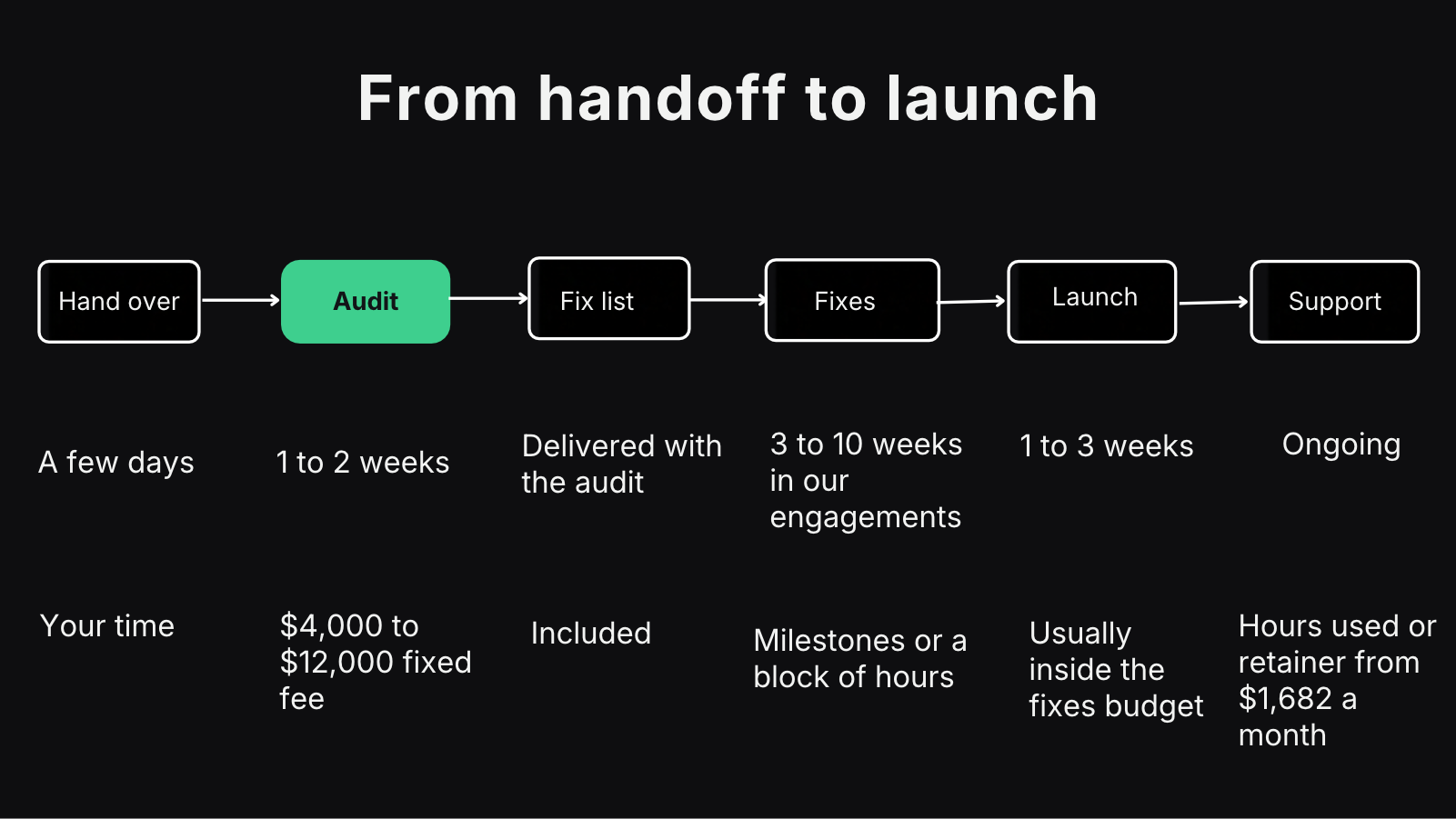
Stage | What you get | Time | Cost, as of November 2026 |
|---|---|---|---|
Before: hand over | Code, database rules and hosting in accounts you own | A few days | Your time |
1. Audit | A written report in plain language and a call on fix or rebuild | 1 to 2 weeks | $4,000 to $12,000 fixed (Leanware's published range) |
2. Fix list | Every finding ranked, scoped and estimated in hours; you pick who fixes each | Delivered with the audit | Included |
3. Fixes | Critical items fixed, staging, tests, backups, monitoring | 3 to 10 weeks in our 2026 engagements | Priced from the fix list: milestones or a block of hours |
4. Launch | A pilot with one team, then everyone | 1 to 3 weeks | Usually inside the fixes budget |
After: support | Patching, alerts, small changes | Ongoing | Hours used, or a retainer from $1,682 a month |
Want the fixed fee for your app’s audit? Book a 30-minute call with an engineer.
What to Hand Over Before Anyone Reads the Code
A team can only fix what it can read, so the first step is putting the code, database rules, and hosting in accounts you own.
Before the audit starts, gather:
- The code repository in a GitHub organization you own.
- Read access to the database, or an export of its structure that includes access rules and functions.
- Access to the app’s hosting, such as Lovable, Vercel, Netlify or Replit.
- A list of integrations and where their keys are stored. Do not paste keys into the chat.
- A tagged version of the code for the audit, since the code changes daily.
- A description of who uses the app and how much data it holds.
- Important dates, including launch, a big customer’s arrival or an investor meeting.
Rob’s main tables and access rules existed only in the live database. The repository alone was not enough to rebuild or test the app. Because he changed code daily, the audit ran against a frozen version, so findings referred to the same code throughout.
Use the production readiness checklist to see what’s missing before handover.
Stage 1: The Audit Tells You What You Actually Have
A fixed-fee audit of one to two weeks reads the code, the database and the deploy setup, and ends in a written report, a ranked fix list and a call on fix or rebuild.
Rob wrote the database functions carefully, protected customer links and limited field staff to the data they needed.
Notes his AI tool had written inside the project said the app was not ready for a full launch. Three features he had shown us did not work as he thought:
- The GPS check on technician clock-ins ran only in demo mode.
- Moving a deal one column along the pipeline marked it as signed and emailed the customer.
- The invoice screen sent a different draft from the one displayed.
During the audit, urgent security issues are reported the day they are found, and small fixes happen as the review proceeds. The owner can keep building on a separate branch.
The Code Audit delivers a written report, findings estimated in hours, a fix-or-rebuild recommendation and a quote you can take to another team. An audit is not a penetration test. The vibe coding security risks guide explains the vulnerabilities that make this review necessary.
Stage 2: A Fix List That Is Ranked, Scoped and Estimated
Every finding lands in one of three buckets (before the next customer, this quarter, or leave alone), with an hour estimate and a choice of who fixes it.
Problems that could harm users, expose data or affect money come first. Next are issues blocking launch, followed by code that makes future changes slower. Well-built parts stay as they are.
Each estimate is a range. You choose whether the team handles an item or you fix it with AI and have the team review it. As of November 2026, reviewing costs roughly a third of doing the work, so you can keep building while getting engineering review.
Rob’s list separates the immediate launch work from changes that can follow. The estimated total was about 130 to 220 hours before launch, plus about 150 to 240 hours within the following 90 days. The table shows the main findings rather than the full list, as its rows do not add up to those totals.
For example, Rob could add two-factor sign-in and have the team review it. The team would handle the database access rules and deployment problems.
Finding, in plain language | Bucket | Estimate | Who fixes |
|---|---|---|---|
Anyone could sign up, and server functions trusted any account that called itself an admin, so a stranger could have sent email from the company's domain | Before the next customer | 8 to 14 h | Team |
Admin accounts protected by a password only: no two-factor sign-in, leaked-password check off | Before the next customer | 3 to 6 h | Rob, team reviews |
Access rules for the main tables existed only in the live database and had never been tested with a non-admin user | Before the next customer | 18 to 30 h | Team |
Moving a deal one column on the pipeline marked it signed and emailed the customer | Before the next customer | 5 to 8 h | Team |
The invoice screen showed one draft and sent another | Before the next customer | 4 to 7 h | Team |
Edits typed during the 20-second background refresh could silently disappear | Before the next customer | 5 to 10 h | Team |
One environment, two ways to deploy, none of the 6 server functions deployed, no error tracking, no point-in-time backups | Before the next customer | 28 to 45 h | Team |
Every admin tab downloads the whole database every 20 seconds, and the app stops opening at around 20,000 records | This quarter | 45 to 70 h | Team |
The quote editor had been rewritten on top of itself about 20 times, each AI change wrapping the last | This quarter | 35 to 75 h | Team, with guardrails from day one |
Database functions, customer links and field-staff data limits | Leave alone: well built | 0 h | Keep |
Want a list like this for your app?
In one to two weeks, for a fixed fee of $4,000 to $12,000 as of November 2026, you can get a ranked fix list with hours. Any engineer can work from it, ours or someone else’s.
Fix or Rebuild: What the Audit Decides
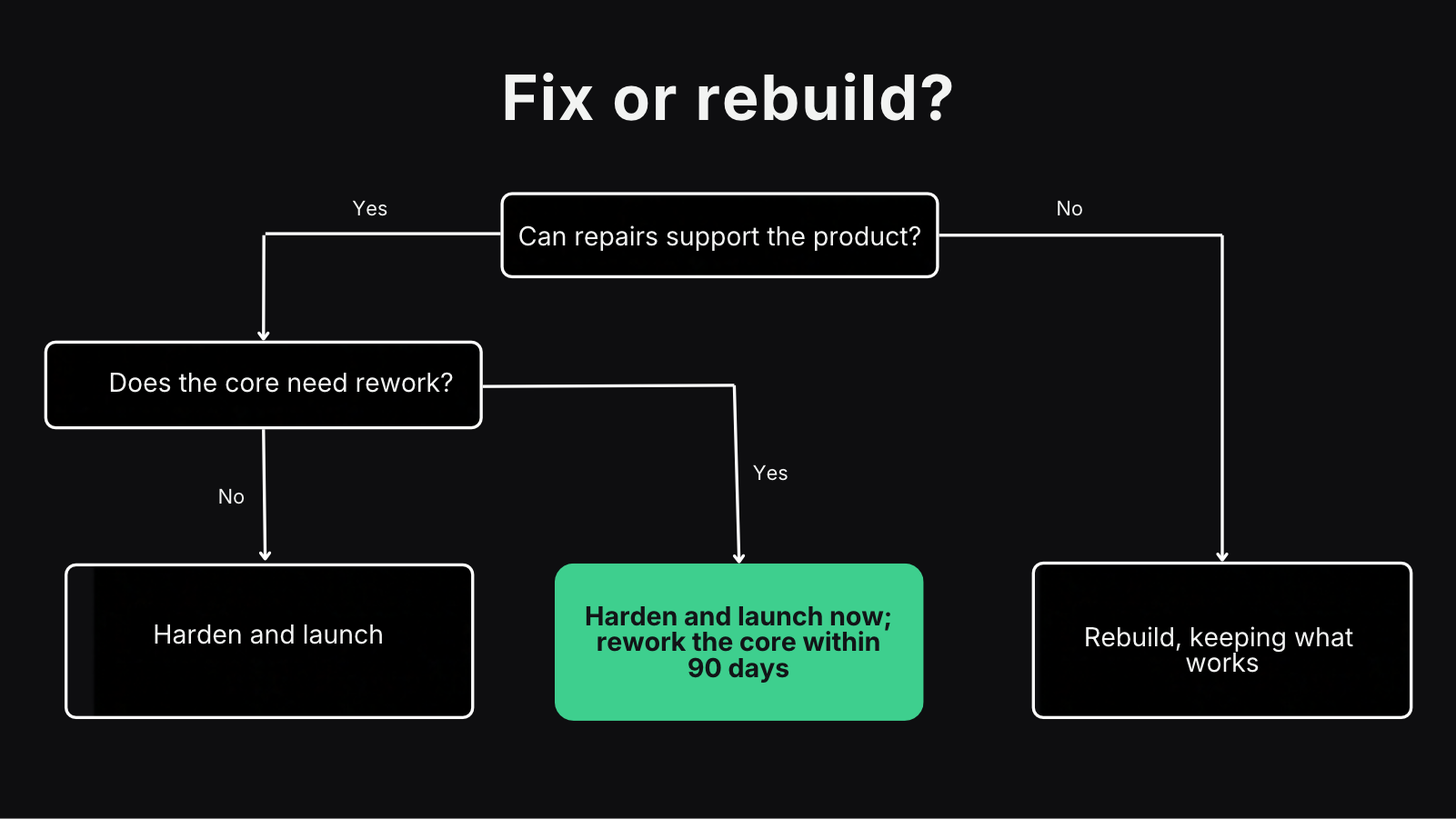
Rebuild only when the data model or the architecture cannot carry the product. Otherwise, harden it; for Rob, that was estimated at 20% to 35% of rebuilding the same scope.
Whether to refactor or rebuild a vibe-coded app is the audit’s call, and it can recommend three paths.
Harden and launch. The business logic is right, and the problems sit in configuration, deployment and a few workflows. Fix those issues and keep the existing app.
Harden and launch now, then rework the core within 90 days. This was Rob’s case. The review found his app suitable for a pilot when fixed, but unable to support many more months of AI-added features. His launch fixes and the work needed over the following 90 days therefore had separate estimates.
Rebuild, keeping what works. This makes sense when the data model cannot represent the business or access control would need to be redone anyway. Another reason is code that cannot run outside the tool that created it. The business rules and data can still carry into the replacement.
Before agreeing to a rebuild, ask the vendor to show why repairs cannot support the product.
For context, see vibe coding vs software engineering. If a rebuild is necessary, Sprint 0 scopes the work before you commit to the build.
Stage 3: Fixes, Priced as Milestones or a Block of Hours
Once the fix list exists, fixes can be priced three ways, and the right one depends on how well the scope is known.
Fixed-price milestones fit a large app with a clear repair list. Each milestone has acceptance criteria, so you can check the result before paying and decide whether to continue. Engagement C offered optional milestones, each priced two ways: the team does the work, or the owner does it and the team reviews it.
A prepaid block fits smaller tasks or a list that is still settling. You pay upfront and use the hours as needed. Engagement B used about $5,000 for roughly 75 hours, valid for six months, as of November 2026.
Rob’s plan also used a block of hours for fixes.
On-demand hours fit changes and incidents after launch, when the amount of work varies. You pay for the hours used, with no monthly minimum.
Pricing | Best when | How you pay | Example |
|---|---|---|---|
Fixed-price milestones with acceptance criteria | The list is clear, and the app is large | Each milestone on acceptance; stop after any one | Engagement C: a menu of optional milestones, each priced "we do it" or "we review yours" |
A prepaid block of hours | Many small items, or the list is still settling | Up front, used as needed | Engagement B: about $5,000 for roughly 75 hours, valid six months |
On-demand hours | After launch, for changes and incidents | Hours used, no monthly minimum | From $40 an hour for a mid-level engineer, as of November 2026 |
When the fix list is clear, compare fixed-price and milestone contracts. With milestone billing, you pay when you accept the work.
For a large app, a Sprint 0 ($5,000 to $15,000 fixed, as of November 2026) turns the fix list into a milestone plan.
Keep Building While It Gets Fixed
You do not have to stop shipping: build on a branch, let the team review what you merge, and freeze the database schema while the audit runs.
Branch protection and required checks control which changes reach the shared code. A rules file, such as CLAUDE.md or .cursorrules, records the team’s conventions for the AI tool to follow. Changes to the database schema, access rules, sign-in and billing require engineering review before merging.
A shared Slack channel keeps questions and decisions visible, while a weekly demo lets the owner and engineers review working changes together.
Rob’s quote editor shows why these guardrails matter. It had been rewritten on top of itself about 20 times, with each AI change wrapping the last. Adding more features to that code makes the next change riskier.
Stage 4: Launch to a Pilot First
Launch to one team first, with backups tested and alerts on, then roll out to everyone after a week or two of real use.
A pilot gives a smaller group time to use the repaired app in their daily work before everyone depends on it. The fixes need to hold up through real tasks, including the flows the audit found unreliable. For Rob, those included technician clock-ins, moving deals through the pipeline, and sending invoices.
Before the pilot, confirm these launch gates:
- A staging environment that matches production.
- Tracked database changes.
- One completed restore drill.
- Error and uptime alerts that reach a phone.
- Data moved from the old systems.
- One to two weeks of close support arranged for after launch.
Use the checklist for the operations checks behind these gates.
Rob’s plan put the office and one field team into a pilot in week 4 or 5 after signing. Full rollout was planned for around week 8. These were planned dates, not completed outcomes.
If the App Will Hold Health or Payment Data
Health or payment data calls for a deeper review. Before using real patient data, put business associate agreements in place with hosting and AI vendors. After the fixes, arrange an outside security test and a retest.
Use a dated readiness letter stating what was reviewed and against which checklist, rather than claiming “HIPAA compliant”. Route card payments through hosted checkout so card data never touches the app.
Engagement C’s plan called for a three-week review, fixes over the following two months, and a readiness letter before the first real patient record.
After Launch: Name Who Answers at 2 a.m.
Someone has to patch, watch alerts, and make small changes, and you can pay for the hours used instead of a retainer you don't need. Choose on-demand hours for occasional work, a prepaid block for a series of changes, or a retainer for regular support. As of November 2026, the retainer starts from $1,682 a month for 42 hours. Before launch, name who receives alerts, when they respond and how you contact them. Confirm those arrangements through Support and Maintenance, including whether overnight response is covered.
What It Costs and How Long It Takes
In three 2026 engagements, the first commitment ran about $5,000 to $11,000, and the whole path to launch about $5,000 to $34,000, set mostly by the app’s size and how sensitive its data is.
The commitments covered different work. Rob’s audit led to a block of fixes, while Engagement B combined setup, security work and small repairs. Engagement C planned a deeper review followed by optional milestones before using real patient records.
The figures below are engagement-specific budgets and plans, as of November 2026. Rob’s rollout dates and Engagement C’s launch path are plans, not completed outcomes.
App | Built with | First commitment | Path to launch | Time |
|---|---|---|---|---|
A. Rob’s property-maintenance CRM | ChatGPT and Claude, on Supabase | $8,000 audit | Audit, then about $10,000 for roughly 150 hours of fixes | Two-week audit, pilot planned for week 4 or 5; full rollout around week 8 |
B. Distribution company’s CRM and dashboards | Claude Code, on Supabase | About $5,000 prepaid block | Roughly 75 hours covering setup, a security-first pass and small fixes | Block valid six months; then hourly support, no retainer |
C. Vibe-coded SaaS for clinics holding patient records | Mostly Claude | About $11,000 fixed review | About $14,000 to $34,000 through launch | Three-week review; fixes over the following two months; readiness letter before the first real patient record |
Leanware’s reference rate starts from $40 an hour for a mid-level engineer, as of November 2026. Senior engineers handle security and architecture work at a higher rate.
For comparison, a Fiverr gig to review and fix vibe code starts at $100 for its basic package, as of November 2026. That suits one defined bug, not a ranked fix list for the whole app.
For Rob, hardening was estimated at 20% to 35% of rebuilding the same scope. Compare what each quote covers before treating a lower starting price as a lower launch budget.
Fix or rebuild?
Send us the app’s URL and tell us how you built it. On a 30-minute call, we confirm the audit fee inside the published range or tell you an audit is not what you need.
Freelancer, Marketplace or Agency: Who Should Take It Over
Choose based on what you get at the end and who owns what, not on the hourly rate.
A vibe code cleanup specialist is an engineer who audits and repairs AI-generated code, work often called vibe coding cleanup. A vibe coding agency may build with AI or fix AI-built apps, so ask which services it provides. Listings for vibe coding services can describe either kind of work.
Option | Fits when | Watch for |
|---|---|---|
A marketplace gig | You need one clearly defined bug fixed. | Confirm the exact task and what the seller will deliver. |
A freelance specialist | You need an engineer to assess and repair the app. | Ask who handles support and handover if they leave. |
A development firm | The app needs several kinds of expertise and ongoing support. | Require a usable fix list and control of your accounts. |
Carrying on alone | The app is small and internal and holds no customer or payment data. | No one checks access rules, backups or security before users find the gaps. |
When you look for Lovable help or hire a Lovable developer, ask about database rules, deployment and apps they have taken over. The same questions apply to a Base44 developer or Replit expert. Calling a supplier a Lovable agency or a Lovable developer tells you which tool they know, but little about the handover.
Before choosing, check for:
- Published prices.
- A fixed-fee audit before any build quote.
- A fix list any engineer can use, even if you leave.
- Work in your GitHub, database, hosting and domain, with credentials in your vault.
- A named engineer you can interview.
- References from apps they took over.
- Support billed for hours used.
- Proof the app cannot be repaired before a rebuild quote.
Rob needed help with access rules, deployment and unreliable workflows while he kept building. Ask each option who would still answer for the app after the fixes.
Final Thoughts
A fixed-fee audit tells you whether your app needs repairs or a rebuild and gives you a ranked fix list. You choose who handles each fix, keep control of your code and accounts, and launch with one team before rolling out to everyone.
Hand it off without starting over. Book the 30-minute call.
Frequently Asked Questions
Can I hire someone to fix my vibe-coded app instead of rebuilding it?
Usually, yes; an audit determines whether your app can be repaired or needs rebuilding. A rebuild makes sense only when the data model or architecture cannot support the product. Rob’s path to launch was estimated at 20% to 35% of rebuilding the same scope.
How much does it cost to fix a vibe-coded app?
As of November 2026, Leanware’s fixed-fee audit costs $4,000 to $12,000. Fixes are priced from the resulting list, with hourly work from $40 an hour for a mid-level engineer. Across the three 2026 engagements, the path to launch ranged from about $5,000 to $34,000, including planned work.
How long does it take to go from audit to launch?
The audit takes one to two weeks; the launch timeline depends on the fixes and testing required. Rob’s plan puts a pilot in week 4 or 5 and full rollout around week 8. Apps holding health data take a few months because they need an outside security test and retest.
What should I give a developer before handing off my Lovable, Replit, Base44 or Claude Code app?
Provide the repository in a GitHub organization you own, database access including its rules, hosting access, an integration list and a tagged version to audit. Keep credentials in your vault rather than chat. Use the production readiness checklist for the export checks before handing everything over.
Can I keep building with AI while my app is being fixed?
Yes, you can keep building on a separate branch while the team reviews changes before merging them. Freeze the database schema during the audit so the findings refer to a stable version. Changes to access rules, sign-in and billing also need engineering review.
Should I hire a freelancer, a Fiverr gig or an agency to fix my vibe-coded app?
Choose according to what is at stake: a marketplace gig can handle one defined bug, while business-critical apps need broader accountability. If the app holds customer or payment data, or your staff depend on it, start with a fixed-fee audit and name who supports it afterward.
Who owns the code and the accounts after the handoff?
You keep ownership of the code and accounts after the handoff. The team should work inside your GitHub organization, database and hosting accounts, with credentials kept in your vault. You can stop after any stage and take the findings to another engineer.
What does a vibe code cleanup specialist do?
A vibe code cleanup specialist audits and repairs AI-generated code, addressing security weaknesses, testing and deployment. The work usually includes setting up monitoring and backups. An audit should explain what needs fixing, what can stay and whether the app needs deeper changes before launch.
My app will hold health or payment data. What changes?
Health or payment data requires a deeper review and additional checks before launch. Put the relevant vendor agreements in place before using real patient data. Arrange an outside security test and retest, use hosted checkout for cards, and request a dated readiness letter stating what was reviewed.
How do I compare companies that fix vibe-coded apps?
Compare published prices, a fixed-fee audit, a portable fix list and work performed in accounts you own. Ask to interview the named engineer and see references from apps they took over. Before accepting a rebuild quote, require evidence that repairs cannot support the product.


