What Is Sprint Zero (Sprint 0) and What Should It Actually Cost?
If a vendor puts Sprint 0 at the top of a proposal it is hard to tell if the price is fair. Let me give you the definition and the cost in one place.
Sprint 0 is the scoping sprint that happens before Sprint 1. It takes two to four weeks. Usually costs between $5,000 and $15,000 as a fixed fee.
The rest of this guide explains where that number comes from. I will show you how to tell if the version you are being quoted is worth your money.
Why Sprint 0 is Hard to Get an Answer On
If you ask a vendor what Sprint 0 costs they will usually ask to get on a call instead of giving you a number. That is a sales habit but it is a useless answer when you are trying to plan a budget.
Most articles and guides that explain the concept do not talk about money/cost. The ones that do talk about discovery pricing use different names for the same work so the two parts of your question never meet. This guide puts them together starting with what you're actually buying.
What is Sprint 0?
Sprint 0 is the prep work that happens before Sprint 1. It exists so the actual build follows a plan instead of a guess. The name is a description rather than an official term since Sprint 0 is simply the sprint that comes before the first one. You might also see people call it a product discovery sprint, a discovery phase or a scoping sprint.
Sprint 0 should not be a planning meeting with an invoice attached. If a Sprint 0 only produces documents, the hard work has just been moved into the build phase. That is the most expensive place to fix mistakes.
Sprint 0 vs. Product Discovery Sprint
Discovery sprint, design sprint, and sprint 0 are all names for the same process. A design sprint, however, is a term that refers to a much narrower concept. The easiest thing to do here is simply to forget the terminology and look at what is left in our hands.
Term | Typical length | What you walk out with |
|---|---|---|
Design sprint | 5 days | A tested prototype and a validated direction |
Product discovery sprint | 1 to 4 weeks | Research, defined scope, usually documents |
Sprint 0 | 2 to 4 weeks | Scope, stories, design system, architecture and a priced milestone plan |
The design sprint is the most specific of the three. It is a five-day process made by Google Ventures to answer a business question by making a prototype and testing it with customers. It will tell you if an idea works. You finish the week holding a prototype rather than a repository or a build plan.
An AI-made prototype lands in the same place: a Claude Design prototype shows the screens and leaves the scope, the stories and the architecture open.
If someone quotes you a product discovery sprint ask if technical architecture and a scaffolded repository are included. Some include them and many do not. That one answer is usually why two quotes that look similar end up being very different.
Is Sprint 0 Official Scrum or Just Common Practice?
This is a widely accepted practice rather than an officially mandated Scrum activity. According to the Scrum Guide of 2020, there is no reference made to the Sprint 0 or Sprint Zero concept. This concept is neither defined by Scrum.org nor Scrum Alliance. Teams run one anyway. Vendors sell one because the work has to happen somewhere.
Some people call it an anti-pattern. They argue that a sprint which does not produce anything releasable sets a bad habit. I think that argument is really about the name rather than the work. You still need to define the scope and set up the architecture before anyone writes production code. If the name bothers your team just call it a scoping sprint. Move on.
What Happens During Sprint 0: Core Activities
Sprint 0 activities produce four deliverables. Everything else in the sprint is the process used to get to them.
Typical Sprint 0 Deliverables
The first is the UI/UX design and the design system underneath it. This includes the core flows, the key screens and the tokens and components that everything else gets built on. Detailed screen designs come later sprint by sprint using that foundation.
The second is your scope broken into epics and user stories. Each one must have written acceptance criteria. This is the document that ends arguments about what you're actually building. It becomes the standard for testing every milestone once the build starts.
The third is a billable milestone plan. This shows every stage and the price attached to each one. It covers what is included, how it gets accepted and what it bills. The schedule and the billing are the same document here. This means you can work out how much money the full build needs before you commit to any part of it.
For how to judge that plan once it is in front of you, acceptance criteria, payment triggers, and exit terms included, see how to structure payments with a software development agency.
The fourth is the technical architecture. This is delivered as a scaffolded repository with the basic infrastructure already set up. This is what makes a real Sprint 0 different from a slide deck. If discovery ends in paper alone it leaves every technical risk to be handled later during the expensive build phase.
Before you sign anything, check what happens to all of that if you decide not to move forward. We run Sprint 0 as its own product rather than a down payment. This means the scope, stories, scaffolding and plan stay yours no matter what you decide. Any competent engineering team can use them.
Here is how the whole sequence runs, from the call to the first build sprint.
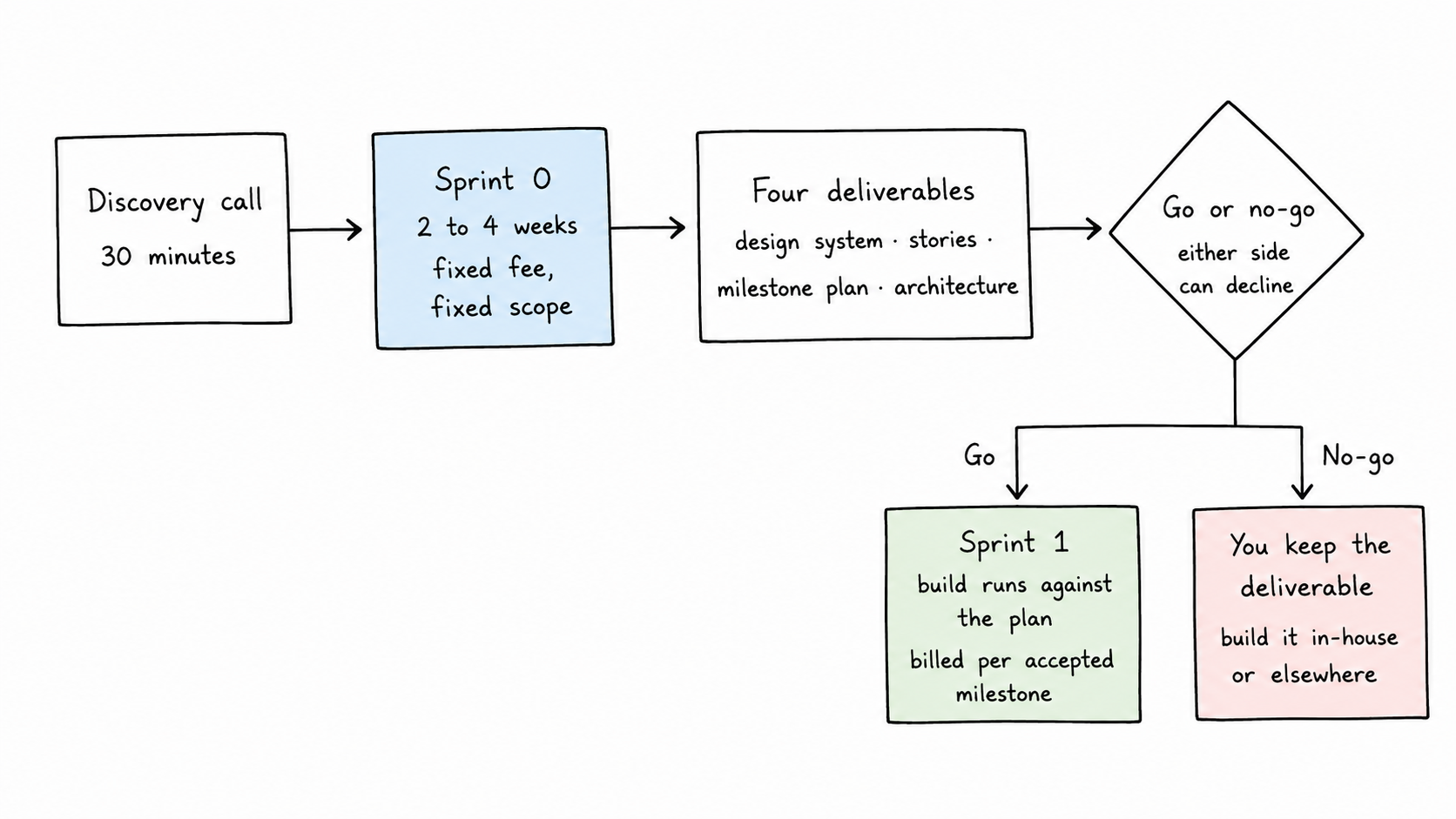
Look closely at the decision point after Sprint 0. If a vendor treats it as a formality they have walked you through a sales process rather than a real scoping engagement.
How Long Does Sprint 0 Take?
It takes two to four weeks. Three things decide where you fall in that window: how many people/stakeholders you need to interview, how many outside systems the plan needs to connect to and how deep the design-system work needs to be.
If someone quotes you less than two weeks you are buying a scoping call with a fancy name on it. If it runs longer than four weeks the work has lost its focus. You are into open-ended consulting.
What Should Sprint 0 Cost?
It should cost between $5,000 and $15,000. This should be a fixed scope and a fixed fee for a two to four week job. That is the range we use and the fee is set during the discovery call and stays the same from there.
It’s easy to match up with your budget. The typical cost of discovery is between 5-10% of the development budget. A project costing $50,000 will be at the lower end of that range while something costing $150,000 will be at the upper end. Apply that ratio to any quote that you receive, including ours. A discovery phase of $15,000 for a $20,000 build is not reasonable.
Be careful at both ends of that range. Free discovery is usually a sales pitch in an engineering costume. Also paying by the hour for discovery gives the work no reason to ever stop.
Fixed Fee vs. Time and Materials for Sprint 0
Sprint 0 has a set scope and a set calendar, which is why a fixed fee works here. You know the price before you start. If the scope changes you negotiate that as its own piece of work instead of letting the price creep up quietly. A vendor who will not give you a fixed price for a four-week sprint will struggle to hold one for a six-month build.
Time and materials is not the weaker model, it is just the wrong one for this kind of work. It suits work where you cannot pin the scope down at all, like an exploratory build or a roadmap that changes every week. In that case nobody has to pretend they know the total. For a bounded four-week sprint it does not fit. Our guide to software development pricing models covers where each of the three genuinely belongs.
What Drives the Price Up or Down
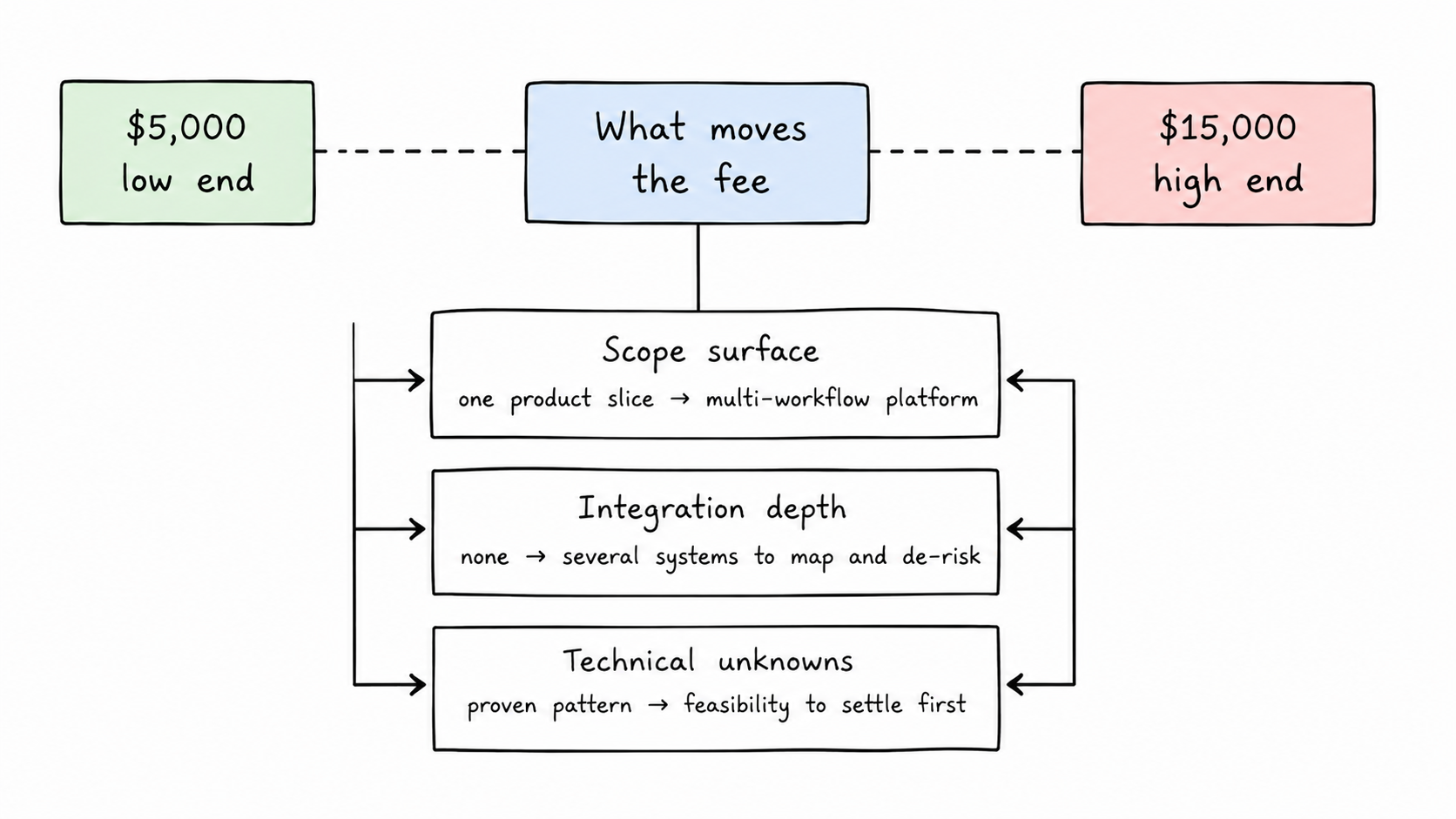
The size of the scope is the biggest driver. A small focused product stays low in the range while a large platform lands near the top. Integration depth matters next. This means how many outside systems the plan has to map out. Technical unknowns are the third factor. If engineers have to spend time proving something can actually be done the price moves up.
Two other things change the number in the market. The number of stakeholders affects how much time goes into interviews. Also team seniority changes the rate though a cheaper junior team usually produces a plan that falls apart once the real building starts.
Is Sprint 0 Worth Paying For?
For most builds, yes. Skipping Sprint 0 does not make the work go away. It just moves the work into the build phase, where making and unmaking the same decisions costs a lot more.
Research from PMI on requirements management found that 47% of unsuccessful projects fail to meet their goals because the requirements were wrong not because the code was bad.
The other reason is simpler. A priced milestone plan tells you what the whole build will cost before you spend any money on it. Without one you are agreeing to a number someone said on a call. Estimates for the same project vary wildly between vendors because everyone assumes something different about the unknown parts.
There is one exception. If your project is small, does not need to connect to outside systems and follows a shape you have built many times before, four weeks is longer than you need. A one-week scoping session covers it. Paying for a full Sprint 0 would mean paying for certainty you already have.
Choosing the Right Partner for Sprint 0
Four things separate a Sprint 0 worth buying from a discovery phase worth skipping.
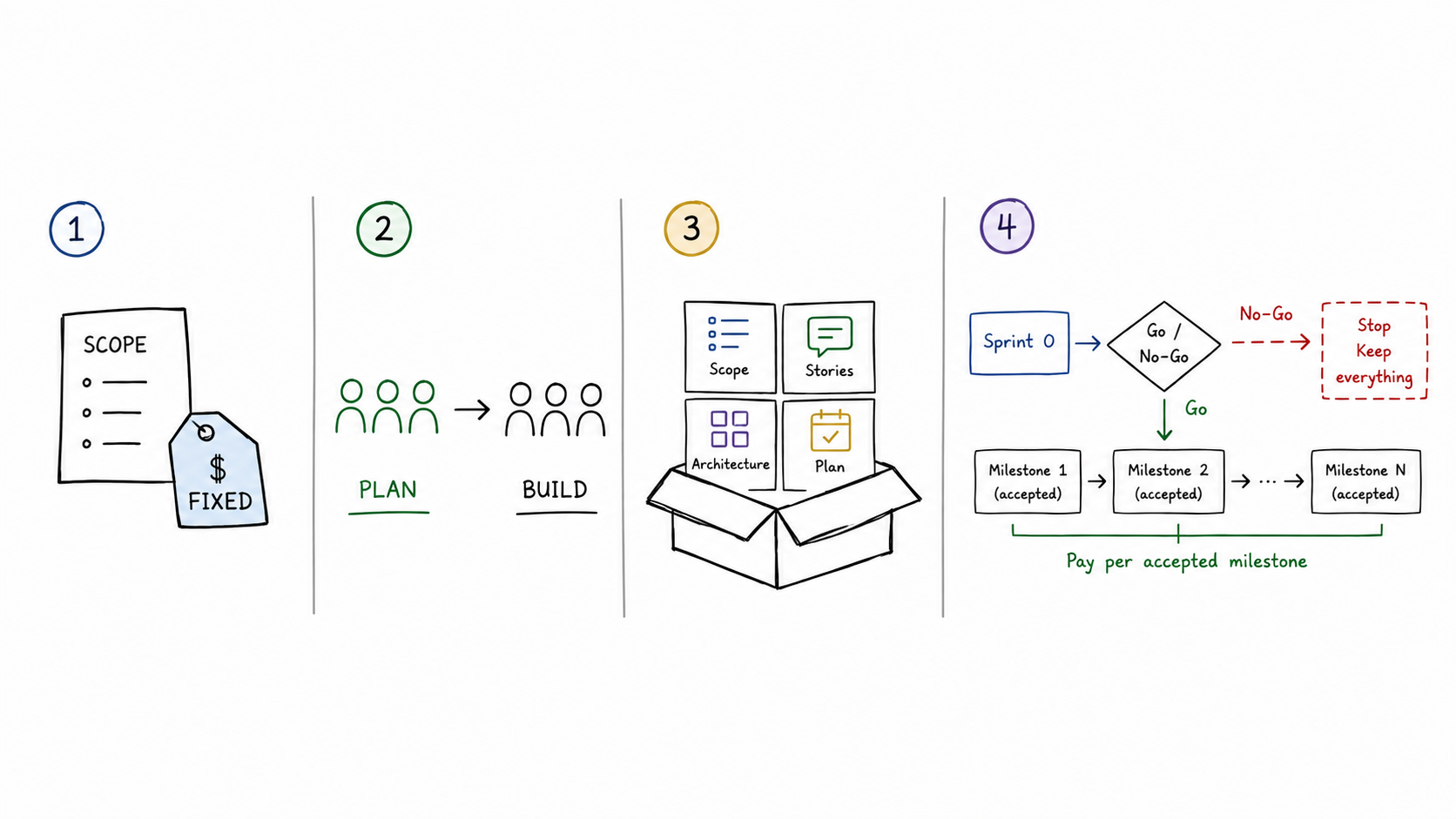
You should start with a fixed scope and a fixed fee that they tell you before any work starts. If a vendor cannot give you a price for four weeks of bounded work they are showing you exactly how they will price your build later.
Next you should ask if the same team will stay for the build. I truly believe the people who plan the work should be the people who do the work. If the planning gets handed off to a different team the estimate becomes useless and the project requirements get lost in the process of transfer.
Ask the vendor directly what you will get to keep if you decide not to move forward. You should be the owner of scope, the stories, the architecture and the plan. These things should be useful to any engineering team. If a vendor needs a moment to answer that question you already know the truth.
Finally look at how the project's set up to end. The best way is to have a go-or-no-go decision after Sprint 0. Then you should pay for the build based on milestones that you have accepted. This way you can stop at any point and keep everything that was finished. This is how our milestone-based engagement model works. We write the exit terms down at the start so we do not have to argue about them when a relationship turns bad.
Your Next Step
Sprint Zero is the preparation sprint that happens before Sprint 1. It takes two to four weeks. It costs $5,000 to $15,000 as a fixed fee. The price is not hard to figure out. It is just that many vendors prefer to tell you on a call instead of writing it down.
Get two things in writing before you commit to anything: the fixed fee and the calendar window. You only need thirty minutes to get both. If a vendor cannot give you either one you have learned what you needed to know.
If you want to talk through what a Sprint 0 would look like for your own project, that is what our Sprint 0 engagement is set up for. You get the fee and the calendar window on the discovery call, and the deliverable is yours either way.
Frequently Asked Questions
Is Sprint 0 worth paying for?
For most product builds, yes. It is much cheaper to define the scope up front than to find out the scope in the middle of a build. The only exception is a project that is very simple and has no integrations. For those a one-week scoping exercise is enough.
What does Sprint 0 include?
There are four deliverables: UI/UX design and the design system, epics and user stories with written acceptance criteria, a billable milestone plan with every milestone defined and priced, and the technical architecture delivered as a scaffolded repository.
How long does Sprint 0 take?
Generally between two and four weeks. Depends on the number of stakeholders, external integration requirements, and design system requirements.
How much does Sprint 0 cost?
Normally around $5,000 to $15,000 as a fixed cost for a fixed scope. It actually varies according to the scope size, the level of integration and how many technical unknowns Sprint 0 has to solve before the plan's ready.
Is Sprint 0 the same as a product discovery sprint?
Sort of. Most vendors use both terms to mean the same thing. However, the main difference is that a discovery sprint might not include the engineering setup. Before comparing quotes, ask whether technical architecture and a scaffolded repository are included.
Leanware’s product discovery services page shows the version that includes the engineering setup: Sprint 0 at $5,000 to $15,000, two to four weeks, with the architecture and the scaffolded repository in the deliverable.