How Much Does an AI Agent Cost to Build and Run?
How much does an AI agent cost? The answer depends on which of four payment models you choose. Options range from a self-serve subscription for a simple task in one system to a setup fee plus a monthly fee for an engineered agent that handles a business process across several systems.
As of October 2026, Gumloop Pro starts at $37 a month and Intercom Fin at $0.99 per outcome; those are software prices, not implementation budgets. For an engineered agentic AI workflow, McKinsey’s example puts the cost of running a conversational agent that onboards 2,500 new customers a year at $10,000 to $15,000.
This guide helps operations leaders, CFOs, COOs and founders estimate AI agent cost before a vendor conversation. If you have order intake, invoice processing, quoting or submission triage in mind, it explains what to budget for agentic AI and what each price includes.
Every cost figure in this post names its source (a vendor pricing page or research from Gartner, McKinsey, Deloitte, IBM, APQC or Ardent Partners), and we checked all of them in October 2026. Treat agency-published cost ranges as agency price lists, not studies.
AI Agent Cost at a Glance: Four Ways to Pay for One
The price depends on what you buy and who maintains it. A subscription gives you tools to configure yourself. A vendor agent charges for usage inside an existing product. A custom agent adds engineering costs, and your team or a managed provider handles ongoing operations.
The vendor prices below come from their own pricing pages, as of October 2026. They are starting prices.
Way to pay | Upfront cost | Monthly cost | What the monthly cost covers | Who keeps it running | Fits when |
|---|---|---|---|---|---|
Self-serve platform agent: Lindy, Gumloop or Zapier Agents. | No custom build fee; your team configures it. | Per-seat or usage subscription. For example, Gumloop Pro starts at $37 per month. | Platform access and included usage, with additional usage charges depending on the plan. | You configure and maintain the workflow; the vendor operates the platform. | A predictable trigger-and-action task in one or two tools. |
Vendor agent priced per action or resolution: Salesforce Agentforce or Intercom Fin. | No custom build required; configuration and integration work may still cost money. | Usage-based charges. For example, Intercom Fin starts at $0.99 per outcome; you also pay for the messaging channels you use. | The vendor’s agent service, billed by conversation, action or outcome. | The vendor operates the agent; your team manages its settings and business content. | High-volume work centered on the vendor’s product. |
Custom build you run yourself. | Engineering costs for an in-house team or one-off contractor. | Model API usage, hosting, monitoring and engineer’s time. | The infrastructure and ongoing technical work you pay for separately. | Your internal AI team or a retained engineer. | Your company already has an AI team that can own the agent. |
One setup fee, fixed at signing. | One monthly subscription. | Hosting, model API costs, monitoring, ongoing refinement and support, with no separate invoices for the cloud, the model providers or the tooling. | The provider. | A workflow crosses several systems, and you do not want to staff an AI team. |
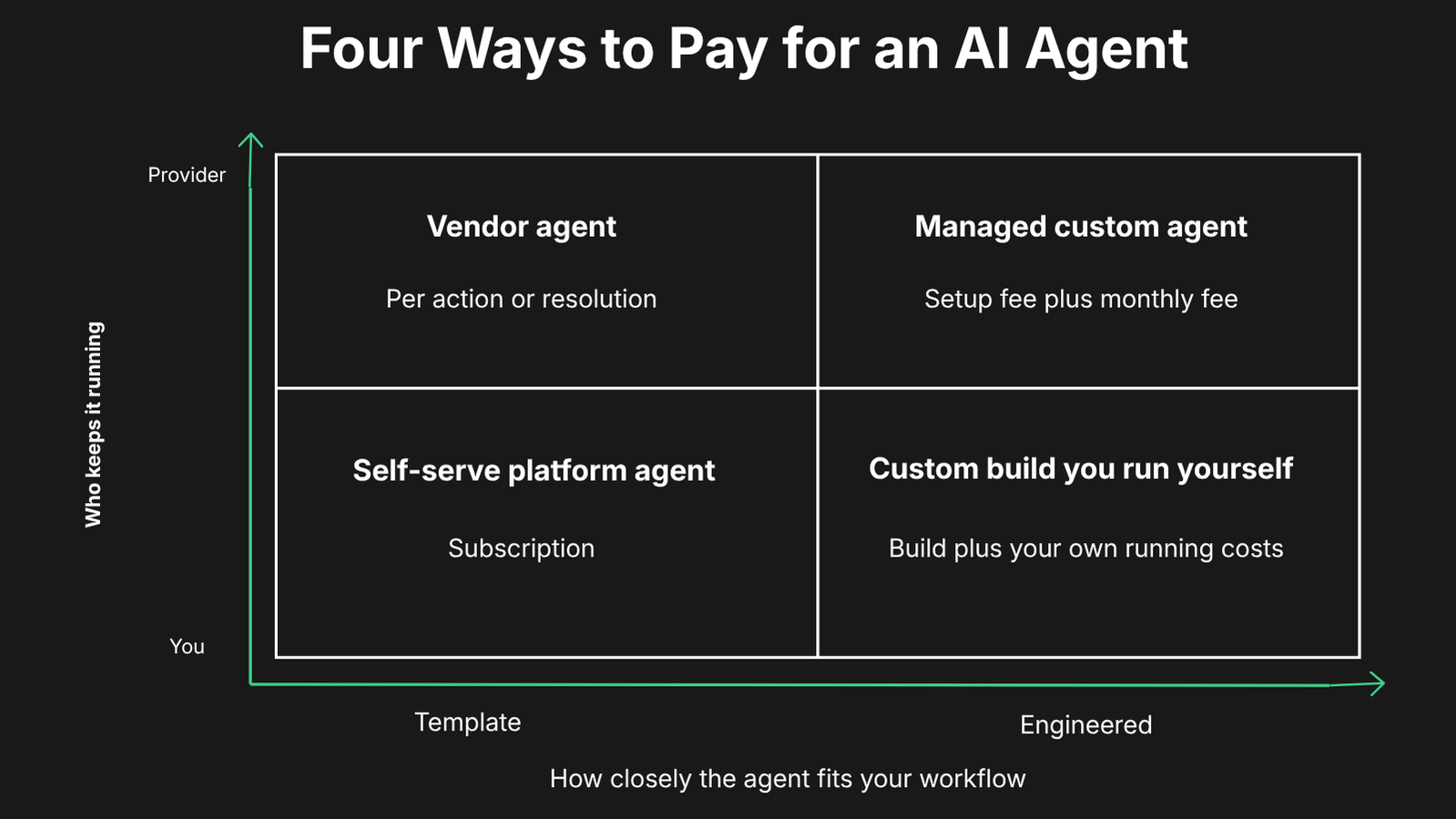
For the work they fit, self-serve platforms and vendor agents are the cheapest options. A custom build makes sense when the workflow needs integrations, exception handling, or ongoing engineering that those options don't adequately cover.
Leanware’s setup fee plus a monthly subscription follows the managed model shown above. Any scope expansion is agreed in advance.
AI Agent Development Cost: What the Setup Fee Pays For
AI agent development cost depends on what it takes to make a process reliable in production. How much does it cost to build an AI agent? That comes down to the steps it performs, the systems it connects to, how often it hits exceptions and what compliance requires.
The setup fee covers workflow design, system integration, test case preparation, and ensuring the agent handles routine work and exceptions. These four drivers determine how much engineering that takes.
Driver | What it adds to the build | How to estimate it for your process |
|---|---|---|
Number of steps | Each decision or action adds logic, tool calls and testing. Leanware’s agents page calls step count the primary complexity proxy. | Map the process from arrival to completion. Count the decisions and actions the agent must perform, including exception paths. |
Systems of record | Each system the agent reads from or writes to needs integration, permissions, data mapping and failure handling. | List the systems involved, what the agent must read or change, and whether usable APIs exist. |
Exception rate | Varied formats, missing fields and conflicting information require additional validation, routing and test cases. | Review a sample of real inputs. Record how often cases need clarification or manual correction and why. |
Compliance requirements | Audit trails, regulatory documentation and human approval gates add controls and testing. | Identify which actions require approval, what evidence must be retained and who must review it. |
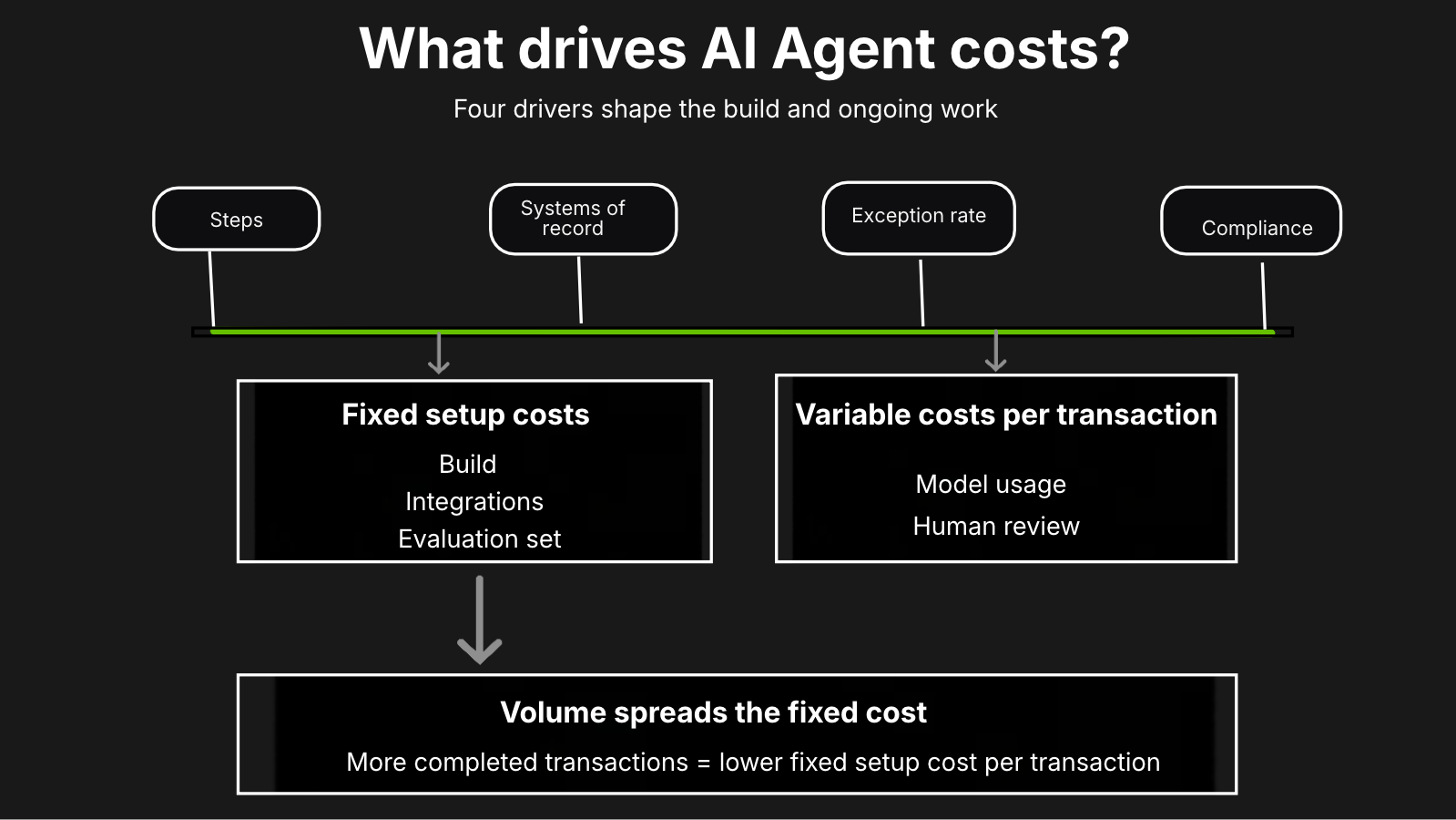
Applied to the invoice example later in this post: the steps run from reading each invoice to posting it, the agent reads from email and the supplier portal and writes to the ERP, and the exceptions are supplier formats that vary, missing purchase orders and three-way matches that fail. Any approval required before an entry posts adds to the compliance work.
Research does not provide a standard build-cost range that can reliably price your specific business process. Agency price lists circulating online are not research benchmarks, so this post does not repeat them.
Research explains how costs behave. McKinsey’s Where AI agents pay off: A practical guide to the economics of agentic workflows separates fixed operating costs, such as infrastructure and orchestration, from variable costs, such as model usage and human review. For your setup budget, separately account for the initial build, integrations and evaluation set: real cases to test performance.
McKinsey’s example covers running costs only: a conversational agent onboarding 2,500 customers per year costs $10,000 to $15,000 to run. If you double that volume, the cost rises to $15,000 to $20,000.
More completed cases spread fixed costs across more work. That makes volume and per-case savings more useful for judging a setup fee than the agent’s sophistication alone. Reusing an agent across workflows with shared tasks can also spread development costs, although new integrations and testing still require work.
Leanware’s proposal specifies the setup fee, monthly fee, number of steps, number of integrations, target savings, and target ROI for the client to sign off on. Its stated build timeline is 3 to 10 weeks. For the implementation steps behind that scope, see how to build an AI agent.
How Much Does It Cost to Run an AI Agent Each Month?
AI agent cost per month covers everything that keeps the workflow reliable: model calls, infrastructure, monitoring, evaluation, human review and engineering support.
Monthly cost | What makes it grow |
|---|---|
Model API usage | More cases, more model calls per task, longer inputs and outputs, and retries. |
Hosting and infrastructure | More simultaneous tasks, stored documents, database activity and availability requirements. |
Monitoring and observability | More activity to log, longer retention periods and more systems to track. AI agent monitoring also requires someone to investigate alerts. |
Evaluation and refinement | New document formats, changing business rules and additional test cases that require prompt or retrieval updates. |
Human review of exceptions | More escalations, longer reviews and the expertise needed to resolve each case. |
Engineer support | Integration failures, model changes and shifts in accuracy or behavior that require investigation and fixes. |
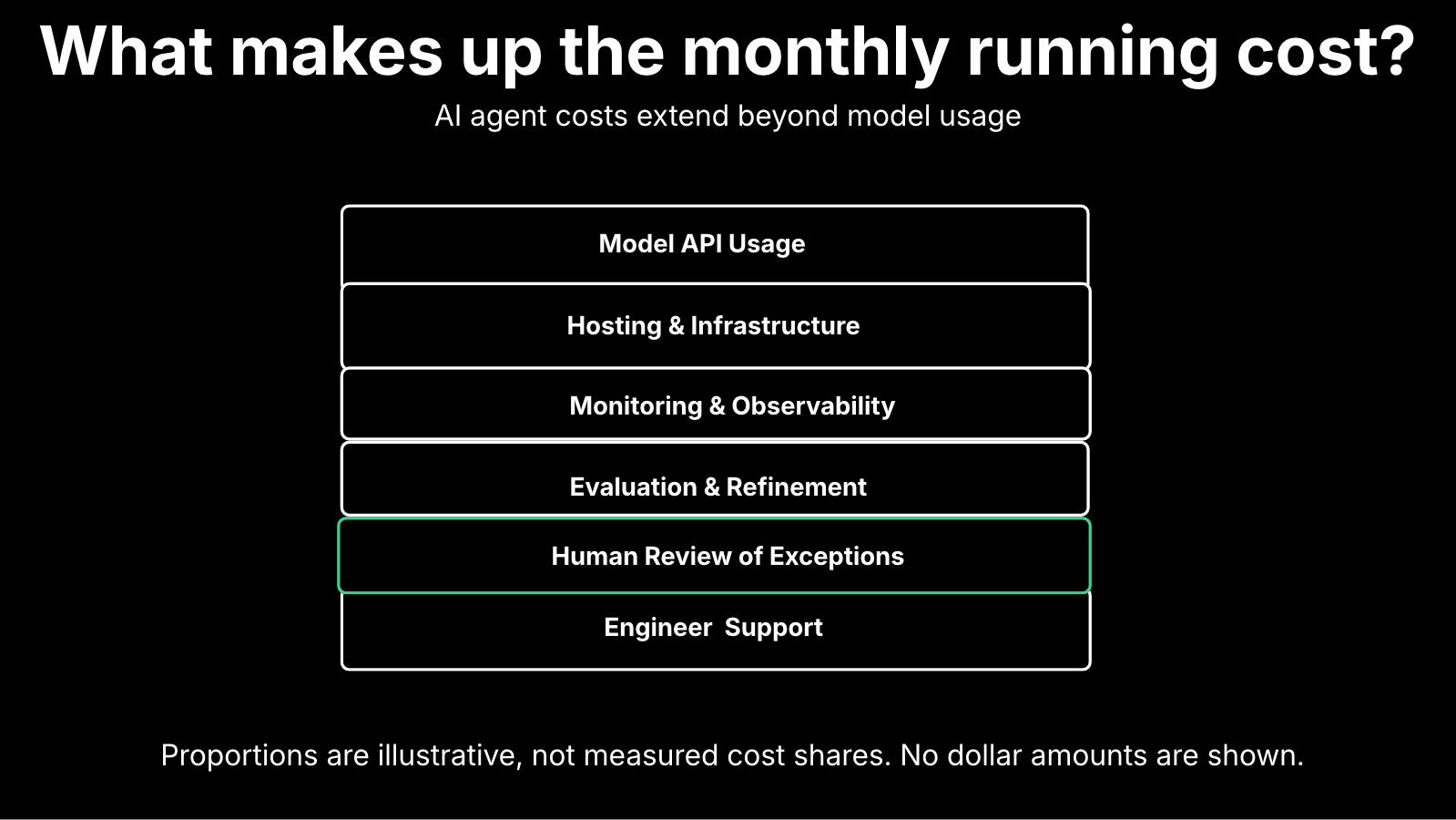
An agent can make multiple model calls to complete one task. Its token bill therefore depends on monthly volume multiplied by calls per task and tokens per call.
For an illustrative calculation, take the invoice example worked through below: assume 5,000 invoices per month, four calls per invoice, and an average of 2,000 input tokens and 500 output tokens per call. Anthropic’s pricing page lists Claude Haiku 4.5 at $1 per million input tokens and $5 per million output tokens, as of October 2026.
Illustrative monthly token cost: 5,000 x 4 x [(2,000 / 1,000,000 x $1) + (500 / 1,000,000 x $5)] = $90.
This example assumes standard API rates without caching or batch discounts. It excludes retries, separately billed tools and every other cost in the table.
For teams running their own agent, controlling model API costs is only part of the job. Regular evaluation checks whether the workflow still performs correctly as inputs and business rules change.
In Leanware’s managed service, the monthly subscription covers hosting and infrastructure, the model API costs, observability and monitoring, ongoing prompt and retrieval refinement, evaluation against your workflow over time, and senior-engineer support when accuracy or behavior moves. New work or scope expansion is agreed in advance against a signed change order. Budget your own reviewers’ time separately.
The review time can outweigh the token bill. In McKinsey’s banking customer service example, tokens account for roughly 20 to 25% of variable running costs, while human oversight accounts for 70 to 75%.
The cost of a human step doesn't disappear: reviewers handle exceptions. In a review-heavy workflow, reducing avoidable escalations can save more than switching to a cheaper model, provided accuracy and required oversight remain intact.
Lower token prices don't guarantee a smaller bill. In its August 17, 2026 forecast, Gartner predicts that AI inference costs per agentic workflow will rise more than fivefold through 2028. Tokens are getting cheaper, but multistep workflows use far more tokens than a simple chatbot exchange, which is one of the reasons Gartner gives.
How Much Does Agentic AI Cost Compared With a Chatbot or a Workflow Tool?
Agentic AI usually costs more than a chatbot answering one question or a workflow tool moving data between two apps. When asking how much agentic AI costs, compare the work required to complete a task, not only the subscription price.
An agent plans its next steps, calls tools, checks results and retries when something fails. One task can require many model calls. It also needs to evaluate its decisions and route unresolved cases to a person. Fixed workflows still need testing and error handling, but they don't carry the same burden of validating model-driven decisions. Agentic AI pricing needs to account for that additional work.
When a deterministic workflow in Zapier, Make, or n8n can reliably complete the job, it is generally cheaper and more predictable. Copying a complete order from a form into another system may only need predefined rules. Handling unfamiliar order formats, resolving conflicting details and deciding which system to update may justify agentic workflows. The agent earns its added cost where changing inputs and decisions require judgment.
In its June 25, 2025 forecast, Gartner predicted that more than 40% of agentic AI projects would be canceled by the end of 2027, citing rising costs, uncertain business value, and insufficient risk controls. This is a forecast, not an observed cancellation rate. Choose an agent when the value of handling those decisions justifies its additional running costs.
Worked Example: What an AI Agent Costs for Invoice Processing
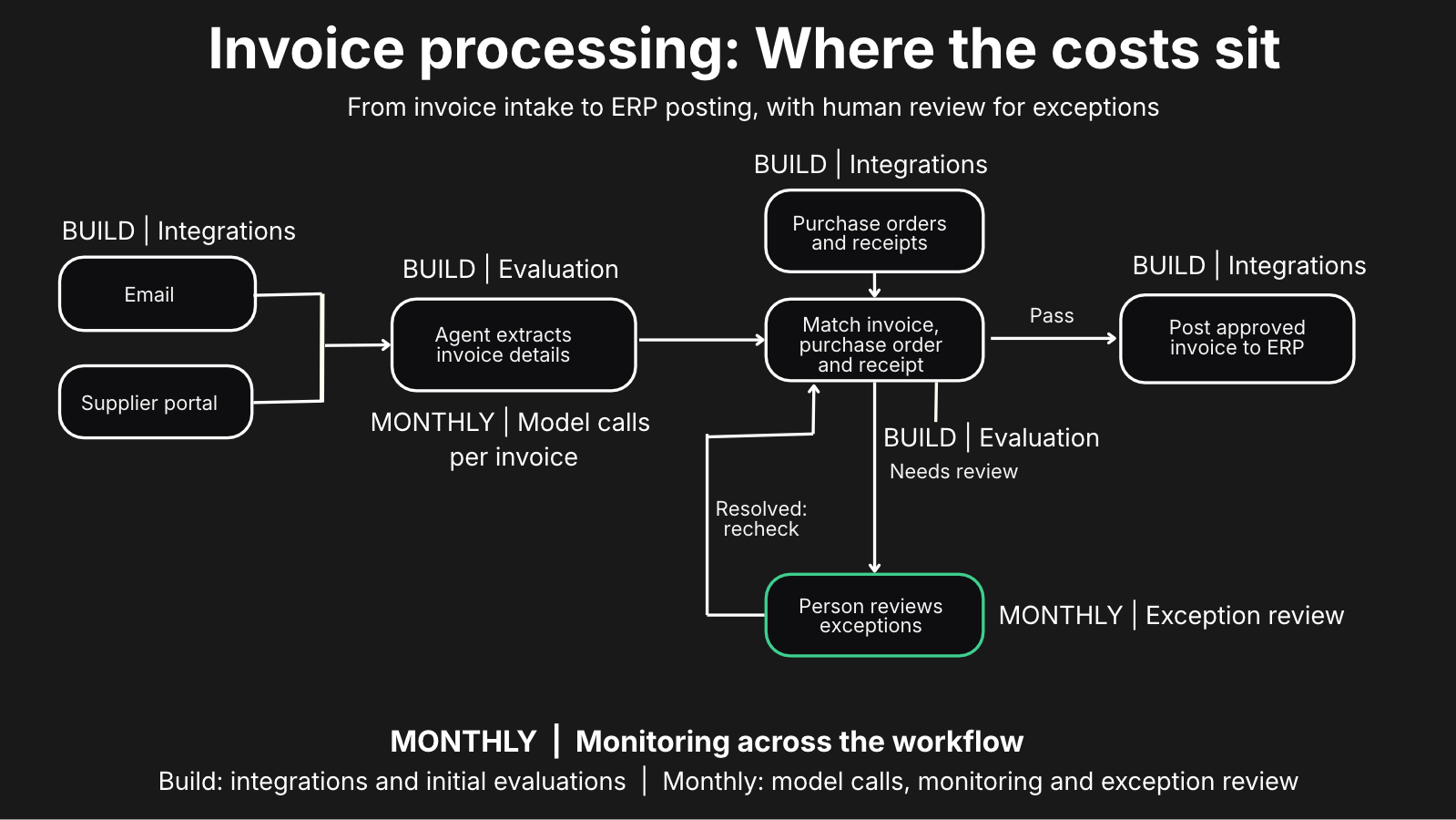
Consider a mid-market company receiving supplier invoices by email and through a supplier portal. Today, its accounts payable team reads each invoice, matches it against the purchase order and goods receipt, and posts the approved entry to the ERP. An agent would handle that same process, routing unresolved cases to a person.
Start with a published benchmark, then check your own costs. APQC’s accounts payable benchmark shows a $6.00 median total processing cost per invoice. Its public table doesn't display quartile values. Ardent Partners’ State of ePayables 2025, Table 2 reports $2.65 for best-in-class teams and $12.42 for other teams.
These are total processing benchmarks across organizations with different automation levels. They don't measure manual labor alone or guarantee savings from agent-driven automation.
For this illustrative company, assume 5,000 invoices a month and a current processing cost of $6.00 per invoice, within the published range.
Monthly cost before automation: 5,000 x $6.00 = $30,000.
Now assume the agent completes 70% of invoices end-to-end, averaged across the first year. That means 3,500 invoices clear automatically and 1,500 still need a person. This coverage assumption is illustrative, not a benchmark.
For a simplified budget ceiling, assume each automatically completed invoice removes the full $6.00 of existing processing cost, while each exception retains that cost.
Remaining processing cost: 1,500 x $6.00 = $9,000 per month.
Available budget: $30,000 - $9,000 = $21,000 per month.
Under those assumptions, the agent’s monthly running cost plus one-twelfth of its setup fee must stay below $21,000 to produce first-year savings. At $21,000, the company breaks even.
This is a budget ceiling, not a vendor price or a promised payback period. The calculation already reserves $9,000 for exception handling; count that review cost only once. Reduce the ceiling for overhead that remains, additional review work or lower coverage during rollout. Time freed for other work does not automatically become cash savings.
The practical constraint is how many invoices need investigation. Supplier formats vary, purchase orders go missing, and three-way matches fail when invoice details disagree with purchase orders or receipts. Invoice reconciliation and AP invoice automation must address these problems.
McKinsey’s August 24, 2026 analysis emphasizes reducing exceptions and simplifying human review to control running costs. For this company, fewer exceptions and shorter reviews create more budget room; more exceptions reduce it.
Platform, Custom Build or Managed Agent: When Each One Is Cheaper
The build vs buy AI decision depends on workflow complexity, volume, and who will keep the agent running. Start with the least expensive option that can reliably complete the work.
Leanware publishes these guidelines for choosing between a platform and an engineered agent:
- A platform agency is the right choice for total automation spend under roughly $1,500 a month, or for single-system workflows.
- Self-serve platforms win on simple, single-workflow agents under $15K.
- The strongest fit is workflows that touch four or more systems of record or that carry compliance constraints a SaaS terms-of-service cannot meet.
For the invoice-processing example, a platform may be enough when invoices follow consistent formats and the required checks fit its existing connectors and rules. When the process outgrows the platform, compare an in-house build with a managed service.
An in-house build can be the cheapest option long term when the company already has an AI engineering team, can maintain the workflow, and wants to own the agent. Include that team’s ongoing support time in the comparison. A managed custom AI agent fits a company that needs engineered integrations and exception handling but does not want to staff an AI team.
McKinsey’s August 2026 analysis explains that high-volume workflows spread fixed costs across more runs. For invoice processing, the investment becomes easier to justify when enough invoices clear reliably to cover setup and running costs. Gartner’s June 2025 guidance adds the decision rule: pursue agentic AI where it produces clear business value or ROI.
Deloitte’s 2025 research found that most organizations report satisfactory ROI on a typical AI use case within 2 to 4 years. IBM’s 2025 CEO study found that only 25% of AI initiatives had delivered their expected ROI. These findings cover AI broadly, not agents specifically; for your process, the economics depend on transaction volume, cost per transaction, and the share of cases that still need human review.
Choose a platform when its capabilities cover the process. Build internally when your existing team can own the process economically. Choose a managed agent when the workflow needs custom engineering and ongoing support you do not want to provide internally.
How to Get a Real Number for Your Process
Published research shows what drives the cost; your budget number comes from measuring your workflow. Leanware’s AI Readiness Assessment takes 2 to 3 weeks with one senior engineer, for a fixed fee scoped on the introductory call and agreed and billed at signing. You receive a ranked opportunity map with ROI projections and build-vs-buy-vs-wait recommendations that you keep whether or not you proceed. If you proceed with a Custom AI Agents build within 30 days of Assessment delivery, 50% of the Assessment fee is credited toward the Agents setup fee. The build proposal carries the Assessment’s numbers forward, and we measure savings against the committed target at month 4.
Final Thoughts
The price of an AI agent depends on the process it runs: its volume, systems, exceptions and compliance requirements. Monthly running costs matter as much as the build cost, so budget for both. Tell us about your process and its monthly volume for a read on which of the four ways to pay fits your needs.
Frequently Asked Questions
How much does an AI agent cost?
AI agents have four payment models: a self-serve subscription, vendor pricing per action or resolution, a custom build with your own running costs, or a managed agent with setup and monthly fees. As of October 2026, Gumloop starts at $37 per month, while Intercom Fin starts at $0.99 per outcome, plus the messaging channels you use. For an engineered workflow, McKinsey’s example puts running costs at $10,000 to $15,000 for an agent that onboards 2,500 customers a year; this is an example, not a build-price quote.
How much does it cost to build an AI agent?
Build cost depends on the number of steps, the systems of record it connects to, the exception rate, and compliance requirements. No reputable research firm identified a standard build-cost range for an agent handling a single business process. Leanware states a build time of 3 to 10 weeks, depending on scope.
How much does it cost to run an AI agent per month?
Monthly AI agent costs include model API usage, hosting, monitoring, evaluation and refinement, human review of exceptions, and engineer support. In McKinsey’s banking customer-service example, human oversight accounts for 70-75% of variable running costs, compared with 20-25% for tokens. Gartner’s August 17, 2026 forecast predicts that inference costs per agentic workflow will rise more than fivefold through 2028 despite falling token prices.
How much does agentic AI cost?
Agentic AI generally costs more to run than a simple chatbot or fixed workflow because it plans, calls tools, checks results and retries, adding model calls, evaluation and exception handling. The build and running cost sections explain how workflow complexity drives setup cost and how usage, maintenance, and human review shape the monthly bill.
What is included in a managed AI agent's monthly fee?
Leanware’s monthly subscription covers hosting and infrastructure, model API costs, observability and monitoring, ongoing prompt and retrieval refinement, evaluation against your workflow over time, and senior-engineer support when accuracy or behavior shifts. New work or scope expansion is agreed in advance against a signed change order.
How do AI agent pricing models differ?
Per-seat pricing charges for each user; per-action or per-resolution pricing charges for activity or completed outcomes; a custom build charges upfront engineering plus your own running costs; and a managed agent combines a setup fee with a monthly subscription. If you are pricing your own AI product, compare usage-based vs seat-based pricing to choose how to charge customers.
Is an AI agent worth the cost?
Deloitte’s 2025 survey found that most respondents achieve satisfactory ROI on a typical AI use case within 2 to 4 years, while IBM’s 2025 CEO study found that only 25% of AI initiatives had delivered expected ROI over the preceding few years. These findings cover AI broadly, rather than predicting the return from an individual agent. An AI agent is more likely to justify its cost when transaction volume is high, the current cost per transaction leaves room for savings, and the exception rate keeps human review manageable.
How long does it take to build an AI agent?
Leanware’s AI agent build takes 3 to 10 weeks, following a 2 to 3-week AI Readiness Assessment that defines the scope. The build timeline depends on the number of steps, integrations and complexity of the verification logic, according to Leanware’s service pages.